
A year after the wedding, something funny (and slightly painful) happens: the photos are “somewhere”… but not findable.
Couples start digging through WhatsApp forwards, old Drive links, and half-forgotten backups. A few keyword searches later, they end up inside a laptop folder named Wedding_Final_Final(2) — still scrolling, still guessing.
Not because the photos don’t exist.
Because wedding photos are usually treated like files to deliver—not a living story to revisit.
And that’s the real problem couples and photographers don’t notice early enough: once the hype is over, the photos stop being used—not because they aren’t beautiful, but because they aren’t organized for real life.
The core problem: wedding photos are treated as files, not a living story
A traditional wedding workflow is built around one moment: delivery day.
You share a drive link. You hand over a hard disk. You deliver an album. Everyone’s happy. For a few weeks.
Then life starts.
- The link gets buried in chats
- The drive access changes
- A phone gets replaced
- The hard disk goes into a cupboard
- The “main folder” becomes too heavy to open
- Nobody remembers where the best moments are
So the photos slowly stop being used.
That’s the real loss: not “missing files.”
It’s missing moments—because they’re hard to access.
A wedding photo organization system should do more than store. It should help couples relive—quickly, repeatedly, and effortlessly.
And yes—this is the exact reason so many people end up searching things like how to organize 5000+ event photos after the wedding. Because once you have thousands of photos across functions, relatives, and devices, “storage” stops feeling like a solution.
Why albums and drives fail over time
Albums are beautiful. Drives are common. But over time, both have the same weakness: they don’t scale with real life.
Scattered backups
Some photos are on the photographer’s link. Some on the bride’s phone. Some on the cousin’s drive. Some are screenshots from Instagram stories. After a year, nobody has the “complete story” in one place.
This is what makes “memory” fragile: you don’t lose all photos at once—you lose parts of the story gradually. A few missed functions, a few missing candids, a few “someone else has it” moments. Over time, the wedding becomes incomplete.
Lost links and forgotten access
Drive links get lost in WhatsApp. Email chains disappear. Old accounts get logged out. Sometimes the link works—but it’s confusing, unorganized, and impossible to search.
Even when people still have the link, they don’t use it—because it feels like work.
Zero structure for “people moments”
Weddings are not just functions. They’re relationships. Couples don’t want to browse 8,000 thumbnails. They want:
- “All photos with dadi”
- “All couple candids”
- “All my bridesmaids”
- “Only family portraits”
That’s why a digital wedding album alternative needs structure that matches how people remember weddings: by faces, moments, and stories—not by folder names.
This is also why “selection apps” don’t fully solve it. A wedding photo selection app might help shortlist highlights once—but it doesn’t create a lasting system for finding and revisiting photos years later. Selection is one-time. A story system is ongoing.
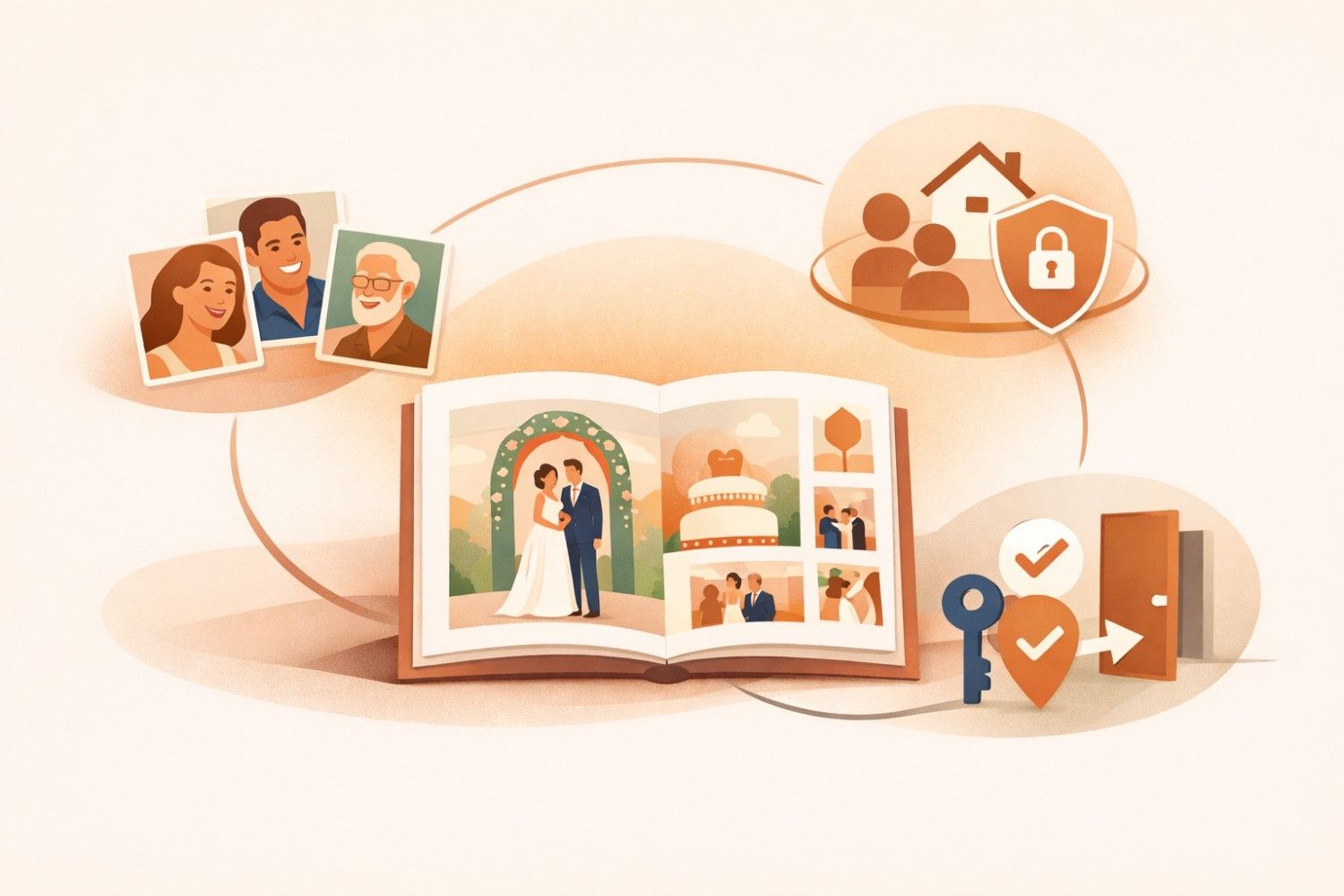
The “story system” approach: central gallery + tagged faces + shareable, private access
A story system is simple:
- One central gallery (not scattered links)
- Personal discovery (find photos by face, not by scrolling)
- Controlled sharing (easy for family, safe for privacy)
That’s it. But that combination changes everything—because it replaces “searching” with “finding.”
Central gallery (the wedding’s “home”)
Instead of treating photos as files, treat them as a living library. One place where the wedding story stays organized—across all functions, all photographers, all moments.
Kamero is built as an AI-driven platform for events that helps photos stay organized and easy to access, designed around guest experience rather than folder-sharing. That “guest-first” approach maps perfectly to weddings—because every family member is basically a guest with expectations.
Face-based tagging (how people actually search)
This is the biggest unlock for long-term usability.
Kamero’s AI Face Recognition allows a person to take a selfie and instantly find all photos they appear in—filtered from thousands of images within seconds, without manual sorting.
So one year later, the question becomes:
Not “Where is the sangeet folder?”
But “Let me just pull up my photos.”
That’s what makes an AI wedding photo gallery feel modern: it works like memory, not storage.
And if someone asks how to use face recognition at weddings, the simplest explanation is:
guests identify themselves with a selfie → the system shows only the photos they appear in → sharing becomes effortless, because discovery is personal.
Shareable yet private access (because weddings are personal)
Weddings are emotional—and sensitive. Not every photo should be open to everyone.
Kamero supports multi-level privacy controls, where guests can view only their own photos while select family/organizers can be given broader access using secure event PINs.
This becomes powerful for couples who want:
- private couple photos only for close family
- kids’ photos restricted
- specific ceremonies shared with specific circles
So the story remains shareable—without becoming public.
That’s the shift couples are increasingly choosing: a privacy-first photo sharing app experience rather than “one link forwarded 200 times.”
The Kamero angle: infrastructure behind living memories
When photographers hear “long-term,” they often think “storage problem.” But for couples, it’s a revisiting problem.
Kamero’s value is that it turns a wedding gallery into something you can keep coming back to:
- Mobile-first access so families can browse without laptop drama
- AI face recognition so the gallery stays searchable even months later
- Privacy controls so sharing feels safe and respectful
And for photographers, it also becomes a professional layer on top of delivery—because the wedding gallery isn’t just “files handed over,” it’s an experience.
This is what a true wedding photo sharing platform should deliver: not just access today, but usability over time.
Where QR + face recognition becomes the simplest “entry point”
One reason modern galleries work better is because entry is frictionless. A QR code face recognition gallery flow fits weddings perfectly:
- it’s easy for guests (scan → selfie → photos)
- it’s easy for couples (one share point, not 10 links)
- it keeps the experience consistent across functions
- it reduces “send me my photos” requests drastically
And this matters long term too. When the entry point stays simple, people keep coming back—anniversary, throwback, family gatherings—without needing someone to resend links or explain folders again.
Why app-first access works better for families
Weddings have mixed audiences: cousins, friends, elders, and relatives. The one thing they all have in common? They want photos in a place that’s easy to revisit.
That’s why an app-first gallery makes the “story system” actually stick. Once guests open the wedding in the app, it becomes a familiar space they return to—during the ride home, the next morning, on anniversaries, and for throwbacks—without hunting old links again.
The best long-term experience happens when the wedding lives in one consistent, easy-to-open place.
The real payoff: photos stay usable for reels, invites, anniversaries—without digging
When wedding photos are organized as a story system, they keep creating value. Not once—over and over.
Anniversaries
“Best moments” are easy to pull and share, instead of digging through drives. Couples can quickly create a 30-second reel, a story post, or a small collage without asking the photographer again.
Throwbacks
Family can repost memories without waiting for someone to forward files. This is where the “story system” feels like a living memory library.
Reels & edits
Couples can quickly find sequences and candids for edits. Not “scroll 5000 photos,” but “find my best moments.” That’s what makes it usable.
Invites for future functions
Families reuse photos for anniversary parties, baby showers, housewarming—because the story is still accessible and organized.
Family legacy
Elders and relatives can revisit moments without tech struggle. This sounds small, but it’s one of the biggest emotional wins. When parents can find their photos easily, the wedding stays alive in the family.
This is the difference between long-term wedding photo storage and wedding photo management for couples.
Storage is passive. Management is emotional + practical. It keeps the story alive.
And if you’ve ever tried to answer “how to organize 5000+ event photos,” you already know the truth: organizing isn’t about folders. It’s about a system that makes the right photo easy to find.
📸 Explore a “story-first” wedding gallery built on Kamero
If you want wedding photos to stay accessible, searchable, and shareable for years—not buried in drives and chats—build a gallery that behaves like a story system.
- 📲 Access the Story System on Mobile: Open sample event in App.
- ✨ View the Complete Story System (Web): See web sample gallery.
- 🔑 Build Your Own Gallery: Create your Account on Kamero.
About Tanuj Thakkar
Hi! I’m Tanuj Thakkar – a BCA graduate from St. Xavier's College, Ahmedabad, with an endless curiosity for people, ideas, and stories. I’m passionate about sales, marketing, and finding creative ways to connect with people. Nothing excites me more than understanding what makes someone tick and turning that into solutions that actually make a difference.
When I’m not diving into strategies or brainstorming ideas, you’ll probably find me exploring new places, geeking out on tech and innovation, or having conversations that spark fresh perspectives.