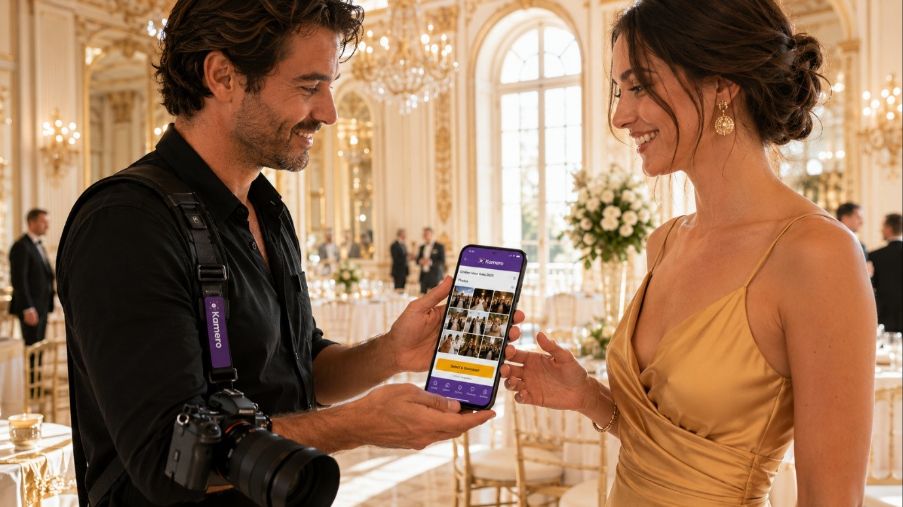
The final deliverable is the most critical touchpoint in the professional photography lifecycle. You can shoot with industry-leading medium format cameras, deploy complex off-camera lighting, and spend hours meticulously color-grading your RAW files. But if your final delivery mechanism is to paste a generic URL into a WhatsApp message, you are actively degrading the perceived value of your work.
For years, basic cloud storage platforms served as the default distribution method for the photography industry. But treating your high-end service like a simple file-transfer transaction is no longer viable. A luxury wedding package or an enterprise corporate contract demands a bespoke digital experience, not a digital dumping ground. When you send a standard, unbranded drive link, you force your clients to do the administrative labor of sorting, finding, and distributing their own media.
To maintain premium pricing and secure high-end referrals, modern studios are migrating away from static storage. They are adopting a dedicated client photo portal powered by intelligent distribution. The industry standard has officially shifted toward seamless, frictionless delivery infrastructure.
The Death of the "Folder Search": The Modern Client Expectation
The fundamental flaw of generic cloud storage is that it is built for archival purposes, not for media consumption. Whether you are delivering a 5,000-image corporate retreat or a massive three-day Indian wedding, forcing your clients and their guests to manually scroll through endless grids of thumbnails is a massive failure in user experience.
Scroll fatigue is the enemy of client satisfaction. A corporate executive or a wedding guest will not spend thirty minutes hunting for a single usable photo of themselves. They want immediate gratification. If they cannot find their photos within seconds, they will abandon the gallery entirely, meaning your hard work goes unseen, unshared, and unappreciated.
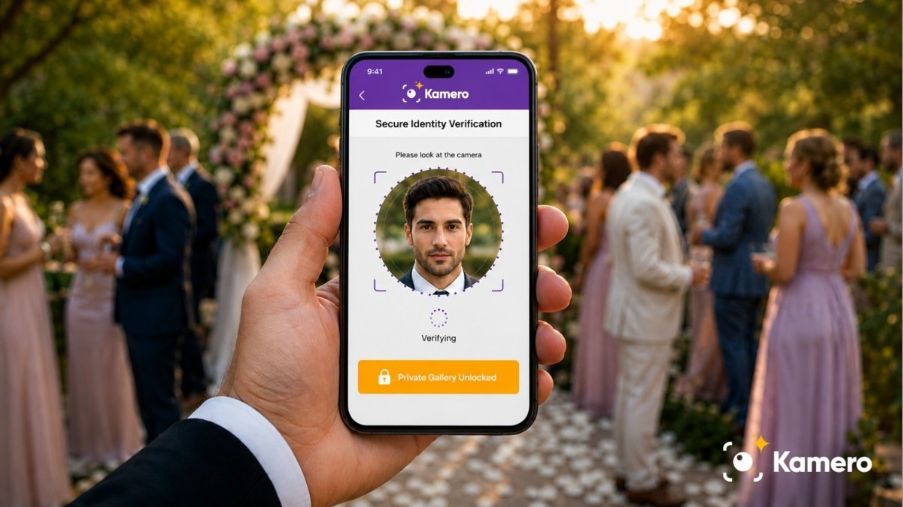
This friction is the primary reason why top-tier studios are actively seeking Dropbox alternatives for photographers. The modern client expectation is zero-touch curation. They expect the technology to do the heavy lifting. By implementing AI facial recognition delivery, you eliminate the "folder search" entirely. Guests simply upload a secure selfie, and the backend algorithm instantly filters the massive archive, returning a highly personalized gallery containing only the images they are actually in. You transition from delivering a messy database to delivering a curated, hyper-personalized magazine for every single attendee.
Security & Privacy: Why AI Vectors Beat Public Links
Beyond the user experience, traditional cloud links represent a massive data and privacy liability. When you generate a "Master Link" to a public cloud folder, you lose all control over the chain of custody. Anyone with that URL can access, download, forward, or scrape images of corporate executives, unreleased product prototypes, or minor children.
Enterprise clients and high-net-worth individuals now explicitly write strict data privacy requirements into their RFPs. They will not hire an agency that relies on unprotected, shareable URLs.
Upgrading to enterprise-grade AI photo gallery software fundamentally changes your security architecture. Instead of relying on vulnerable public links, AI facial recognition creates secure, biometric silos. The software maps the unique vectors of a user's face and grants them access only to the photos in which those specific vectors appear. A guest can view and download their own photos, but they are entirely locked out of the bride’s private getting-ready session or the corporate board's closed-door meeting. AI doesn't just sort photos; it acts as an impenetrable, automated security gate.
Transforming Delivery into an Experience
Your delivery method should be a marketing asset, not an administrative chore. When you utilize generic storage, you strip away your own studio's branding and replace it with the logo of a Silicon Valley tech giant. You are giving away free digital real estate.
Branded QR onboarding vs. text-heavy emails.
The traditional delivery workflow involves sending a text-heavy email containing passwords, PIN codes, expiration dates, and a clunky URL. This creates immediate friction before the client even sees a single photograph.
Premium delivery transforms this cumbersome process into a frictionless, interactive experience. Instead of an email chain, you deploy fully white-labeled, branded QR codes. By placing these custom QR codes on reception tables, event badges, or stage jumbotrons, you bridge the physical-to-digital gap instantly. Guests simply scan the code with their smartphone camera, bypass the need for app downloads or complex registrations, and are immediately dropped into your studio's custom-branded environment. This frictionless onboarding mechanism guarantees maximum gallery engagement and ensures that every guest interacts directly with your brand, turning a simple delivery process into a highly effective lead-generation engine for your next booking.
Kamero vs. Generic Cloud Storage
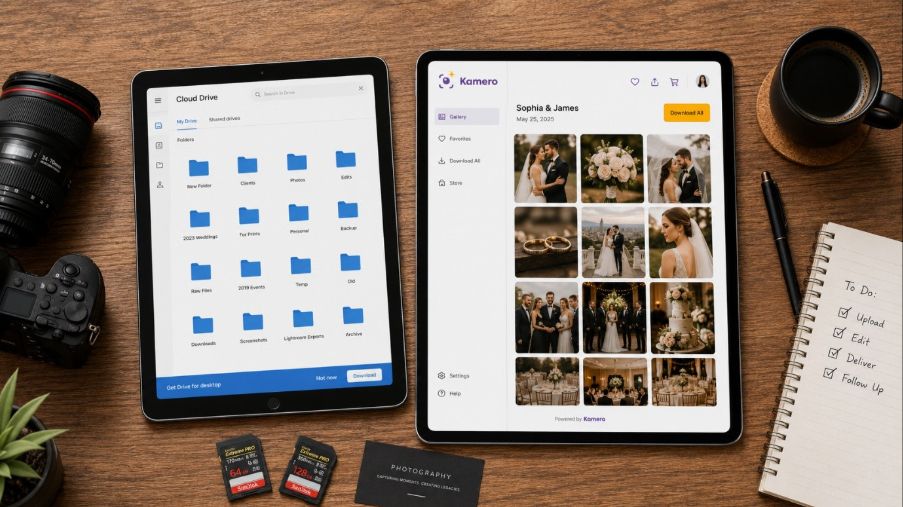
Basic cloud drives are built for utility; they store spreadsheets, text documents, and PDFs just as easily as they store JPEGs. Because they are generalized tools, they will never offer the specialized infrastructure required to run a high-volume media business.
How Kamero’s event-scoped AI discovery provides a luxury "concierge" feel that Google Drive cannot replicate.
Kamero is engineered exclusively for the professional photography industry. It does not just hold your files; it actively serves your clients.
When you use generic storage, you are treating your clients like data entry clerks, forcing them to sift through raw information. Kamero’s event-scoped AI discovery provides a luxury "concierge" feel. The technology anticipates the client's needs, executing complex biometric sorting in milliseconds to deliver exactly what they want, the exact moment they want it.
Furthermore, Kamero ensures that this entire concierge experience happens entirely under your own brand identity. From the custom domain name to the branded mobile interface, your clients never see a third-party logo. Google Drive reminds your clients that you use cheap software; Kamero proves to your clients that you run an elite, enterprise-grade studio.
To command premium rates, your backend technology must match the quality of your front-end photography. Stop relying on utility tools to deliver luxury services.
Give your clients the instant gratification they actually expect in 2026.
Try Kamero's AI facial recognition delivery for your next event and provide a flawless, hyper-personalized client experience.
Stop sending messy drive links that frustrate your clients.
Upgrade to Kamero and wow them with frictionless, personalized photo access wrapped entirely in your own studio's branding.
Follow us on Instagram for daily tips on scaling your studio: @kamero.ai
What event are you shooting next?
About Mayank Oraon
Hi, I’m Mayank, an MBA student exploring the business world with a focus on operations, supply chain, and product strategy (aka the parts of a business that keep things from quietly falling apart).
I’m interested in understanding how systems actually run behind the scenes- and why they sometimes don’t. I also enjoy simplifying complex ideas - partly because it helps others, and partly because if I can’t explain it simply, I probably didn’t understand it in the first place (which is a humbling but effective feedback loop).