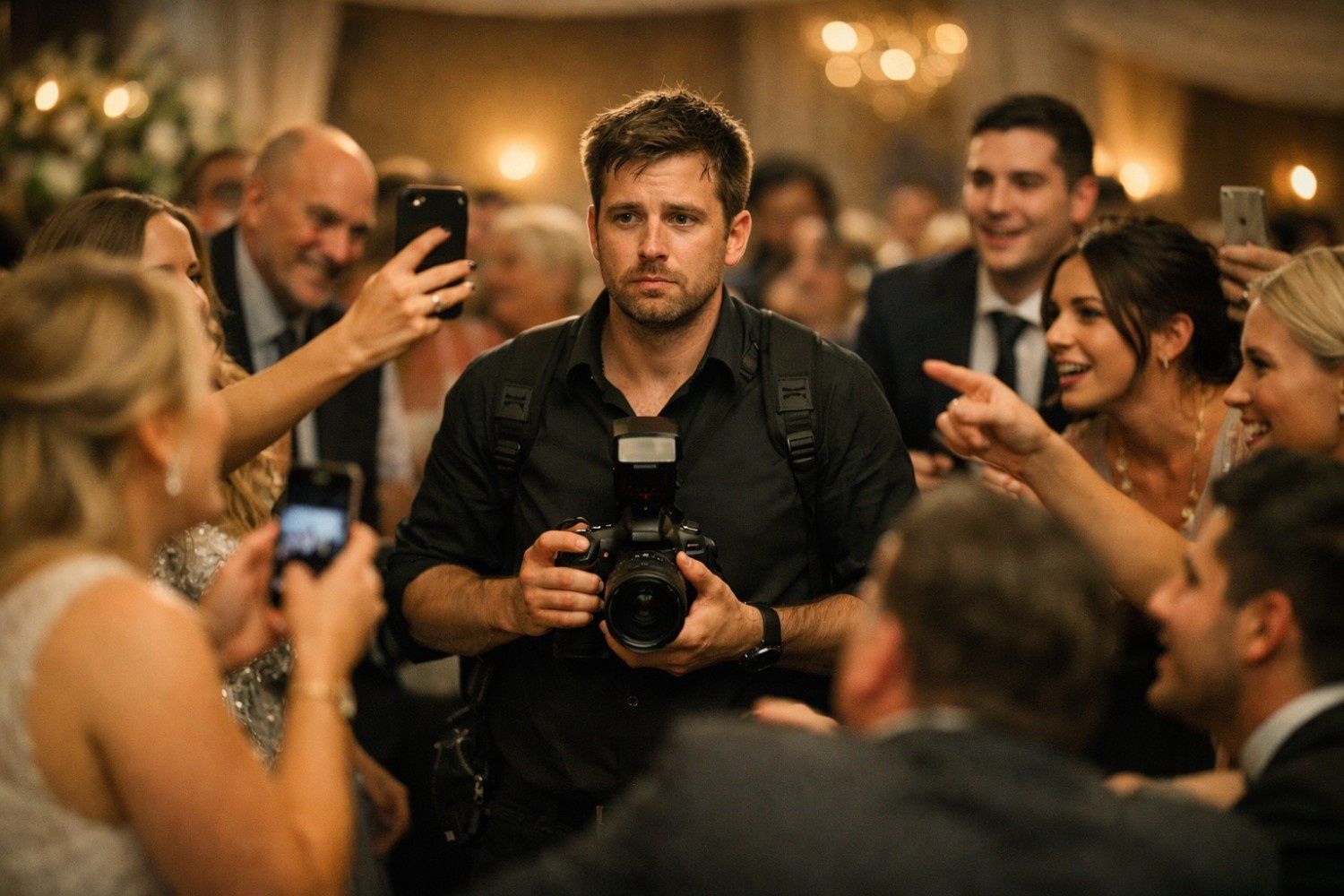
At today’s events, everyone believes the photographer is shooting for them.
The bride wants portraits. The groom wants candids. Parents want “all family photos.” Friends want their dance clips. The planner wants highlights for Instagram. The venue wants branded shots. Sponsors want proof-of-visibility. And every guest? They just want one thing:
“Meri photo mil gayi kya?”
Welcome to the new reality: event photography isn’t one client anymore. It’s 1,000 micro-clients—each with their own expectations, timelines, and patience levels.
The reality shift: one event, thousands of expectations
A few years ago, delivery meant you satisfied the main client (couple/organizer), handed over a drive, and moved on.
Today, wedding guest photo access has become part of the event experience. Guests don’t want to wait weeks for a link that contains 8,000 random files. They want their photos—fast, on mobile, without confusion.
This isn’t “impatience.” It’s behavior. Guests scroll photos like Instagram. They share the same night. They tag, repost, and forward in WhatsApp groups while the excitement is still high.
So the real job isn’t just capturing moments anymore—it’s running a modern event photography workflow where thousands of people can access memories smoothly, without you personally responding to hundreds of requests.
Where traditional delivery breaks: shared links, email chains, confusion at scale
Most photographers still deliver like this:
- One shared Google Drive link
- One folder dump (“Final”, “Final2”, “Candid”, “Portraits”)
- A WhatsApp message forwarded 200 times
- Or a long email chain nobody reads
This is exactly where photo delivery for large events collapses.
Because shared links don’t solve the real problem: every guest has to manually search. And when people can’t find themselves quickly, they don’t blame the folder structure—they blame you.
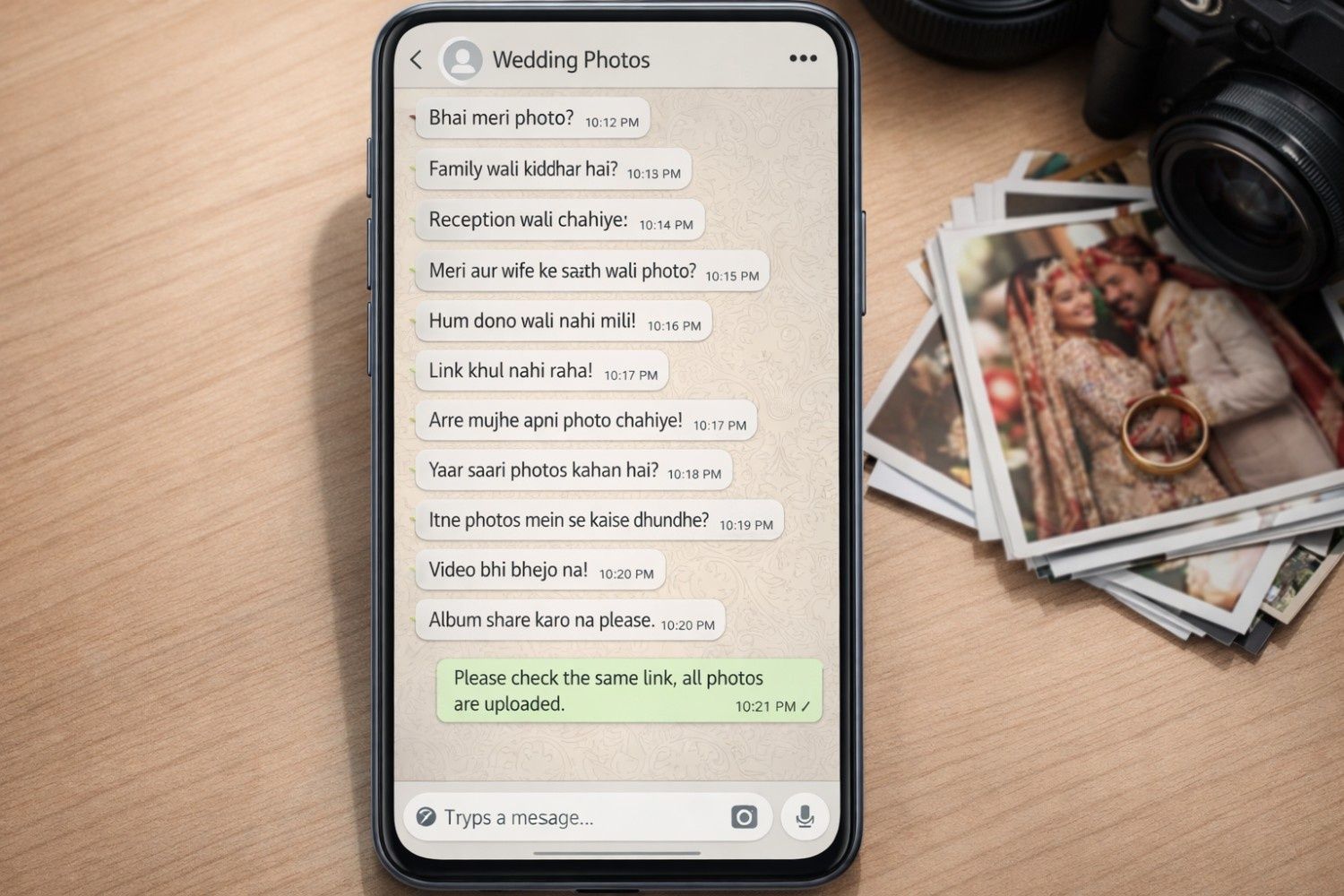
Here’s what happens next (you’ve seen this movie):
- “Bhai meri photo bhejna”
- “Humari family wali photo kidhar hai?”
- “Link open nahi ho raha”
- “Itne photos mein kaise dhundhe?”
- “Mujhe sirf reception wali chahiye”
Suddenly you’re not a photographer—you’re customer support. And the bigger the event, the worse it gets. One wedding can mean 300–1,000 micro-requests. A college fest can mean thousands.
Personalization is the new baseline (not a premium add-on)
In 2025, personalization isn’t a luxury. It’s the minimum expectation.
People don’t want a “gallery.” They want their gallery.
That’s why face recognition photo sharing is changing the standard. When a guest can take a selfie and instantly see photos they appear in, two things happen:
- Guests stop asking you to “send my photo.”
- The event feels premium—because it’s personal.
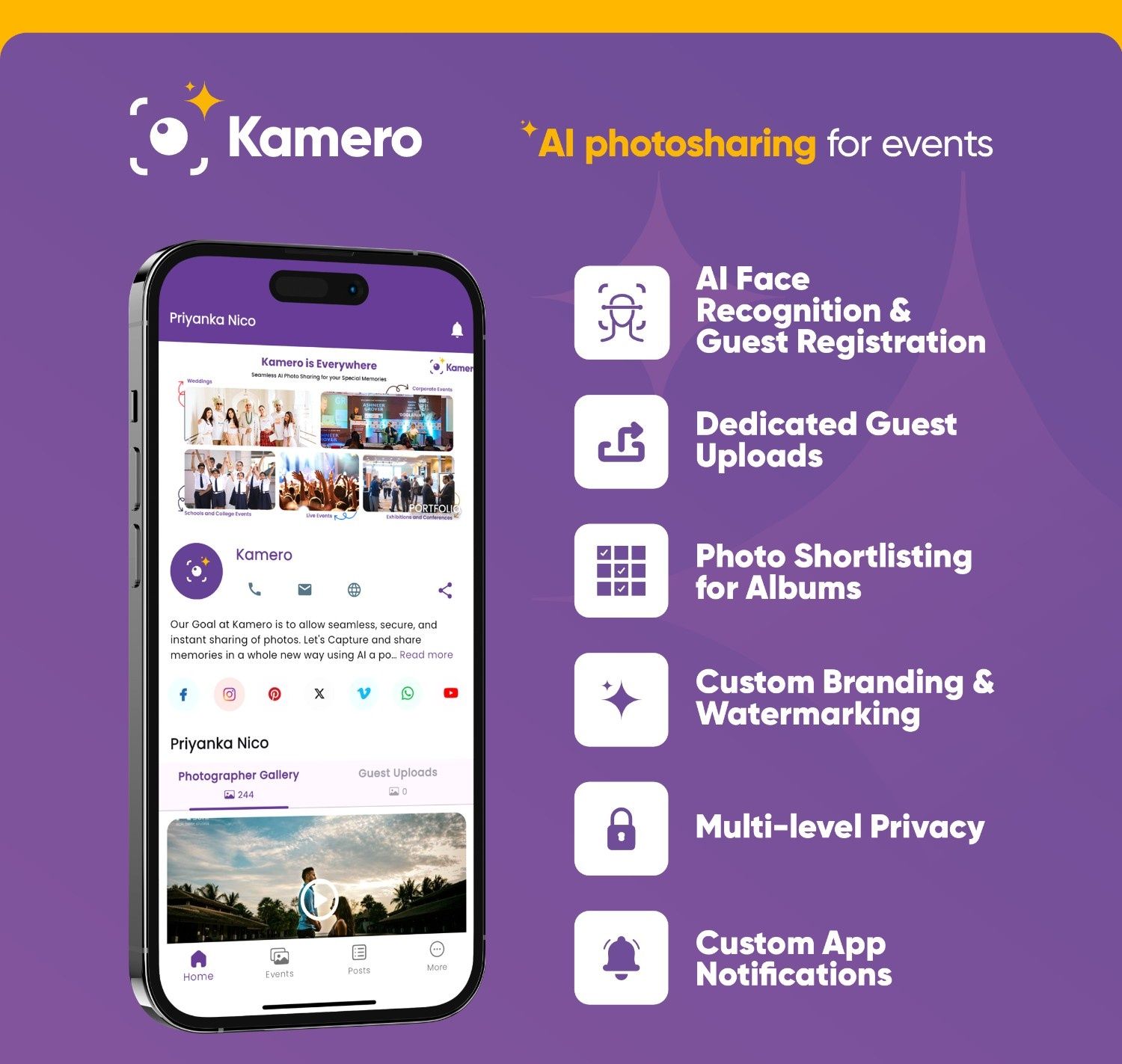
This is exactly what Kamero’s AI is designed for: guests can find all their photos by taking a selfie, and the system filters through thousands of photos within seconds to create a personalized album—without manual sorting.
That one shift turns “I’m lost in 8,000 photos” into “Oh wow, these are all mine.”
And when personalization becomes easy, people use it more—which improves satisfaction across weddings, exhibitions, and fests.
What mass personalization needs: frictionless access + security + scale
Personalization only works if guests can actually get in—fast.
Because the moment you force steps like “create an account,” “verify email,” or “download this and sign up,” you lose half the crowd (especially elders, busy corporate attendees, or college students who won’t bother).
Modern delivery needs three pillars:
A) No-friction entry
Kamero is built so guests can scan a QR code and access the gallery instantly—without being forced into a complex sign-up flow. That’s critical when you’re serving 1,000 micro-clients.
B) Secure, privacy-first sharing
Mass access doesn’t mean public access. In big weddings and institutions, privacy matters. Kamero supports robust multi-level privacy controls—hosts can allow each guest to view only their own photos, while giving broader access to select family/organizers via secure event PINs.
That’s how you keep sharing easy and safe—especially in events with children, VIPs, or internal corporate teams.
C) Infrastructure that doesn’t choke at scale
A platform may work for 400 photos. The real test is thousands—across mobile devices, at a venue, with patchy networks. Kamero is designed to be guest-focused, with QR registration for instant access and a mobile-first, easy-to-share experience.
That’s what “built for micro-clients” actually means.
Where micro-client chaos shows up the most
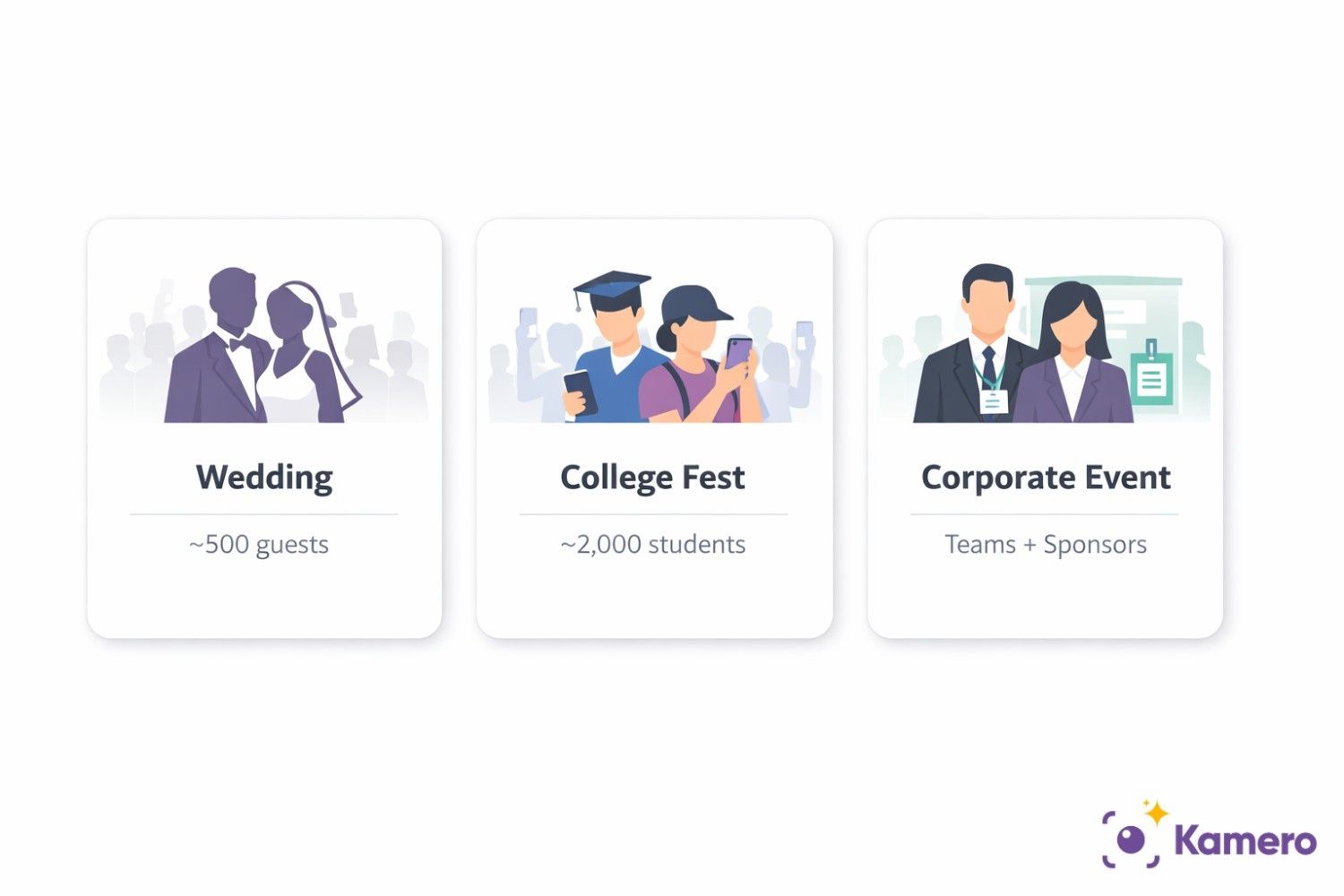
Weddings
Weddings are the most intense version of this shift. One couple hires you, but 500 guests behave like 500 clients. Personal access becomes the experience.
College fests
College fest photography management is micro-clients on steroids. Students don’t want folders. They want instant selfies → instant photos → instant sharing. If it’s not fast, it’s forgotten.
Corporate events & exhibitions
A corporate event photo gallery isn’t just about memories—it’s about brand, visibility, and speed. Teams want quick access for LinkedIn posts, internal communications, sponsor decks, and PR. When delivery is delayed, the moment is gone.
Across all these, the mission is the same: stop treating delivery like “file sharing,” and start treating it like guest experience at scale.
A quick self-check: can your workflow serve 1,000 micro-clients?
Ask yourself:
- Can guests find their photos in under 30 seconds?
- Will elders and busy guests access it without help?
- Is privacy controlled, not “one link for all”?
- Can your system handle thousands of people at once?
- Do you spend your evenings replying to photo requests?
If most answers are “no,” it’s not a talent problem. It’s a delivery system problem.
Kamero was built to make event photo sharing more than delivery—turning it into engagement, lead generation, and brand-building through an AI-powered, guest-first experience.
See how modern event delivery handles everyone
If one event now means 1,000 micro-clients, your delivery needs to serve 1,000 people without adding 1,000 headaches.
See how modern event delivery handles everyone—with selfie-based personal galleries, QR-first access, and privacy controls that scale.
👉 Visit kamero.ai
About Tanuj Thakkar
Hi! I’m Tanuj Thakkar – a BCA graduate from St. Xavier's College, Ahmedabad, with an endless curiosity for people, ideas, and stories. I’m passionate about sales, marketing, and finding creative ways to connect with people. Nothing excites me more than understanding what makes someone tick and turning that into solutions that actually make a difference.
When I’m not diving into strategies or brainstorming ideas, you’ll probably find me exploring new places, geeking out on tech and innovation, or having conversations that spark fresh perspectives.