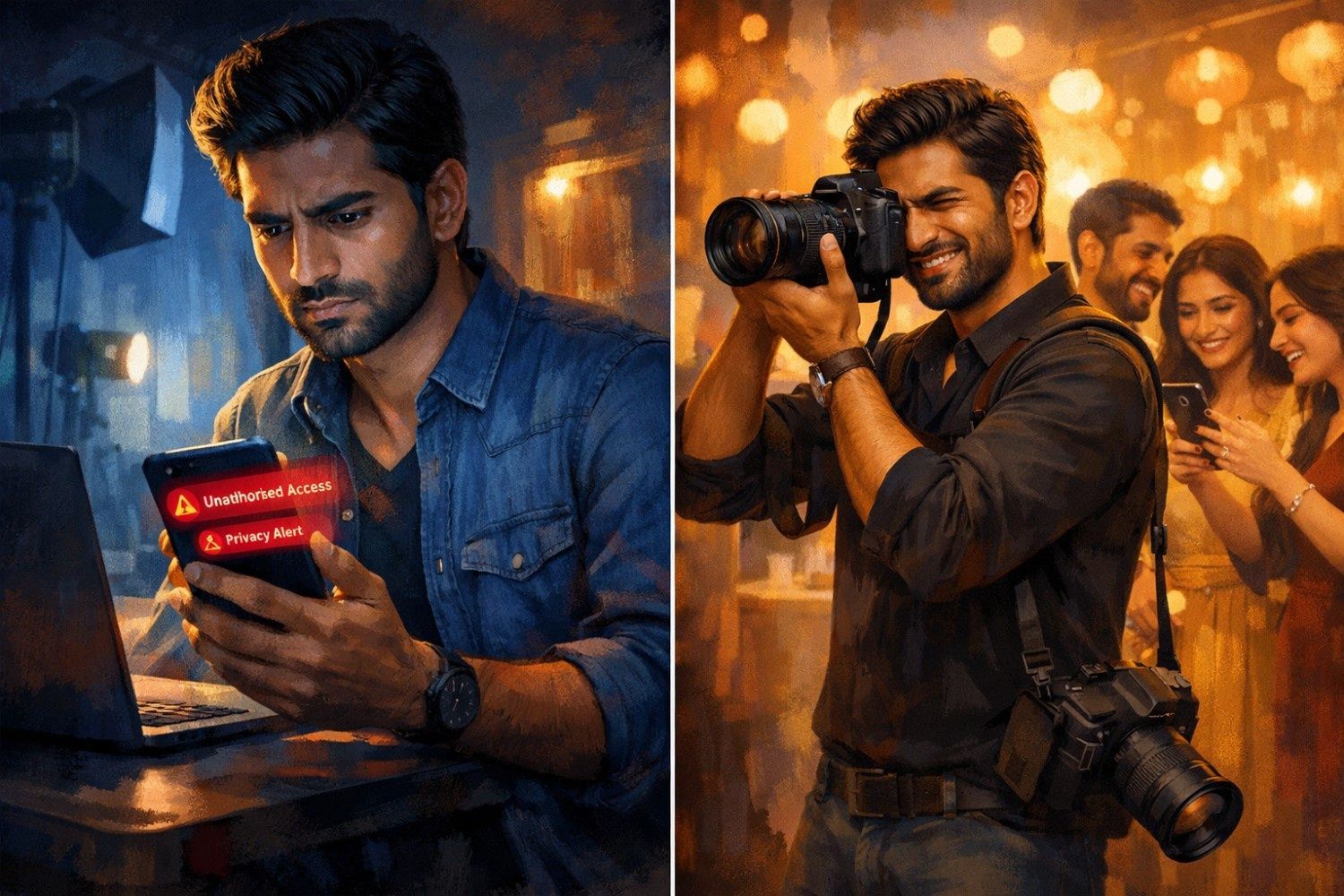
For years, event photographers and planners have lived with a quiet fear:
“If I deliver photos too fast, something will go wrong.”
Wrong people may see private images.
Unapproved photos might get shared.
Clients may complain about access, edits, or misuse.
So delivery gets delayed.
Links are held back.
Speed is sacrificed in the name of “control.”
But here’s the truth most professionals discover too late:
Speed is not the enemy. Lack of control is.
Modern event workflows prove that fast event photo delivery and strict control can—and should—exist together. The teams that do it best don’t “take risks.” They use a system-first approach—where privacy and permissions are built into the delivery layer from day one.
That’s also why more professionals are adopting event photo distribution software instead of generic links: because security in events isn’t about moving slower—it’s about having the right safeguards while moving fast.
The Core Fear: Privacy Leaks, Wrong Access & Misuse
Let’s address the real concerns—because they’re valid.
Event professionals worry about:
- Guests accessing photos they shouldn’t see
- Corporate or VIP images leaking publicly
- Parents seeing other children’s photos at school events
- Unedited images being downloaded and shared
- Brand misuse without permission
In India especially—where weddings, corporate events, and institutions involve large guest counts and sensitive moments—privacy mistakes aren’t small mistakes. They cost trust.
So teams slow things down, manually sort photos, restrict links, and delay sharing.
Ironically, this increases risk instead of reducing it.
Because when delivery is delayed, people compensate by creating unofficial workarounds:
- someone forwards the link “just to help”
- photos get re-uploaded to random WhatsApp groups
- couples and organizers start sharing unverified folders
- guests request personal images—and receive them manually
This is where leaks actually happen: not because you delivered fast, but because the delivery was uncontrolled.
That’s why a privacy-first photo sharing app approach is becoming the safer default for events. Privacy isn’t something you add later. It has to be designed into the workflow.
The Reality: Lack of Control Causes Risk — Not Speed
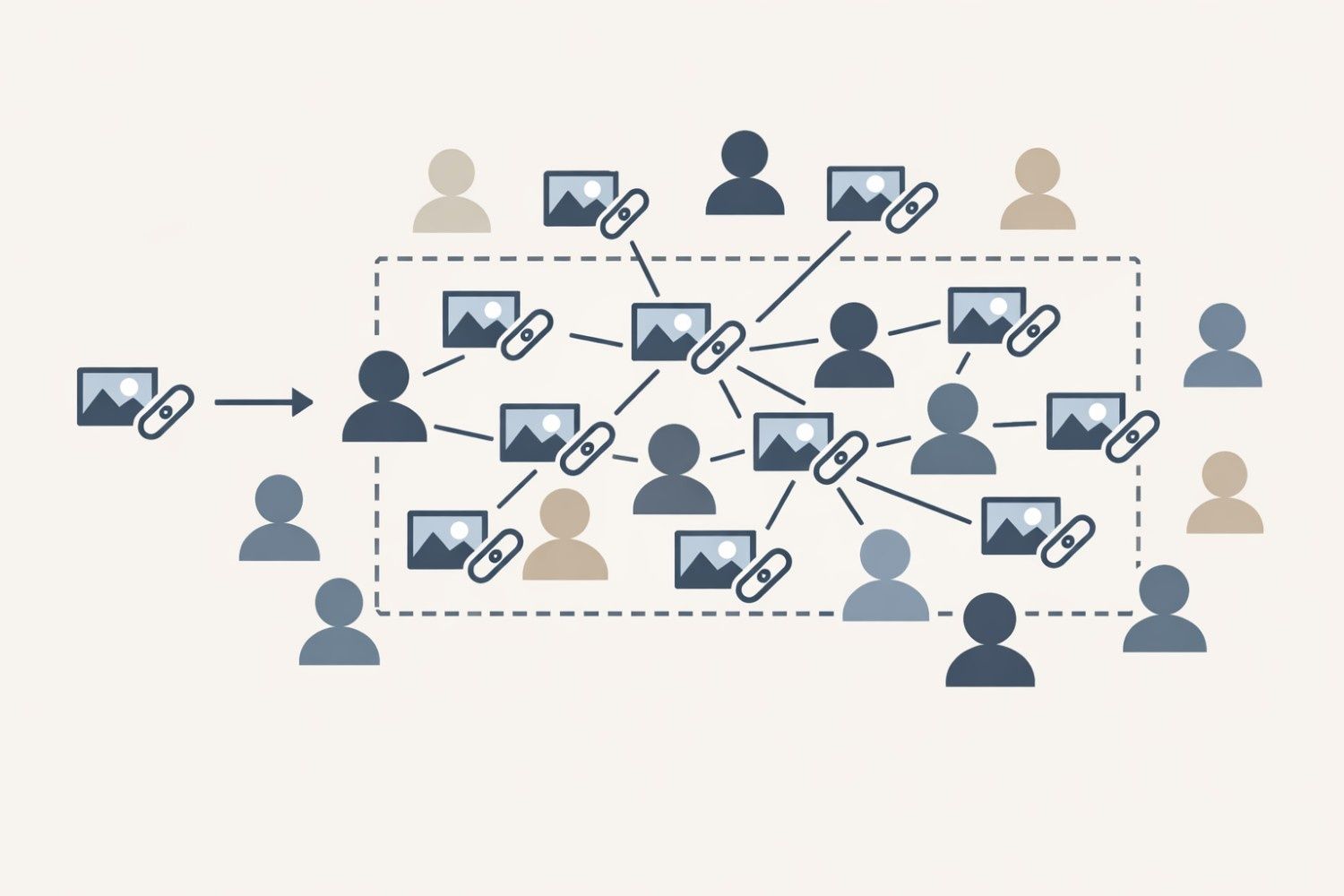
Most photo-sharing problems don’t happen because delivery was fast.
They happen because:
- Everyone gets access to everything
- Generic download links are shared endlessly
- There’s no identity-based access
- Control is manual, not system-driven
A Google Drive link sent to 500 guests is not “secure photo sharing for events.”
It’s just hopeful sharing.
When delivery is slow and manual:
- Guests repeatedly ask for photos
- Links get forwarded outside intended circles
- Organizers lose visibility on who accessed what
- Photographers end up sending photos individually (and inconsistently)
So the contradiction becomes clear:
- Speed without control is risky.
- Control without speed is outdated.
The solution is a controlled, permission-based delivery system that works in real time—exactly what modern event photo distribution software is built to do.
The New Workflow: Fast Delivery with Built-In Permissions
Modern event photo delivery follows a different logic:
Access is defined first. Speed follows automatically.
Here’s how controlled, fast delivery actually works today:
- Guests get access based on identity, not links
- Photos are filtered automatically per person
- Sharing permissions are clearly defined
- Organizers stay in control without micromanaging
This is where AI face recognition photo delivery changes everything. Instead of slowing down to “protect” photos, the system protects them by design.
And for many real events, the simplest starting point is a QR code face recognition gallery experience:
- guests scan a QR at the venue
- they verify identity with a selfie
- they see only the photos they appear in
No public folders. No mass browsing. No awkward moments going to the wrong audience.
This is what “secure delivery” looks like in 2026: fast, filtered, and permission-based.
How Kamero Enables Speed Without Losing Control
Kamero is built on a simple belief:
Fast delivery should reduce stress, not create it.
That’s why Kamero is a control-first, speed-enabled platform—especially for Indian event scale.
Instead of asking teams to choose between speed and security, Kamero treats privacy and permissions as the foundation of delivery. In practice, it behaves like a privacy-first photo sharing app layered into an event-grade distribution system.
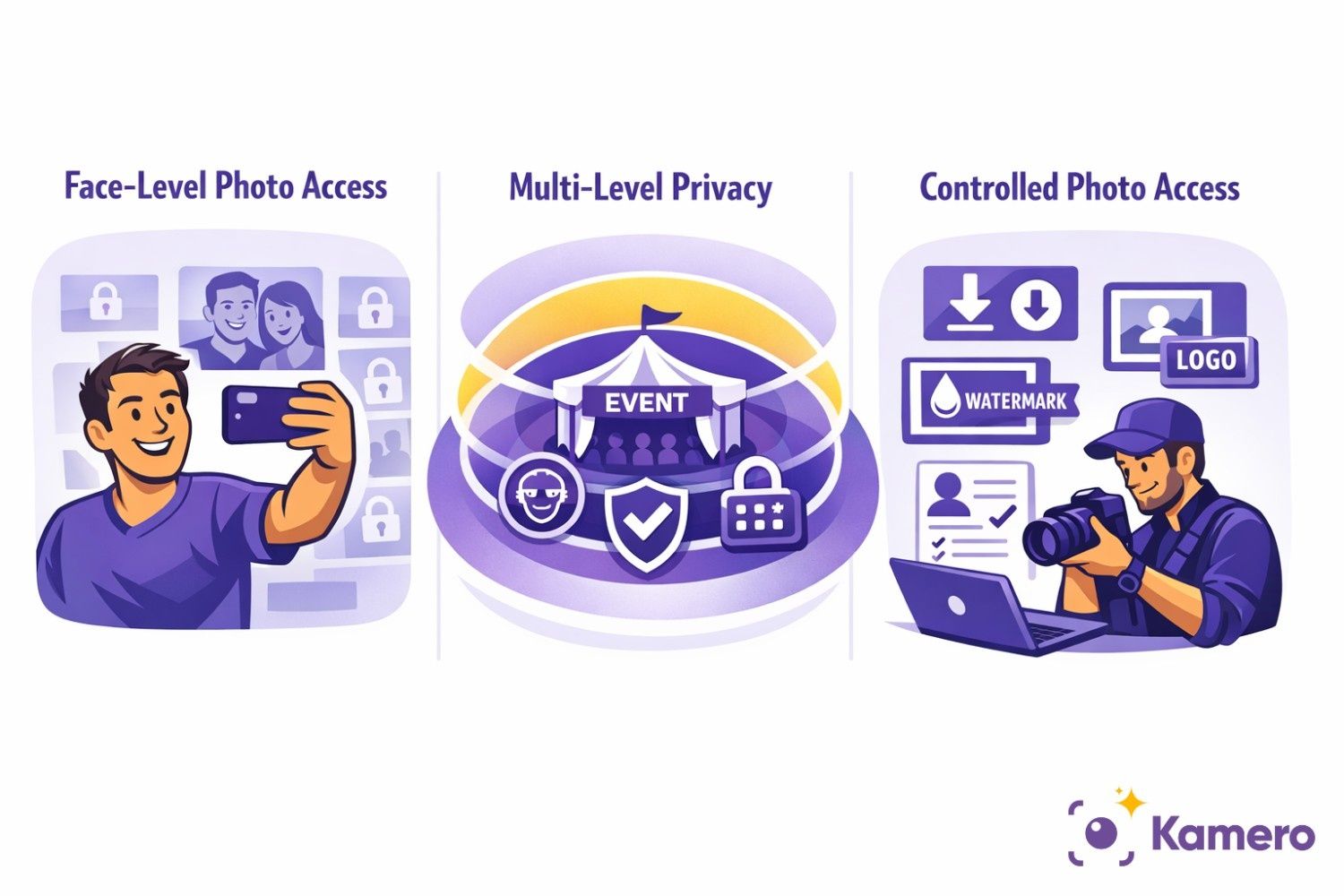
🔐 Face-Level Photo Access (Not Folder-Level)
With Kamero’s AI face recognition, guests only see photos they appear in.
- No browsing through others’ moments
- No accidental access to private images
- No manual sorting by photographers
This is true event photography privacy control, not just password protection.
This is also the biggest reason face recognition reduces risk: it removes the “open folder” problem completely. When guests can only access “my photos,” the chance of mistaken viewing drops dramatically.
If you’ve ever wondered how to use face recognition at weddings without creating complexity, the simplest model is:
- place QR codes at the venue
- guests scan → take one selfie
- the gallery instantly shows their personal photos
That’s it. No logins, no searching, no folders.
🛡️ Multi-Level Privacy & Moderation
Kamero allows:
- Selfie-based “My Photos” access for guests
- Moderation before guest uploads go live
- Restricted access using event IDs or PINs
Whether it’s a wedding, corporate exhibition, or school event, you decide who sees what—always.
This is where a true event photography client proofing layer fits in. Many teams want to deliver quickly, but still maintain review control. With moderation and publish rules, you can:
- share highlights first
- keep sensitive images private
- release full sets after approval
- avoid unedited or unapproved photos going live
Proofing isn’t just about “selecting.” In high-volume events, proofing becomes a safety mechanism.
📷 Controlled Photo Access for Photographers & Brands
Photographers maintain control over:
- Download permissions
- Watermarking on shared images
- Branded profiles inside galleries
- Lead capture through guest registrations
Even when photos move fast, ownership and attribution stay intact.
This is a crucial distinction: speed should not come at the cost of brand value. A proper system ensures that photos can spread—but your work stays protected and credited.
Control doesn’t mean delaying— it means defining access upfront
Most teams treat control like a timeline decision: “We’ll share later, once everything is safe.”
But in modern event delivery, control is not about waiting. It’s about rules.
When control is defined upfront—who can view, what can be downloaded, what stays private, and how guests access the gallery—speed stops feeling risky. Because you’re no longer depending on manual coordination or “please don’t forward this link” trust.
This is where systems outperform storage. A folder link can’t enforce intent. It can’t stop a forwarded link from reaching the wrong group. It can’t separate guest access from organizer access. It can’t protect sensitive moments by design.
A permission-based workflow flips the model:
- access is structured first
- sharing becomes predictable
- delivery can move fast without fear
That’s the real upgrade: speed becomes safe when control is built into the system, not managed manually.
The Impact: Faster Delivery, Fewer Complaints, Happier Clients

When speed and control work together, something powerful happens:
- Guests stop chasing photographers
- Organizers stop worrying about leaks
- Clients feel confident, not anxious
- Teams spend less time on damage control
- Brand trust actually increases
Photographers using controlled, real-time delivery report:
- Fewer post-event complaints
- Faster approvals and album selections
- Better guest engagement
- More referrals from impressed attendees
Fast event photo delivery becomes a competitive advantage—not a liability.
Why This Works Especially Well for Indian Event Scale
In India, events are bigger, louder, and more socially connected.
A single wedding can have:
- multiple functions
- multiple photographers
- thousands of photos
- hundreds of guests
- multiple family decision-makers
Which means the risk surface is larger too. One open link can travel across dozens of groups. One unapproved image can become a family issue. One leak can damage trust instantly.
That’s why “basic storage + password” doesn’t feel safe anymore.
A privacy-first photo sharing app approach—paired with identity-based filtering—fits Indian event realities far better:
- guests get their photos without browsing others
- organizers get control without micromanaging
- photographers deliver faster without fear
This is why event photo distribution software is becoming the default for teams that do large weddings, school events, corporate exhibitions, and festivals.
Final Thought: Deliver Fast With Confidence
Speed doesn’t mean chaos.
Speed without control does.
The future of secure photo sharing for events isn’t about delaying delivery—it’s about delivering smart.
Kamero.ai proves that when permissions, privacy, and automation are built into the workflow, photographers and organizers can move faster and safer.
👉Deliver photos instantly.
👉 Stay fully in control.
👉 Build trust at scale.
If you’re ready to move beyond slow links and risky sharing, experience Kamero and deliver fast—without losing control.
About Tanuj Thakkar
Hi! I’m Tanuj Thakkar – a BCA graduate from St. Xavier's College, Ahmedabad, with an endless curiosity for people, ideas, and stories. I’m passionate about sales, marketing, and finding creative ways to connect with people. Nothing excites me more than understanding what makes someone tick and turning that into solutions that actually make a difference.
When I’m not diving into strategies or brainstorming ideas, you’ll probably find me exploring new places, geeking out on tech and innovation, or having conversations that spark fresh perspectives.