
The day you shoot 3,000 photos isn’t the hard part.
The hard part is the next day—when 300 people want their photos, on their phone, right now.
That’s the moment most teams discover an uncomfortable truth: storage isn’t delivery. A Drive link can hold files, but it can’t run a smooth, scalable experience for a real event—especially once guest count, photographers, and expectations grow.
This is the shift happening across weddings, festivals, college fests, and corporate events: from storage to systems.
Today, teams aren’t just asking “Where do we upload?” They’re asking, “What’s the best client gallery delivery workflow when we’re dealing with thousands of photos and hundreds of people?” That’s where the idea of event photo distribution software becomes essential—not as a fancy add-on, but as the foundation for modern delivery.
The illusion: “A Drive link is delivery”
For years, “delivery” meant: upload → share a link → done.
And for small events, that works. But once you hit scale, that approach starts to feel like you’re handing someone a library and saying, “Good luck.”
Because a Drive link answers only one question: Where are the files?
Guests have a different question: Where are my photos?
This is the core difference in photography storage vs delivery:
- Storage is passive (files exist somewhere).
- Delivery is active (people can quickly find what they want, without help).
In modern events, delivery is judged by experience, not by file count. A folder can hold 10,000 images, but it can’t guide a guest to their best 12 moments. That’s why photographers and teams are now investing in systems built for discovery and control—not just storage.
The breaking point: volume + multiple shooters + guest expectations
Folders usually collapse for three reasons:
1) Volume turns browsing into work
A guest doesn’t want to scroll 6,000 thumbnails to find two pictures. If discovery feels like effort, they exit. And when guests exit, requests begin.
This is where many teams realize they need more than “upload space.” They need a smarter way to organize 5,000+ event photos so that the gallery behaves like an experience—not a dump.
2) Multiple photographers multiply chaos
Add a second shooter and suddenly you have:
- duplicate angles
- repeated bursts
- mismatched naming
- different upload habits
- confusing subfolders
At three photographers, it becomes a manual merge project—right when you’re already busy with the next event.
And this is the hidden cost: even if the photos are great, the delivery becomes messy—and guests judge the whole experience based on the delivery.
3) Guests behave like “micro-clients”
One wedding might have 400 guests. That’s 400 mini-expectations. No one may complain loudly, but everyone quietly expects fast, mobile-friendly access.
When they can’t find photos, the pressure lands on the couple… and then on you.
This is why photo delivery for large events breaks “normal storage” workflows. Not because storage is bad—because it was never designed to manage this many people and requests. At scale, you don’t need “a link.” You need a system.
The upgrade: from file-sharing to workflow
A system-first approach doesn’t start with “Where will we upload?”
It starts with: How will people find and access photos at scale?
A true event photography workflow system adds automation around the photos—turning delivery into a repeatable client gallery delivery workflow rather than a one-off scramble.
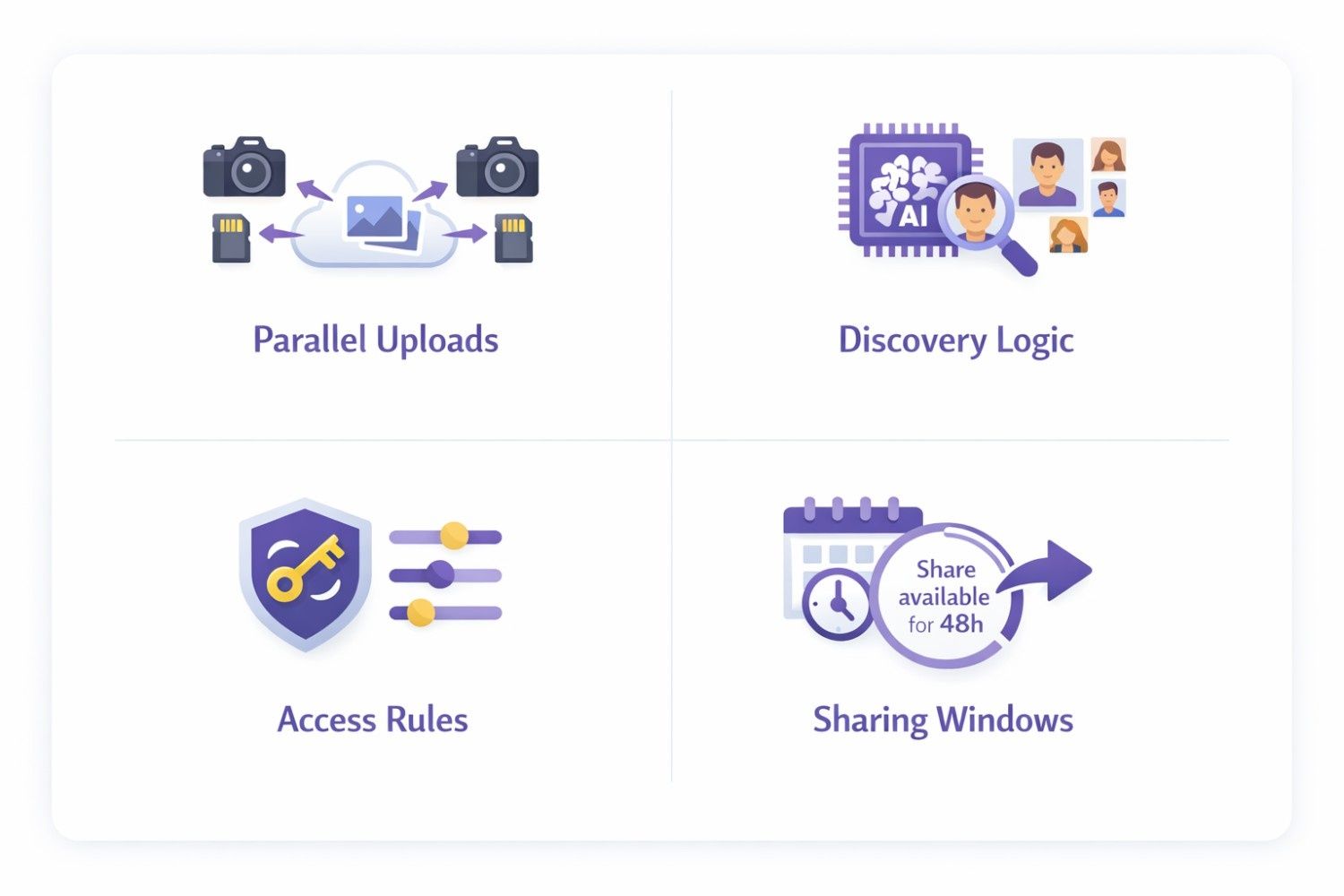
Parallel uploads (so the event doesn’t wait)
Instead of “everyone uploads later and we merge,” you allow uploads in parallel—multiple shooters contributing to one organized event space.
This is how event teams avoid backlogs: the delivery engine starts early, and the gallery builds progressively.
Discovery logic (so guests don’t browse forever)
A system should help guests find relevant photos fast—especially in large crowds—without manual support from the photographer.
This is where the question shifts from “How do we upload faster?” to “How do we organize 5,000+ event photos so guests instantly find what they care about?”
Folders can’t answer that. Systems can.
Access rules (so sharing stays controlled)
Not every photo should be open to everyone.
A system-first gallery includes event gallery access control—who sees what, how, and when. This is where privacy-first photo sharing apps outperform open links, because privacy isn’t handled manually. It’s built into the system logic.
Sharing windows (so momentum stays alive)
The best time for sharing is when excitement is high. Systems make that easier by reducing the time between capture and access—so photos don’t arrive when the event has already moved into “past tense.”
This is also where AI photo sorting for events becomes the missing layer. AI isn’t “nice to have” at scale—it’s what removes the human bottlenecks that don’t scale.
The system that wins: event-grade organization, privacy, and engagement signals
An event-grade system is built for real-world scale: thousands of photos, hundreds of guests, multiple stakeholders, and mobile-first behavior.
That’s the lens Kamero is built with: an AI-powered, guest-focused platform designed to organize and share event photos as a scalable experience, not just a file dump.
In other words: Kamero behaves like event photo distribution software—a system that helps you run delivery like an operation.
Here’s what “system-grade” looks like in practice:
AI-powered personal discovery
Kamero’s AI face recognition enables guests to find photos by taking a selfie, generating a personalized set without manual sorting.
This reduces the biggest support load in events: “Can you send my photos?”
It also answers the hardest part of scale: guests don’t want “all photos.” They want their photos. AI makes discovery instant—even when you’re handling 5,000, 10,000, or 20,000 images.
Guest-first access
Kamero supports QR-based instant access and a mobile-first experience designed to minimize friction for guests.
This matters because the easier the experience is, the fewer questions and complaints you deal with later. A strong client gallery delivery workflow is designed around guest behavior, not photographer convenience.
Privacy and access control
With multi-level privacy controls, hosts can limit what guests can view (for example, only their own photos) while giving broader access to select people via secure PIN.
That’s the difference between “one link for everyone” and real event gallery access control.
This is why many teams actively choose a privacy-first photo sharing app approach: it creates trust, prevents awkward leaks, and reduces post-event disputes.
Engagement signals (the part storage never captures)
A system also gives you visibility into how guests are interacting—registrations, activity, what’s being accessed—turning galleries into more than delivery.
Storage tools don’t show you what guests care about. Systems do. And those insights help photographers, planners, and brands understand what worked—and what should be repeated in the next event.
Proof in the field: large weddings and festivals already run on systems
If you shoot smaller events, folders might survive.
But large weddings and festivals don’t run on “we’ll sort later.” They run on momentum—fast access, smooth discovery, and a guest experience that doesn’t break at scale.
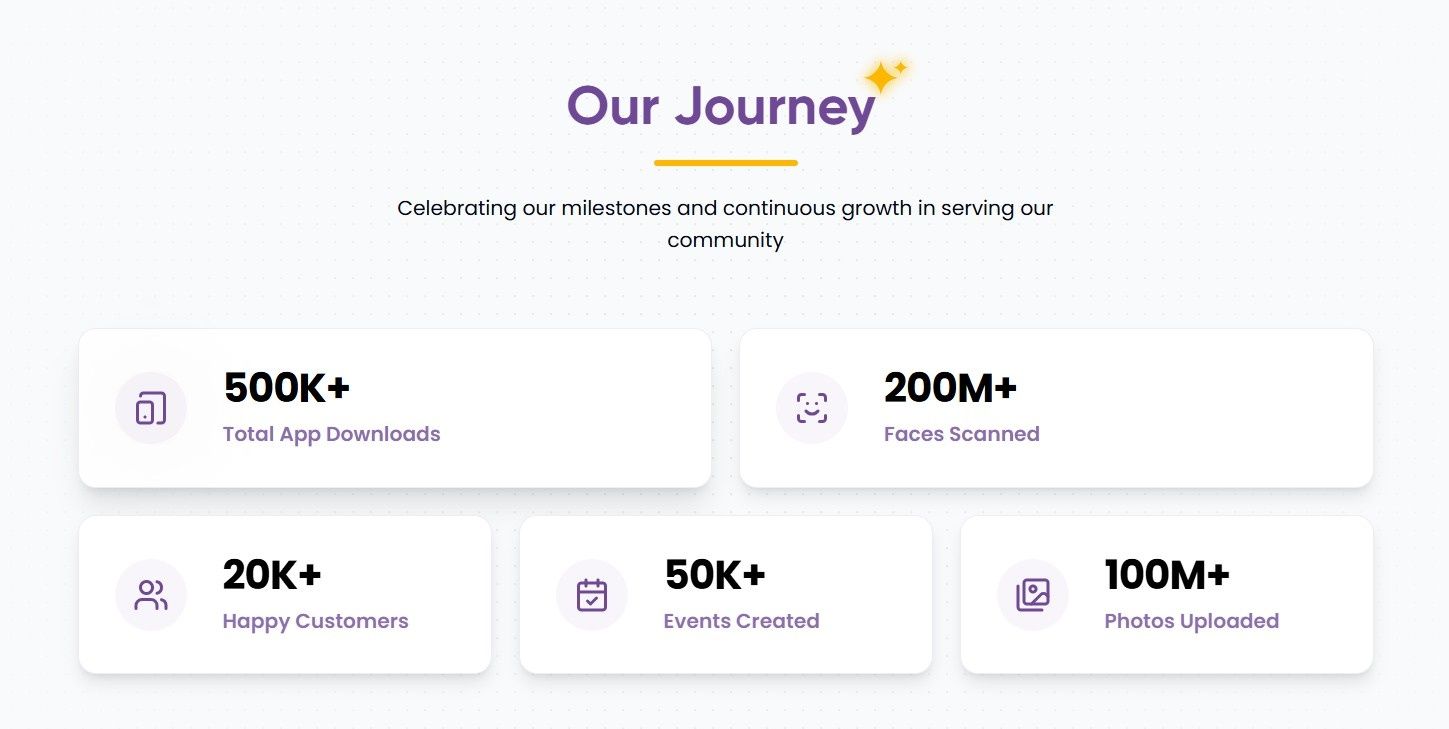
And this shift isn’t theoretical. It’s already playing out across real, high-volume events—50K+ events covered, 100M+ photos uploaded, 200M+ faces scanned, and 20K+ happy customers.
Here’s the pattern teams see the moment they move from storage to systems:
- faster guest access → fewer “send my photos” requests
- easier discovery → more sharing while excitement is high
- controlled access → higher trust from families and organizers
- smoother delivery → stronger referrals and repeat business
You feel it most when volume spikes—multi-function weddings, concerts, and college fests—where the crowd expects their moments quickly, on mobile, and with privacy built in.
That’s why the question is no longer “Do we need a gallery?” It’s:
Do we have the best photo gallery for high volume events—or just a folder link?
Explore the move from storage to systems
If your current workflow is basically “upload → share link → handle follow-ups,” you don’t have a delivery system—you have storage.
A system-first approach helps you deliver like a premium team even when the event is massive: structured uploads, smart discovery, controlled access, and smoother guest experience.
If you’re regularly dealing with thousands of photos and hundreds of guests, a strong client gallery delivery workflow starts with tools designed for scale: event photo distribution software that supports discovery, privacy, and high-volume performance.
Experience a system built for real event-scale delivery at kamero.ai
About Tanuj Thakkar
Hi! I’m Tanuj Thakkar – a BCA graduate from St. Xavier's College, Ahmedabad, with an endless curiosity for people, ideas, and stories. I’m passionate about sales, marketing, and finding creative ways to connect with people. Nothing excites me more than understanding what makes someone tick and turning that into solutions that actually make a difference.
When I’m not diving into strategies or brainstorming ideas, you’ll probably find me exploring new places, geeking out on tech and innovation, or having conversations that spark fresh perspectives.