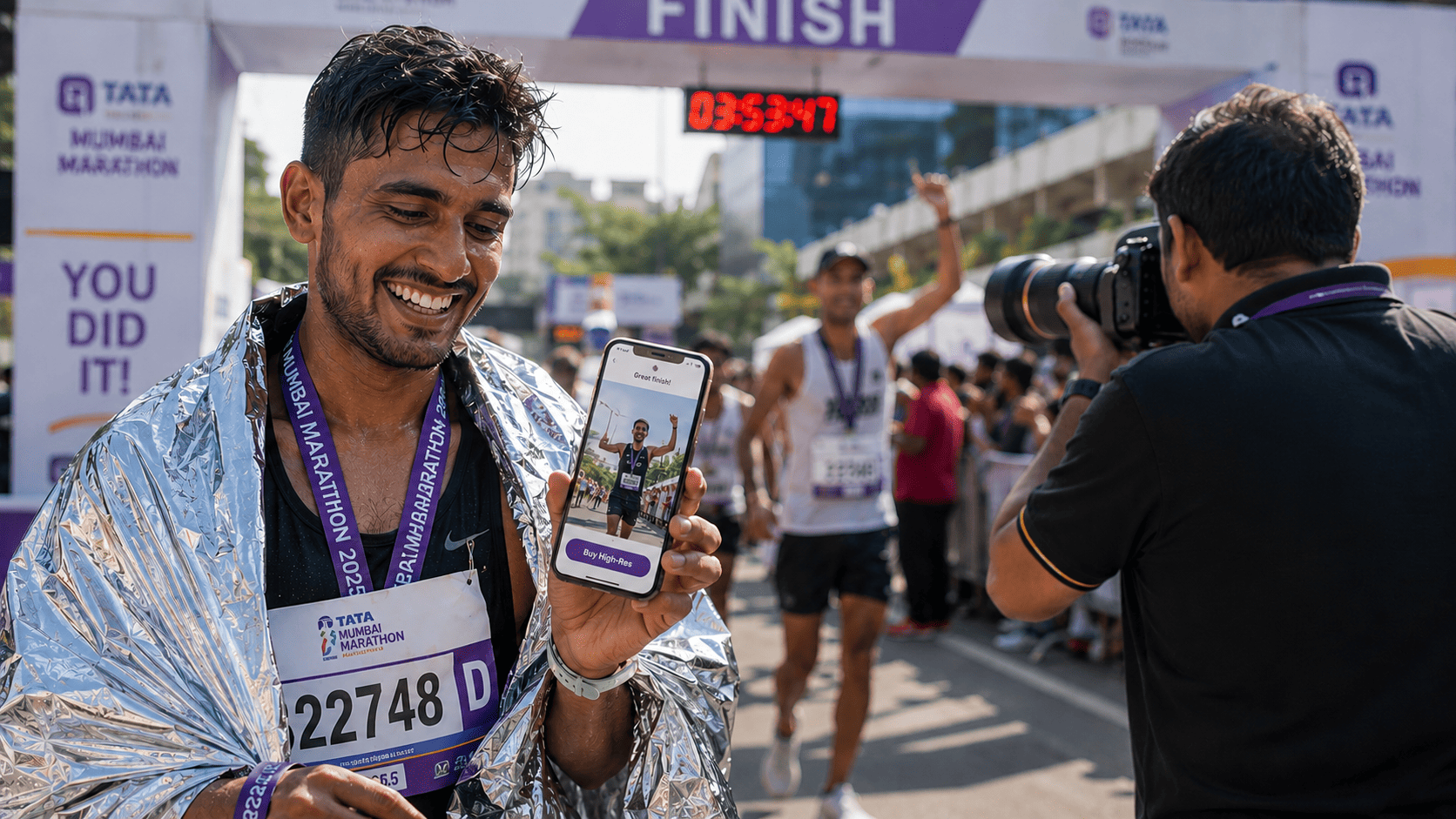
2026 India Profit Snapshot:
- The 1-Hour Rule: Real-time delivery (under 60 minutes) increases purchase intent by 3x compared to next-day delivery in Indian marathons.
- UPI Advantage: Integrating instant UPI payment triggers on gallery pages results in a 40% faster checkout rate vs. traditional credit card forms.
- Revenue Diversification: Moving to a hybrid model (Direct Sales + Sponsor-Backed Downloads) ensures 100% monetization of every shutter click.
The Economics of Marathon Photography: Why Speed is Your Greatest Revenue Driver
In the Indian sports circuit—from the Mumbai Marathon to local 10K runs—the product you are selling isn't just a JPEG; it’s an emotion. Specifically, it is the peak achievement state a runner experiences immediately after crossing the finish line.
The "Finisher's High" Window
Data from recent major Indian races shows a sharp decay in purchase probability over time. 80% of sales happen within the first 6 hours of a race. This is the "Finisher's High" window. When an athlete is still wearing their medal and sharing stories on WhatsApp Status, their willingness to sell sports photos online as a commemorative asset is at its zenith. By the time the "post-race muscle soreness" sets in the next day, the emotional urgency to buy drops by over 60%.
The Cost of Manual Culling
Traditional Indian photography workflows—where a photographer goes home to offload 10,000 images, culls them manually, and uploads them 48 hours later—are actively killing your margins. Manual sorting creates "delivery fatigue." While you are culling, the runner has already moved on. In 2026, time spent behind a laptop is lost profit. Automation is the only way to protect your professional fee.
Concrete ROI: The All-Access Digital Pass
The old model of selling individual photos for ₹199 is being replaced by the ₹999 "All-Access Digital Pass." Because high-volume photo sales are now automated via AI, you can offer a runner every single photo of themselves (often 30+ images) for a flat premium fee. This model typically yields a 40% higher Average Order Value (AOV) than the traditional "pick-and-choose" method.
Strategies to Monetize Marathon Photography in 2026
To monetize marathon photography successfully in India, you must treat your gallery like a high-performance e-commerce funnel.
Automated E-commerce Aggregators (UPI-Ready)
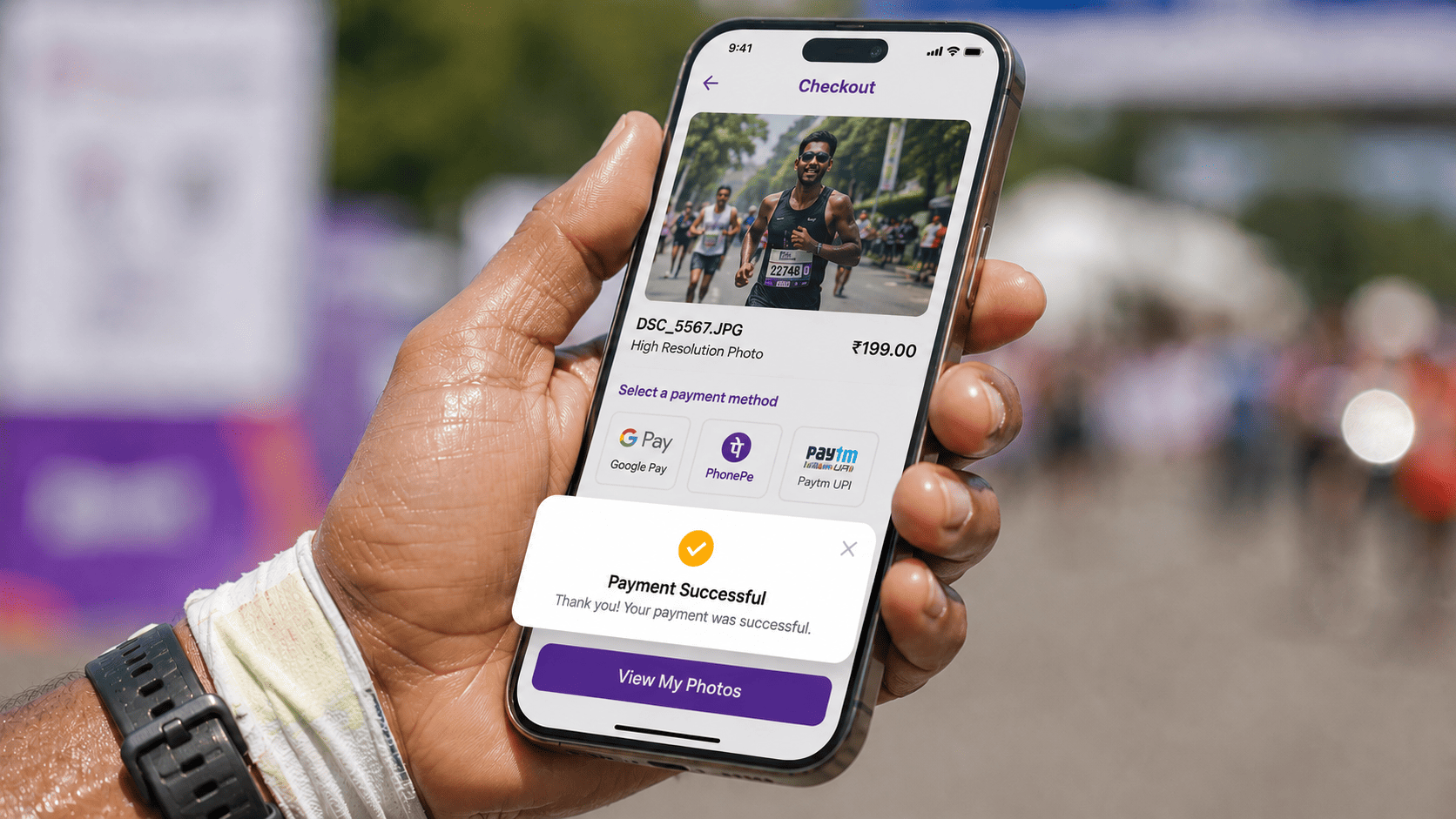
The bottleneck for most Indian sports photographers is the payment process. You cannot afford to manually share bank details or wait for screenshots. You need a storefront that handles instant UPI payments (GPay, PhonePe, Paytm) and—most importantly—instant high-res delivery. Once the runner pays via UPI, the watermark must vanish automatically, and the high-res file must be delivered to their phone within seconds.
Dynamic Pricing Models
Maximized cash flow requires a tiered pricing strategy tailored for the Indian runner:
- Pre-booking (₹499): Sell the "All-Access Pass" before the race starts to lock in revenue.
- Live Event (₹999): The standard price during the "Finisher's High" window.
- Post-Event (₹1,499): A premium price for those who wait more than 72 hours, covering long-term hosting costs.
Sponsor-Backed Galleries
This is the "Zero-Barrier" monetization strategy. Instead of charging the runner, you charge a brand (e.g., a sports drink or a fitness wearable). The sponsor pays you a flat fee to offer "Free Branded Downloads." This ensures you get paid for every single photo taken, while the sponsor gets their logo shared across thousands of Instagram and WhatsApp profiles in India.
High-Volume Photo Sales: Tech Stack Essentials for Race Day
Scaling to 5,000+ runners requires a tech stack that eliminates human intervention between the shutter click and the digital storefront.
AI Bib & Face Recognition
The "Blocked Bib" is the nightmare of selling race photos. When a runner's bib is obscured by their hands or a hydration pack, standard OCR fails. 2026 technology uses hybrid facial identification to link the runner to their bib number. If the bib is visible in just one shot, the AI "learns" the face and automatically tags all other photos of that runner in the crowd.
Real-Time Camera-to-Cloud (FTP)
"Zero-Touch" is the goal. Using 5G-enabled cameras or mobile hotspots, photos should move via FTP directly from the camera to the cloud. This allows the AI to begin sorting and the storefront to begin high-volume photo sales while the race is still in progress—allowing runners to see their photos before they even leave the venue.
Scalable Web Infrastructure
An Indian marathon gallery experiences massive "burst" traffic. When thousands of runners cross the finish line and check their phones simultaneously, your gallery must be hosted on scalable infrastructure that can handle thousands of concurrent AI searches without lagging or crashing.
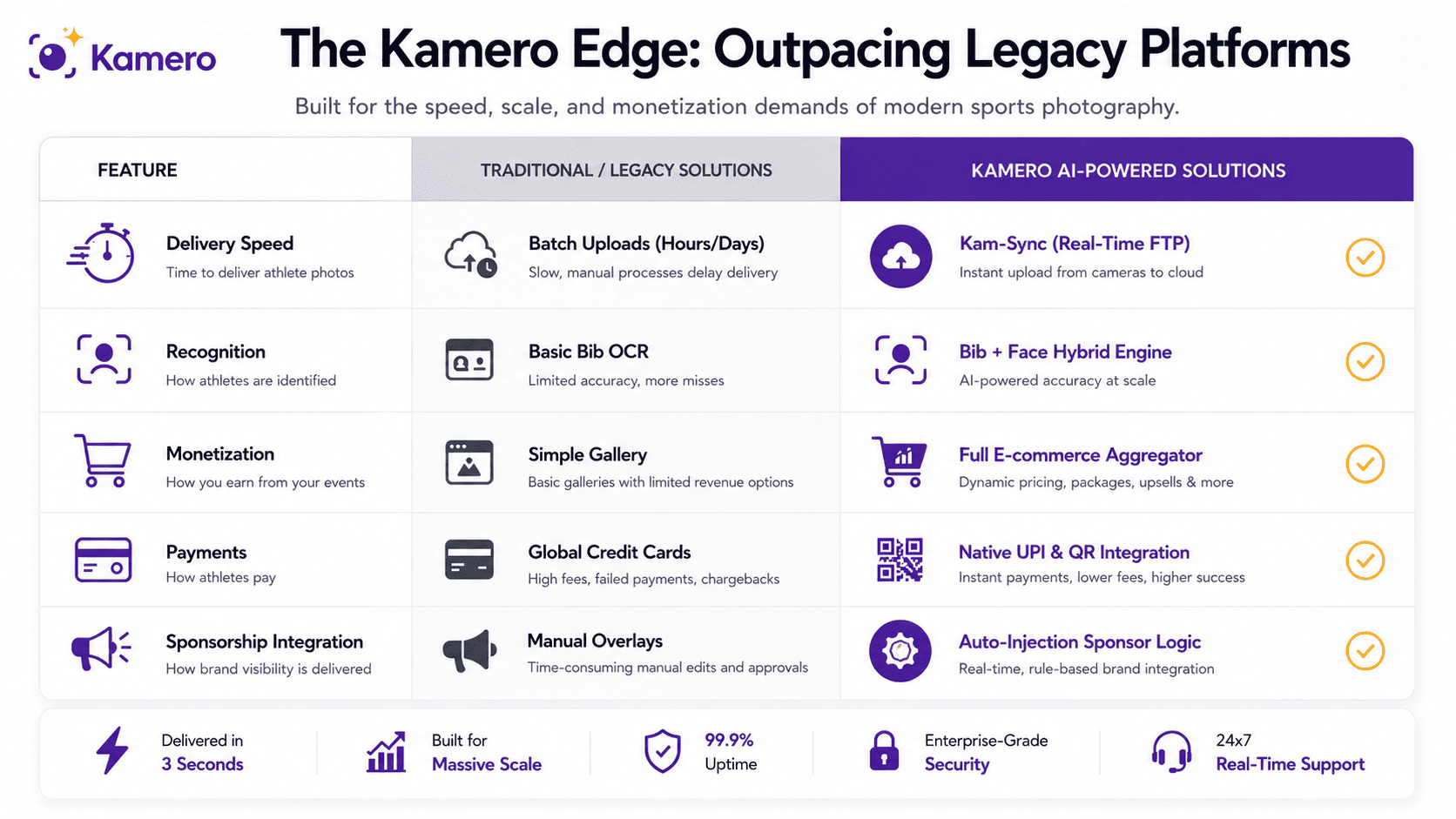
The Kamero Edge: Outpacing Legacy Platforms
While other platforms offer basic hosting, Kamero is built specifically for the high velocity demands of 2026 Indian sports photography.
Turning Race Day into a Scalable Business
The difference between a hobbyist and a professional sports photographer in India is automation. By focusing on speed, leveraging hybrid AI recognition, and deploying a friction-free, UPI-enabled storefront, you transform a grueling day of shooting into a scalable, high-margin revenue engine.
Don't let your hard-earned shots sit on an SD card while the "Finisher's High" fades away. It is time to sell sports photos online with the speed and scale that modern Indian athletes expect.
Ready to stop sorting and start selling?
Stop the manual grind and let AI handle the heavy lifting. Turn your race day photography into a 24/7 revenue stream with Kamero’s specialized sports tools.
- Scale your sales: Set up your Marathon Store on Kamero.ai today
- Watch the speed in action: Book a Demo with our Indian Specialist Team
- Stay ahead of the pack: Follow us on Instagram @KameroApp
About Mohit Prakash Lal
Hi, I’m Mohit, an MBA student at TAPMI, Manipal, exploring the world of business with a focus on marketing and strategy. I’m interested in understanding how brands connect with people and create meaningful, lasting impact in a competitive landscape. I enjoy working on real-world projects across marketing, sales, and business development, where I can apply ideas in practical settings.
I also enjoy simplifying ideas into clear, practical insights. Outside of work, I like travelling, reading, and taking time to recharge.