Every growing photography studio eventually hits a critical infrastructure ceiling. When you first transition from delivering hard drives to utilizing cloud distribution, consumer-grade sharing applications feel like a revelation. They are accessible, straightforward, and generally functional for smaller, low-stakes events like private birthdays or intimate engagements.
However, as your business scales into capturing 1,000-guest luxury Indian weddings, corporate mega-summits, and massive college fests, the cracks in entry-level software begin to show. App crashes during peak weekend traffic, aggressive image compression, and a lack of true enterprise controls quickly turn what should be a seamless client handover into an operational nightmare. When your software limits your operational scale, it directly limits your revenue. If you are a high-volume agency experiencing these bottlenecks, you must upgrade photography software to protect your brand equity. For studios searching for a robust Kwikpic alternative, the transition to Kamero represents a fundamental shift from a basic file-sharing utility to a complete, enterprise-grade media ecosystem.
The Limits of Basic Face Recognition Delivery
Artificial intelligence and facial recognition have become table stakes in the photography industry. But not all AI engines are engineered to handle the same computational load.
Entry-level platforms utilize basic, consumer-tier facial recognition. While this works adequately for a gallery of 300 photos, it begins to buckle under the weight of high-volume events. When you upload a 15,000-image wedding archive, basic AI frequently returns false positives, misses profiles in complex lighting, or worse, times out the server entirely. Forcing a luxury client or a corporate VIP to manually scroll through a disorganized folder because the facial recognition engine crashed is a catastrophic failure of customer service.
Kamero was engineered specifically for massive concurrency and complex data sets. Our enterprise-grade biometric engine indexes thousands of faces in milliseconds, maintaining elite accuracy across varied lighting environments, side profiles, and heavy crowd shots. This ensures that professional event photo delivery remains frictionless, regardless of whether the gallery contains 500 or 50,000 high-resolution images.
Real-Time vs. Post-Event: The Kam-Sync Revolution
The most glaring limitation of budget photo-sharing tools is their reliance on manual, post-event ingestion. You are forced to shoot the entire event, commute back to your studio, and initiate a massive bulk upload via a web browser. If your internet connection drops midway through a 50GB transfer, you are forced to start the process over.
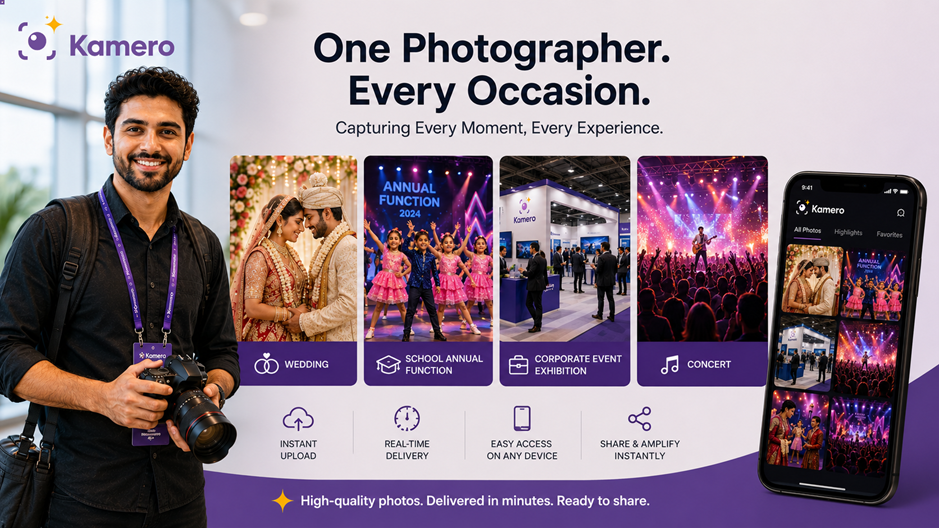
Kamero fundamentally breaks this linear timeline with Kam-Sync. Kam-Sync is our proprietary Camera-to-Cloud (C2C) FTP pipeline that operates in real-time. As your team shoots a live concert or a high-stakes corporate PR event, Kam-Sync securely trickles the RAWs or JPEGs from your camera directly to your cloud dashboard. The AI indexes the faces while the event is still happening. This parallel processing means your delivery time drops to zero. By the time the keynote speaker steps off the stage, their personalized, branded photo gallery is already sitting in their inbox. This capability alone elevates your studio from a standard service provider to an elite, tech-forward media partner.
Deep Feature Comparison: UX, Storage, and Global Reliability
When evaluating the Kamero vs Kwikpic debate, it is essential to look beneath the surface-level marketing and examine the core architectural differences that dictate the end-user experience.
Native iOS/Android Apps vs. Mobile Web Browsers.
The client's perception of your photography is heavily influenced by the medium through which they view it. Most budget sharing platforms rely on mobile-responsive web wrappers. When a guest attempts to scroll through a heavy grid of high-res images on a standard mobile browser, the interface frequently stutters, lags, and forces constant page reloads.
Kamero delivers a vastly superior UX by offering 100% white-labeled Native iOS and Android Apps. Native architecture allows for hardware acceleration and offline caching. This means galleries scroll buttery-smooth, animations are instantaneous, and images load without the frustrating "stutter-step" inherent to web browsers. A $10,000 wedding contract deserves a luxury digital interface, not a clunky web link.
Integrated Commerce vs. Simple Image Sharing.

A fundamental difference between Kamero and its entry-level counterparts is the ultimate goal of the platform. Basic apps are built strictly for image sharing; they are a cost center. Kamero is built for commercial aggregation; it is a profit center.
While consumer apps allow you to distribute files, they lack the sophisticated infrastructure required to monetize them effectively. Kamero provides a deep, integrated e-commerce engine. You can instantly pivot from free sharing to a highly secure digital storefront, complete with global payment gateways (Stripe, Razorpay, UPI), automated print fulfillment, and custom "Per Photo" or "All My Photos" pricing tiers. Kamero does not just deliver your photos; it actively sells them.
Why Kamero Wins on Scale and Reliability

At the enterprise tier, software must be evaluated on its failure rate during peak stress. The ultimate test of a photo delivery platform is not how it performs on a quiet Tuesday morning, but how it holds up at 10:00 PM on the busiest Saturday of the wedding season.
Built for high-volume environments (Marathons/Concerts) with offline caching and streaming ingestion.
Imagine shooting a city marathon with 20,000 runners. The second the race finishes, tens of thousands of participants and their families will simultaneously attempt to access the photo server to find their finish-line shots.
Consumer-grade architecture is simply not equipped to handle this level of traffic concurrency. Servers crash, APIs rate-limit, and users are met with 502 Bad Gateway errors—instantly damaging your studio's reputation.
Kamero’s infrastructure is explicitly built for high-volume environments. Our servers utilize advanced load balancing and streaming ingestion protocols to ensure 99.9% uptime, even when hit with massive traffic spikes. Furthermore, our offline caching capabilities mean that even if a guest is standing in a concrete stadium or a remote destination resort with spotty cellular data, they can still seamlessly interact with their previously loaded gallery.
Upgrading your infrastructure is not just about gaining new features; it is about risk mitigation. When you are hired by high-net-worth clients and global brands, "server lag" is not an acceptable excuse. By migrating to Kamero, you are securing the operational stability required to dominate the high-volume event market.
Outgrown basic sharing apps that crash during peak season?
Make the enterprise upgrade to Kamero and handle high-volume events flawlessly. Stop letting entry-level software limit your agency's growth.
Ready for a platform built for professionals, not just consumers?
Migrate your photography business to Kamero today and experience true reliability, real-time Kam-Sync ingestion, and integrated monetization.

About Mayank Oraon
Hi, I’m Mayank, an MBA student exploring the business world with a focus on operations, supply chain, and product strategy (aka the parts of a business that keep things from quietly falling apart).
I’m interested in understanding how systems actually run behind the scenes- and why they sometimes don’t. I also enjoy simplifying complex ideas - partly because it helps others, and partly because if I can’t explain it simply, I probably didn’t understand it in the first place (which is a humbling but effective feedback loop).