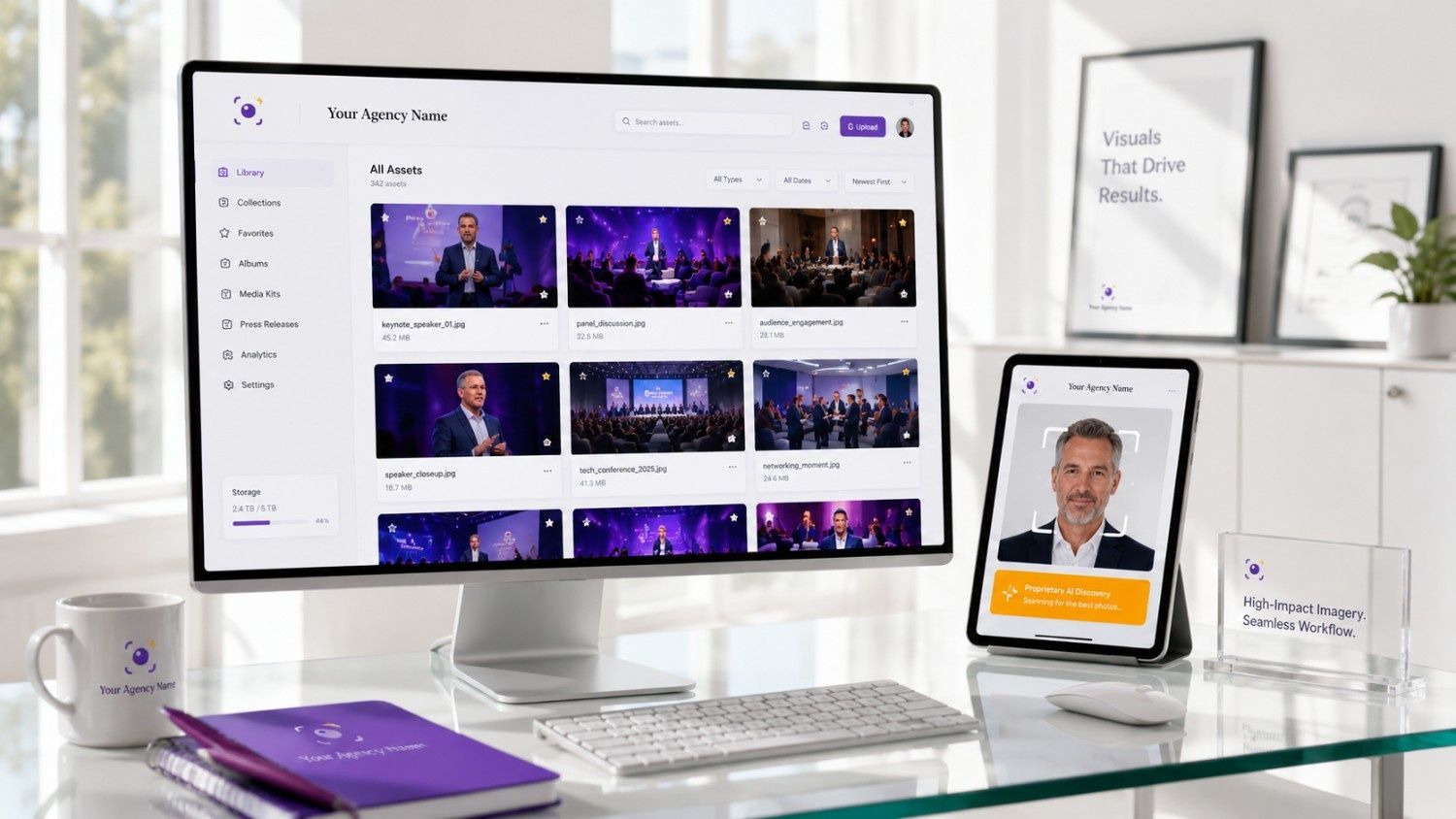
In the hyper-competitive agency landscape of 2026, many creative firms find themselves trapped in a "commodity race." When you deliver photos via generic links or third-party platforms, you aren't just delivering images; you are unintentionally advertising someone else's technology. This is the "Commodity Trap." Agencies that send standard gallery links often lose clients to cheaper competitors because the client perceives the photographer, not the agency’s infrastructure, as the source of value.
To retain corporate clients and justify premium rates, top-tier agencies are shifting toward a "sticky" business model. By utilizing a white-label event photography platform, these agencies transform a simple delivery step into a proprietary tech service. This doesn't just improve the look of the gallery; it allows the agency to market themselves as a high-tech innovation partner.
The Innovation Pivot: Selling Your "In-House AI Discovery Engine"
The most significant shift in the agency playbook is how you position your technology. Agencies should no longer say, "We use Kamero for photo delivery." Instead, white-labeling allows you to market the platform as your "In-house AI Discovery Engine."
Charging a "Technology Fee"
By positioning the AI face-matching and instant delivery as a proprietary service, agencies can move beyond billing solely for their time and talent. You are now a technology provider. This allows you to justify a "Technology Fee" or "Digital Management Fee" on top of your shooting fee. Clients are willing to pay a premium for "Proprietary AI Discovery" because it feels like a high-value, exclusive innovation that they cannot find with a standard freelance photographer.
Owning the Client Journey
White-labeling ensures that the corporate client never sees a third-party logo. Your agency remains the hero of the innovation. When an executive finds their photo in seconds using a selfie-scan, they credit your agency’s tech-forward approach. This builds massive brand equity and makes your agency the "sticky" choice for all future events.
Strategic Scaling: Multi-Brand Management from One Dashboard
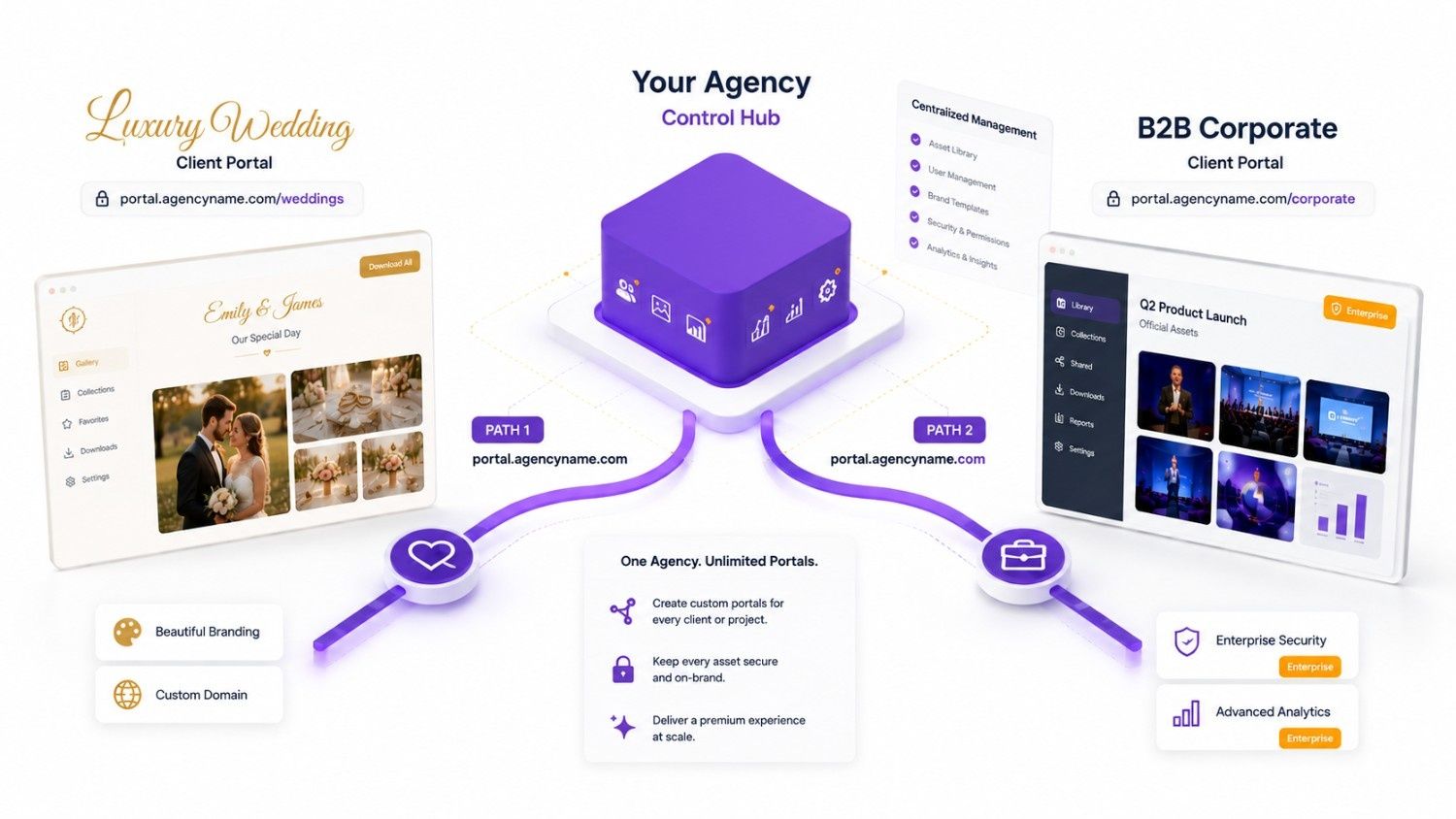
Professional agencies often operate across different verticals, each requiring a distinct visual identity. You might have a luxury wedding wing that demands high-fashion aesthetics and a corporate B2B wing that requires a clean, tech-focused interface.
Diverse Brand Personas
Kamero’s white-labeling supports Multi-Brand Management. This allows your agency to maintain one central dashboard while delivering vastly different client experiences.
- The Luxury Wing: Deliver a "Vogue-style" experience with custom domains, elegant fonts, and high-fashion branding.
- The B2B Wing: Deliver a "Tech-Corporate" experience with secure, minimalist custom branded event galleries and enterprise-grade lead capture fields.
Each wing operates under its own custom domain and SMTP (email) settings, ensuring that your corporate clients and wedding couples receive a tailored experience that feels bespoke to their world.
The Strategic Power of Agency Photo Delivery Tools
White-labeling is more than just a logo swap; it’s a defensive and offensive business strategy.
Eliminating "Software Shopping"
When a client sees the specific tool you use, they may try to bypass you to go directly to the source. A white-label event photography platform masks the engine under the hood. The client sees the result—the "magic" of AI—but they don't see the vendor, ensuring your agency remains the essential gatekeeper.
Consistency Across Associate Teams
As you scale, you may use various associate photographers. By mandating that every team uses your agency photo delivery tools, you ensure a uniform, high-end delivery experience across every project. This consistency is what builds long-term trust and wins lucrative retainer contracts.

The Kamero Advantage: Why Agencies Choose Us Over the Giants
- Kamero vs. Samaro: Samaro is built for guest "sharing" and keeps its own brand prominent. Kamero is built for Enterprise Branding, offering deep white-labeling that removes all traces of our platform.
- Kamero vs. Kwikpic: Kwikpic forces guests into an app, leading to a 60–80% drop-off rate. Kamero keeps your agency on the Web/Mobile-Web, keeping your URL at the forefront—not an app store link.
- Kamero vs. Pixieset/SmugMug: Traditional galleries are "Storage Tools." Kamero is a Marketing Tool. Our AI and lead capture are features you can market as your own "Proprietary AI Services."
Implementation: Branding Your Tech Stack in 3 Steps
- Custom Domains & SMTP: Map your agency’s subdomains so every email and link comes directly from your identity.
- Signature Templates: Design unique gallery looks for your different "wings" (Corporate vs. Luxury) to ensure custom branded event galleries match the client's expectations.
- The Pitch: Update your proposals to highlight your "Proprietary AI Discovery Engine." Stop selling photos; start selling a branded, intelligent ecosystem.
Conclusion: Moving from Vendor to Strategic Partner
In 2026, the agencies that survive are those that own the technology layer of the client relationship. By adopting a white-label event photography platform, you stop being a replaceable vendor and start being a strategic partner. You aren't just selling pixels; you are selling a branded, intelligent infrastructure that allows you to charge more, scale faster, and retain corporate clients for life.
Don't just deliver photos; deliver a branded experience. Claim your white-label Kamero demo today.
- Book a White-Label Demo with Kamero – Take full control of your agency’s brand.
- Follow us on Instagram @kameroapp for more on agency photo delivery tools and high-ticket sales strategies.

About Nidhi S
Hey there! I’m an MBA student with a keen interest in the evolving world of digital marketing and business strategy. I enjoy exploring how brands build their online presence and the creative process behind turning strategic goals into engaging stories.
When I’m not caught up in marketing trends, you’ll probably find me down a YouTube rabbit hole or binge-watching sitcoms. I’m a fan of good stories—whether they’re in a marketing campaign or a 20-minute TV episode—and I’m always looking for new perspectives to keep things interesting!