
In the high-stakes environment of 2026 mega-expos, manual delivery is the primary point of failure. Traditional photography workflows typically require 120+ hours of post-event sorting and emailing. By deploying automated exhibition photography, that window is compressed to less than 60 seconds. AI photo matching doesn't just speed up delivery; it scales engagement by a factor of ten.
The Challenge of Scale: Why Large-Scale Expo Delivery Breaks Standard Workflows
When an exhibition crosses the threshold of 10,000 attendees, standard photography logistics collapse. The sheer volume of data—thousands of high-resolution RAW or JPEG files—creates a technical debt that most event organizers fail to account for until the event is already underway.
The Batch Processing Bottleneck
Traditional "upload and email" methods rely on a linear process: shoot, offload SD cards, edit, upload to a generic gallery, and blast a link to a massive database. By the time this cycle completes, the event is over. This delay results in a 0% social media engagement rate during the actual exhibition. If attendees cannot share a professional photo while they are physically standing at your booth or keynote, the brand loses its most valuable PR momentum.
The Search Fatigue
Imagine an attendee receiving a link to a gallery containing 5,000+ unsorted images. The "Search Fatigue" is real; modern professionals will not scroll through endless rows of photos to find their own faces. Without AI photo sorting, your high-quality assets become "dark data"—valuable content that is never seen, never downloaded, and never shared.
The Social Media Window
In 2026, exhibition photos lose 90% of their PR value after the first 24 hours. The "hype cycle" of a trade show is incredibly short. To maximize a large-scale expo delivery, the content must be available while the attendee is still "in the moment." Delayed delivery is, for all intents and purposes, failed delivery.
Building an Automated Exhibition Photography Pipeline
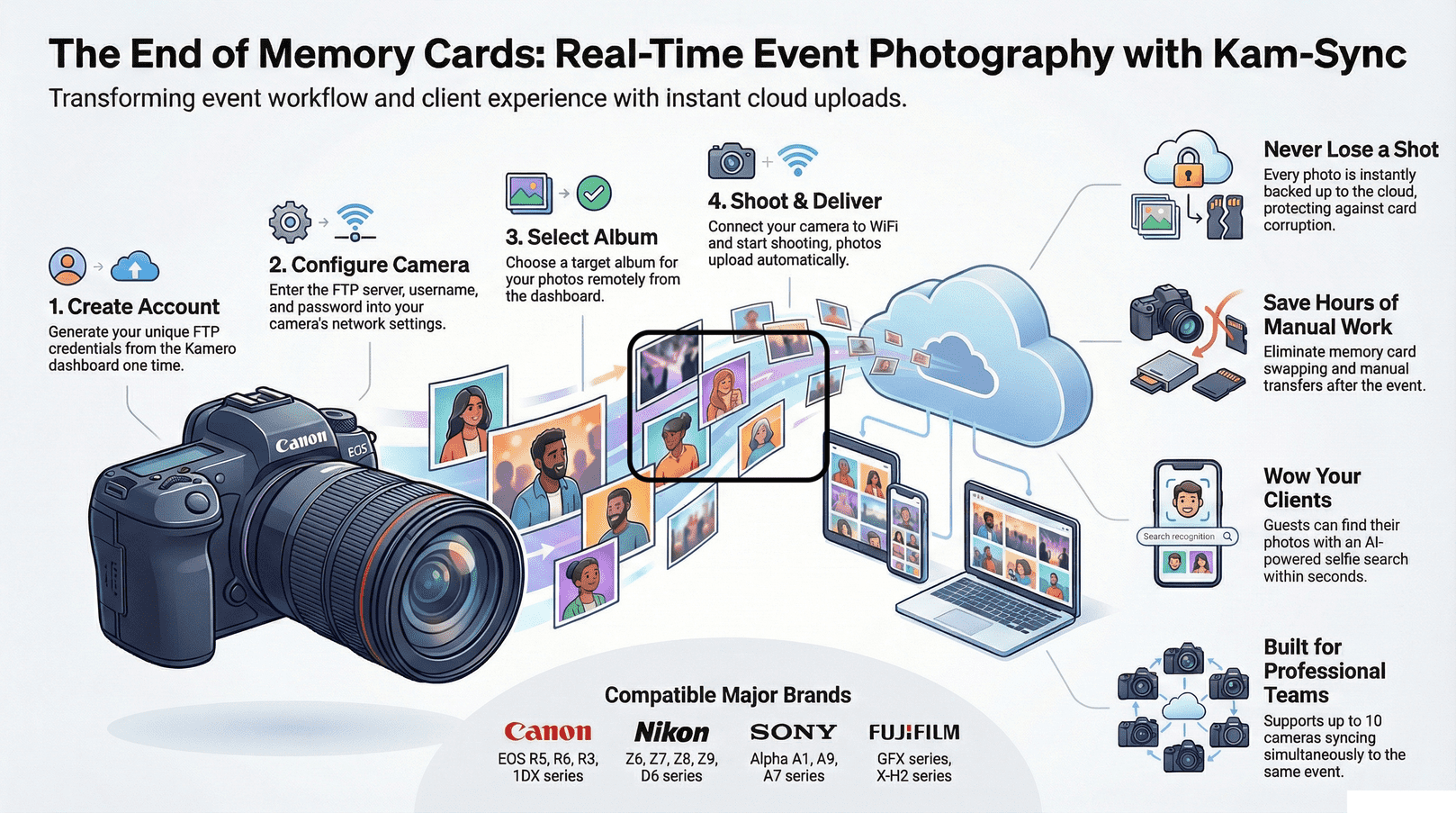
To handle five-figure attendance numbers, you need a move from a manual "task-based" mindset to a "pipeline" architecture. This requires a three-step automated approach.
Step 1: Real-Time Ingestion with Kam-Sync
The first point of failure in a high-volume event workflow is the SD card. Manually swapping cards and running to a media desk is a relic of the past. Kam-Sync leverages direct camera-to-cloud FTP protocols. As the photographer clicks the shutter, the low-res preview or high-res file is instantly beamed to the server via 5G or local Wi-Fi. This eliminates ingestion lag entirely.
Step 2: Instant AI Photo Sorting
Once the images hit the cloud, a powerful facial recognition engine takes over. Kamero’s AI doesn't wait for the event to end; it processes images in a continuous stream. It can handle simultaneous queries from thousands of users without latency. The AI analyzes unique facial markers and "buckets" them into personalized private galleries for every registered attendee in milliseconds.
Step 3: Triggered Delivery via QR & SMS
The final piece of the pipeline is notification. Instead of the attendee checking back repeatedly, the system is proactive. Through a large-scale expo delivery system, attendees scan a single QR code at the start of the event. The moment the AI "spots" them in a new photo, they receive an instant SMS or WhatsApp ping with a direct link to their new image.
Optimizing for High-Volume Event Workflows: Pro Tips for 2026
Scaling to 10,000+ people requires more than just good software; it requires tactical infrastructure.
Bandwidth Management
At massive expos, cellular networks often become congested. To maintain an automated exhibition photography flow, professional teams now set up local FTP hubs. By using a dedicated local server as a buffer, photographers can sync images with zero latency, which then trickle-up to the cloud as bandwidth permits.
Multi-Camera Integration
A 10,000-person event usually requires 5 to 10 photographers roaming different zones. The workflow must sync multiple camera feeds into a single, unified exhibition gallery. This ensures that an attendee who was photographed at the entrance, a breakout session, and the evening gala sees all their photos in one cohesive, branded timeline.
The "Selfie-First" UX
The most efficient way to handle 10k+ people is the "Selfie-First" registration model. By encouraging attendees to scan a QR code and take a quick reference selfie at the registration desk, you pre-verify their identity. This enables seamless, zero-touch delivery throughout the three-day event. The attendee does nothing; the photos simply find them.
The Kamero Edge: Scalability for Enterprise Expos
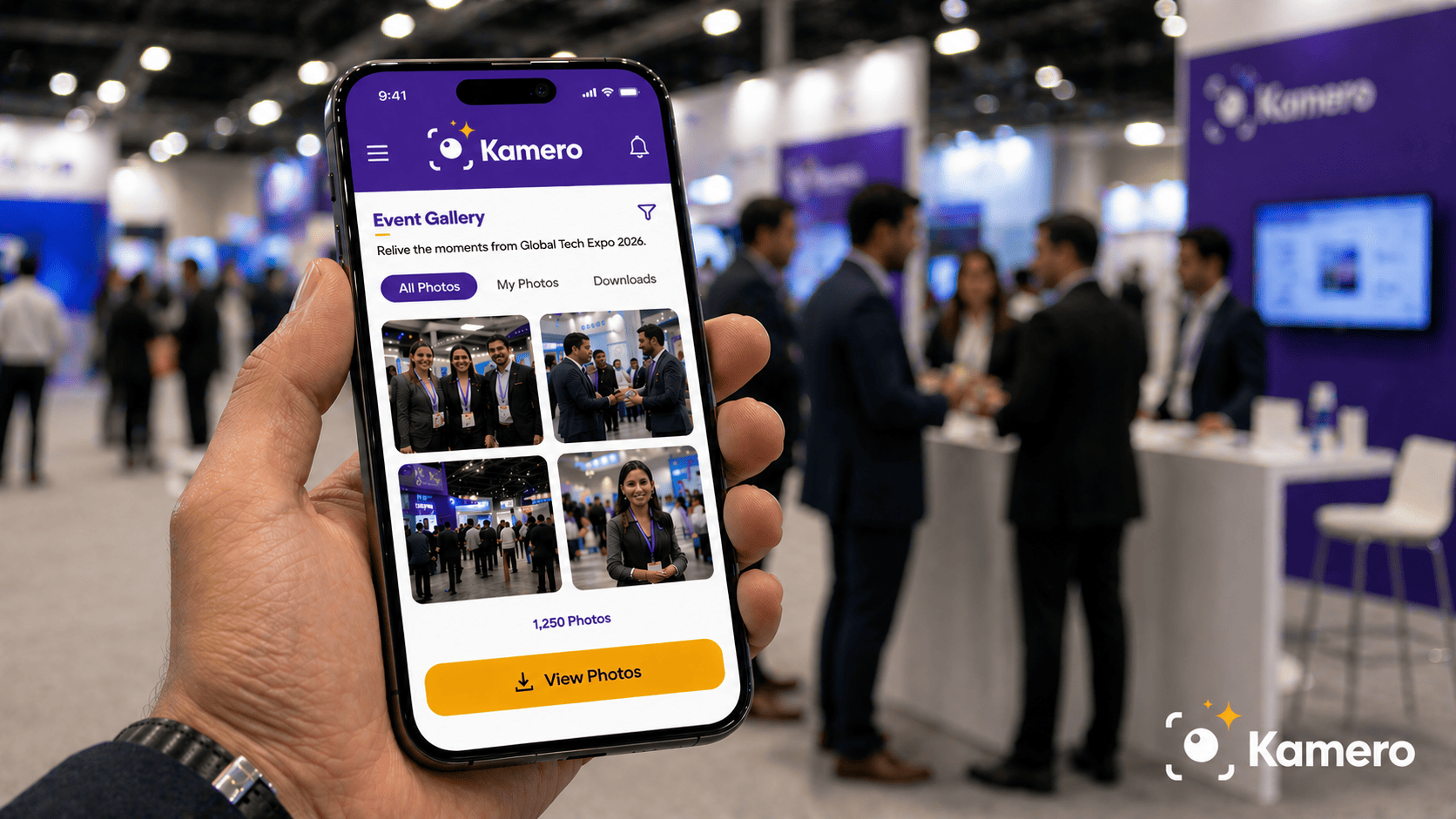
While many platforms offer basic photo sharing, handling the concurrency of a massive trade show requires enterprise-grade architecture.
- Load Balance & Speed: Kamero’s infrastructure is built for Enterprise-level concurrency. While social-grade apps struggle when 2,000 people search simultaneously, our engine is optimized for high-traffic spikes, ensuring the gallery never hangs.
- Kam-Sync vs. Mobile Uploads: Many tools require photographers to upload via a smartphone app, which often crashes or overheats during high-volume shooting. Kam-Sync uses professional-grade FTP, a "set-and-forget" protocol that ensures zero packet loss and maximum reliability.
- Superior AI Accuracy: Exhibition floors are crowded, chaotic environments. Kamero’s hybrid matching engine is specifically trained for "Crowded Backgrounds." It can distinguish between the subject and the blurred faces in the background, preventing "false positive" notifications.
- White-Label Branding: At this scale, the data is gold. Kamero allows the organizer to maintain 100% white-label supremacy. All 10,000 attendees interact with your brand's interface, ensuring the tech stays invisible while your event takes center stage.
Scalability is No Longer a Luxury
In 2026, the success of a large-scale event is measured by its digital footprint. If you are managing 10,000+ attendees, you cannot rely on 20th-century manual processes. An automated exhibition photography pipeline is the only way to ensure that every attendee leaves with a high-value, branded memory in their pocket.
By solving the challenges of search fatigue and delivery lag, you transform a logistical nightmare into a powerful marketing engine.
Managing a high-traffic event? Don't let your content get stuck on an SD card. Scale your impact and ensure every attendee is seen.
- Ready to scale?: Book a Demo for your Enterprise Event
- Experience the speed: Sign up on Kamero for Free
- Get inspired: Follow us on Instagram @KameroApp
About Mohit Prakash Lal
Hi, I’m Mohit, an MBA student at TAPMI, Manipal, exploring the world of business with a focus on marketing and strategy. I’m interested in understanding how brands connect with people and create meaningful, lasting impact in a competitive landscape. I enjoy working on real-world projects across marketing, sales, and business development, where I can apply ideas in practical settings.
I also enjoy simplifying ideas into clear, practical insights. Outside of work, I like travelling, reading, and taking time to recharge.