Most creative curriculums and workshops completely fail to address the operational reality of running a high-volume, profitable studio. You can spend years mastering the exposure triangle, off-camera flash techniques, and advanced color grading, but nobody teaches you how to handle the massive data bottleneck of shooting 10,000 images in a single weekend.
When you first start your career, manual file management feels manageable. You shoot an event, copy the SD card to a physical hard drive, sit at your desk to cull, and export the finals. But as client demand increases, this linear process breaks down entirely. Your revenue becomes inherently capped by the number of hours you can physically sit behind a desk sorting files. If you want to effectively scale photography business operations without burning out, you must stop operating like a freelance technician and start thinking like a Chief Executive Officer. The key to that transition lies in aggressive, end-to-end photography automation.
The "Multi-Tool Tax": Why Fragmented Workflows Stunt Growth
The average professional event photography studio currently runs on a disjointed, heavily fragmented tech stack. You ingest files via Lightroom, back them up to a Dropbox folder, send preview links to event planners via WeTransfer, track client feedback in Google Sheets, and host the final high-res images on a legacy platform like Pixieset.
This fragmentation creates a massive "Multi-Tool Tax." Every single time you move a file from one platform to another, you introduce operational latency, risk human error, and drain your own time. Downloading a 50GB folder from a cloud drive just to upload it to a separate gallery delivery service takes hours of active monitoring. During this manual transfer period, your computer is tied up, your bandwidth is choked, and you are trapped at your desk instead of networking, shooting your next gig, or getting much-needed rest.
This software sprawl not only inflates your monthly overhead with redundant subscription fees, but it actively prevents you from taking on back-to-back weekend events. You simply cannot scale a modern agency if your underlying digital infrastructure requires constant manual babysitting. To truly automate photography workflow, you have to eliminate the gaps between your tools.
From Capture to Delivery in <30 Minutes
Replacing WeTransfer and manual sorting with Camera-to-Cloud sync.
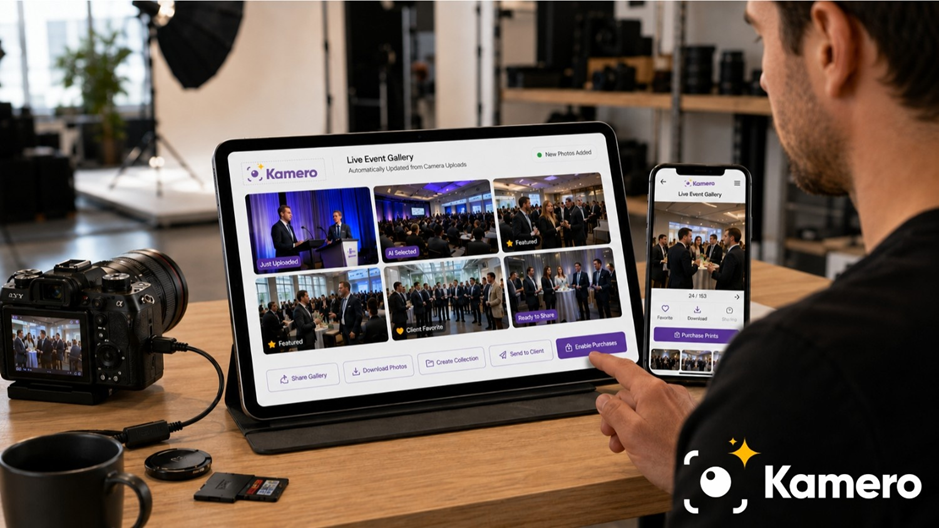
The first and most critical step to true operational efficiency is eliminating the physical SD card handover. Waiting until 2:00 AM in a hotel room to initiate your data ingest is a major operational liability and a relic of the past. To build a modern studio, the data pipeline must begin the exact moment the shutter closes.
Modern event organizers, PR teams, and luxury brides demand near-instant gratification. Relying on archaic file-transfer protocols like WeTransfer forces them to wait days for a basic link, killing the post-event momentum.
By implementing Camera-to-Cloud (C2C) sync, such as Kam-Sync's robust FTP pipeline, you establish a real-time tether to your digital infrastructure. As you shoot a corporate keynote or a wedding reception, the high-resolution JPEGs or RAW files are instantly pushed over the network directly into your cloud repository. This parallel processing means your off-site editors or PR teams can begin pulling, grading, and publishing assets while you are still actively roaming the venue. By the time you pack up your lenses and leave the venue, the initial proofs are already delivered, shaving days off your turnaround time and creating a "wow" factor for the client.
Scaling Without Adding Headcount: The AI Assistant Role

When studios hit an operational bottleneck, the traditional reflex is to hire human capital—an intern to sort photos, an assistant to manage client emails, or a studio manager to track album selections. However, human headcount introduces management overhead, payroll liabilities, and inevitable communication errors. In 2026, the most profitable studios are deploying AI tools for photographers to act as their digital workforce. These algorithms work 24/7, never make indexing errors, and require zero payroll.
Automated watermarking, notification triggers, and client shortlisting.
By utilizing AI, you can completely remove yourself from the tedious administrative tasks that drain your creative energy.
- Automated Watermarking: Protecting your intellectual property should not require a tedious batch-export process in Lightroom. A high-end automated platform instantly applies your custom, non-destructive watermark to every preview image the moment it hits the server, ensuring your brand equity is protected before a single client even opens the gallery.
- Notification Triggers: Instead of manually texting clients when their photos are ready, AI infrastructure can utilize WhatsApp and SMS integrations to automatically ping guests the exact second a new photo of them is indexed into their personal gallery. This creates a frictionless client experience without requiring a single keystroke from you.
- Client Shortlisting: Forcing clients to list filenames in an email to select their print album photos is a primary cause of project delays. An automated workflow provides a gamified, swipe-based interface where clients can "heart" their selections on their mobile devices, automatically syncing those choices back to your administrative dashboard so you can send the files straight to the printer.
The Kamero Advantage: One Platform, Zero Fragmentation
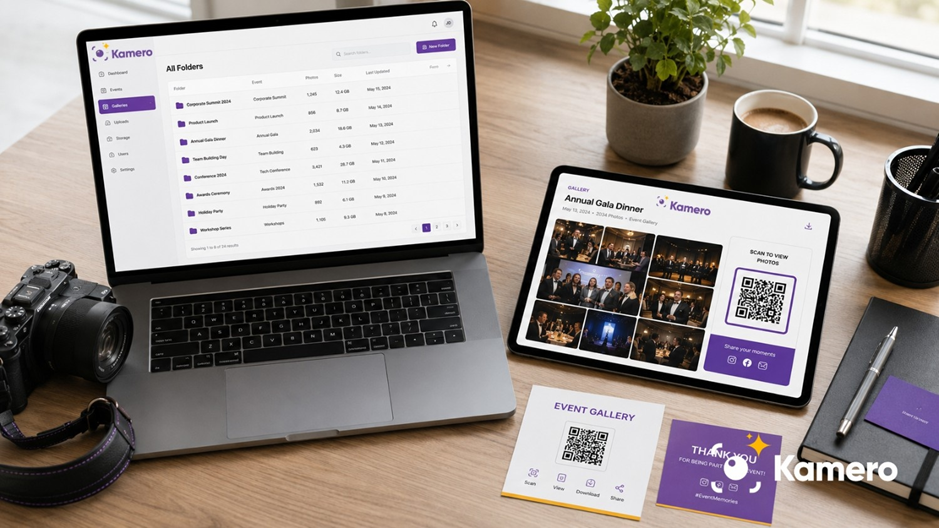
Why professional studios are ditching the 4-7 tool stack for Kamero’s unified mobile-first ecosystem.
The ultimate goal of business scaling is consolidation. You cannot build a high-velocity studio on a foundation of duct-taped software tools. This is exactly why high-volume agencies are abandoning their fragmented tech stacks in favor of Kamero's enterprise infrastructure.
Kamero replaces your ingestion tool, your cloud storage, your facial recognition software, your client proofing CRM, and your e-commerce storefront with a single, unified ecosystem. By centralizing your operations, Kamero entirely eliminates the Multi-Tool Tax. Files are ingested via Kam-Sync, automatically watermarked, sorted by AI facial recognition, and pushed to a 100% white-labeled native mobile app without ever requiring you to manually move a file between folders.x
Furthermore, Kamero is engineered with a mobile-first architecture. While legacy gallery hosts require clients to navigate clunky web wrappers, Kamero delivers a frictionless, app-based experience featuring branded QR code entry and offline caching. This ensures your high-net-worth clients and event attendees receive a premium, uninterrupted digital experience, directly reflecting the prestige of your studio.
If you want to stop operating as a localized service provider and start functioning as a scalable media enterprise, you must adopt the technology that makes manual labor obsolete.
Ready to stop shooting like a freelancer and start scaling like a CEO?
Automate your workflow with Kamero today and buy back your time. Let our unified infrastructure handle your ingestion, sorting, and delivery.
Spend more time behind the lens and less time behind the desk sorting files.Start your free Kamero trial to see AI workflow automation in action and discover how a consolidated tech stack can transform your studio's profitability

About Mayank Oraon
Hi, I’m Mayank, an MBA student exploring the business world with a focus on operations, supply chain, and product strategy (aka the parts of a business that keep things from quietly falling apart).
I’m interested in understanding how systems actually run behind the scenes- and why they sometimes don’t. I also enjoy simplifying complex ideas - partly because it helps others, and partly because if I can’t explain it simply, I probably didn’t understand it in the first place (which is a humbling but effective feedback loop).