
Imagine this: you press the shutter… and that moment is already on its way to the cloud—ready to be delivered while the event is still happening.
That’s the real shift in camera to cloud event photography. Delivery no longer starts “after the event.” It starts the moment a photo is captured. And once you experience that workflow, it’s hard to go back to memory cards, late-night transfers, and next-day upload marathons.
For photographers, studios, and organizers, this shift isn’t cosmetic—it’s structural. It’s redefining how modern event photo distribution software is designed and used.
The bottleneck nobody talks about: waiting till the event ends to upload
Traditional event photography workflows are built around delay. Not because photographers don’t care—but because the process itself forces waiting:
- shoot all day
- wrap the event
- go back and dump cards
- merge folders across shooters
- shortlist and export
- upload late night
- share the gallery later
This structure worked when expectations were lower. Today, it breaks—especially for weddings, concerts, and corporate events with multiple photographers.
The camera work may be smooth, but the upload phase becomes the choke point.
And here’s what that delay costs you (quietly, but consistently):
- Backlogs piling up across events
- Missed engagement windows while guests are still excited
- Repeated follow-ups: “Any update on photos?”
- Extra manual work sending individual images
This is why professionals are moving toward event photography workflow automation. The old system wasn’t built for speed, scale, or modern guest behavior—especially when reducing photo delivery time for weddings has become a competitive expectation.
The structural upgrade: real-time camera-to-cloud delivery

Camera to cloud event photography isn’t just a feature. It’s a workflow upgrade.
Instead of treating uploads as a separate task, uploading becomes part of the capture process—automatic, continuous, and predictable. This is the modern evolution of wireless tethering for event photography, designed for real-world event scale.
What changes immediately:
- You’re not “starting delivery later”
- The gallery builds while the event is live
- End-of-day upload chaos disappears
- Speed improves without rushing edits or compromising quality
Importantly, real-time doesn’t mean loss of control. Professional systems allow review-first publishing, so photographers maintain creative authority while still delivering faster.
This is why real-time workflows are becoming a competitive advantage: they make delivery feel effortless—because structurally, it is.
Why camera-to-cloud uploads are actually more reliable than end-of-day transfers
There’s a common misconception that uploading photos during an event is “riskier” than doing everything later. In reality, the opposite is true—especially for high-volume events.
End-of-day uploads concentrate all risk into one moment. One long transfer session. One exhausted team. One point of failure. If something goes wrong—corrupt cards, system crashes, unstable internet—you discover it when the event is already over and the pressure is highest.
Camera-to-cloud workflows spread that risk across time.
With continuous uploads:
- photos are transferred in small, manageable batches
- issues surface early, not hours later
- backups start forming while the event is still in progress
This is where modern event photo distribution software differs from basic storage tools. The system isn’t just moving files—it’s actively reducing failure points in the workflow.
From an operational standpoint, wireless tethering for event photography combined with camera-to-cloud uploading is safer, not riskier. You’re no longer betting everything on a single late-night upload session. Delivery becomes incremental, predictable, and far more resilient at scale.
Before vs after: delivery starts after midnight vs during the event
Let’s compare two real-world scenarios.
Before: delivery starts after midnight
You finish the event, travel back, dump cards, and by the time uploads start, it’s already late. If there are multiple shooters, you’re merging folders before you can even begin. Delivery becomes a second shift.
Result: Guests wait. Excitement fades. Morning begins with follow-ups instead of appreciation.
After: delivery starts during the event
Photos upload as you shoot. The gallery starts building while the event is unfolding. Guests can start seeing moments sooner (based on your publish settings), planners can access highlights faster, and you’re not stuck with a giant upload backlog at the end.
Result: faster access, smoother perception, less support pressure.
That’s what a live photo delivery system actually means: not “instant everything,” but instant progress.
Who benefits most from real-time camera-to-cloud workflows?
While camera-to-cloud delivery improves almost any event workflow, its impact is most visible in scenarios where speed, volume, and coordination matter most.
Wedding photographers benefit immediately. Multi-function weddings generate massive volumes across days, and expectations around turnaround are higher than ever. Real-time uploads help in reducing photo delivery time for weddings without adding pressure at the end of each function.
Corporate events and conferences gain faster internal access. Marketing teams, organizers, and leadership can review highlights sooner—sometimes even during the event—without waiting for post-event transfers.
Concerts, exhibitions, and large public events rely on scale. With multiple photographers shooting simultaneously, camera-to-cloud workflows keep galleries structured from the start, making them ideal for the best photo gallery setups for high-volume events.
Multi-day or multi-location events see the biggest operational win. Continuous uploads prevent backlogs from compounding across days, keeping teams focused on coverage instead of catching up.
In all these cases, the benefit isn’t just speed—it’s control. Delivery starts earlier, stress drops, and the entire event workflow feels lighter.
The Kamero system: live uploads + AI sorting + secure access (working together)
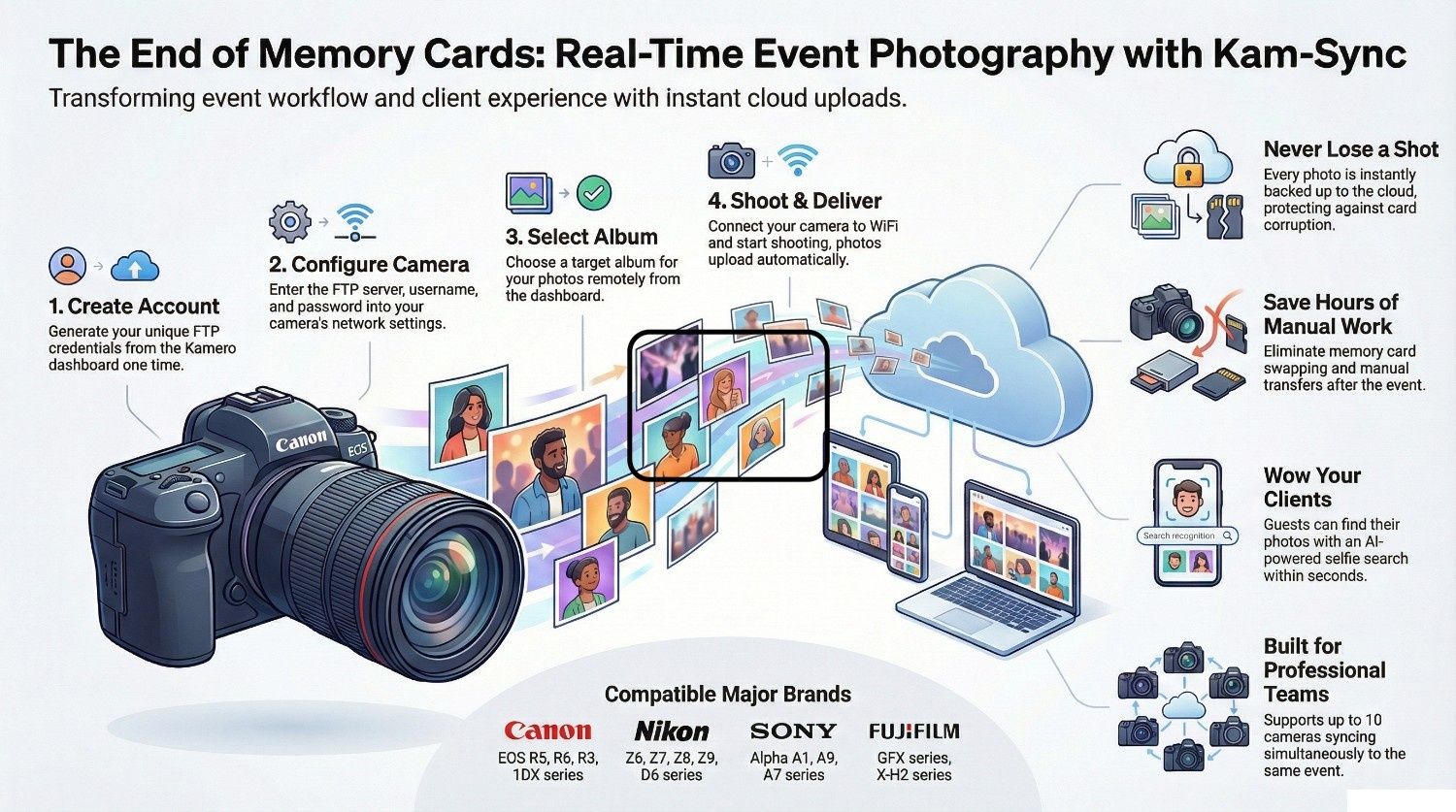
Real-time uploading only works when the entire system is built to handle scale—discovery, organization, and controlled access.
That’s where Kamero functions as more than storage. It’s a guest-centric event photo distribution software, designed for high-volume events and live workflows—especially when paired with Kam-Sync (camera-to-cloud uploads).
How Kam-Sync works (in plain terms)
- You create a Kam-Sync account in your dashboard (you can create up to 10 accounts for multiple cameras or team members).
- You configure your camera once using FTP credentials (host + port + username + password).
- From that moment, photos upload automatically as you shoot—no manual transfers, no card swapping.
- You can choose where photos land: either in the Kam-Sync Album (review-first, hidden until you publish) or directly into a specific album like “Ceremony” / “Reception” (instant publishing).
This workflow delivers speed without sacrificing creative or client control—exactly what professionals expect from modern wireless tethering for event photography.
Multi-device setups that actually fit real events
If you’re running multiple shooters or multiple cameras, you can assign different Kam-Sync accounts like:
- “Main Camera – Stage”
- “Candids”
- “Portraits”
Each stream uploads into its own album automatically. The gallery stays organized from the start—no late-night sorting marathons. This is how AI photo sorting for live events and workflow design work together to reduce chaos.
What guests get
Guests benefit from faster discovery through AI face recognition (selfie-based), a mobile-first viewing experience, and privacy controls—so real-time delivery stays fast and safe.
Now picture this: a wedding with 15,000+ photos while the event is still live

Large weddings routinely generate 15,000+ images across multiple functions.
In traditional workflows, that volume becomes tomorrow’s problem. Uploading starts late. Delivery follows after excitement cools.
In a camera-to-cloud workflow, volume is handled differently:
- Photos upload continuously instead of in one painful batch
- Galleries build throughout the event
- Albums can be published phase-wise (teasers, functions, highlights)
- Guests access photos sooner, on mobile, without confusion
- Teams focus on shooting—not transferring and firefighting
This is why platforms like Kamero are considered among the best photo gallery solutions for high volume events. Delivery doesn’t feel delayed—because it already started.
Try Camera-to-Cloud with Kam-Sync
Want to experience real-time delivery instead of reading about it? 🚀
See how camera-to-cloud works with Kam-Sync
Set up Kam-Sync, connect your FTP-enabled camera once, and watch photos upload automatically as you shoot—no card swaps, no late-night transfers, no backlog.
Create your Kamero account and head to Kam-Sync in the dashboard to start your first camera to cloud event photography workflow.
About Tanuj Thakkar
Hi! I’m Tanuj Thakkar – a BCA graduate from St. Xavier's College, Ahmedabad, with an endless curiosity for people, ideas, and stories. I’m passionate about sales, marketing, and finding creative ways to connect with people. Nothing excites me more than understanding what makes someone tick and turning that into solutions that actually make a difference.
When I’m not diving into strategies or brainstorming ideas, you’ll probably find me exploring new places, geeking out on tech and innovation, or having conversations that spark fresh perspectives.