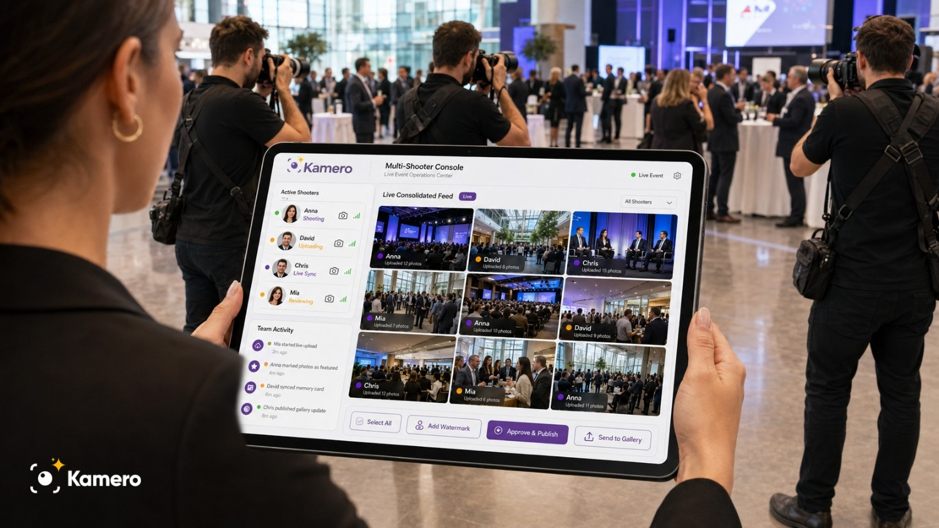
Booking a massive, ten-shooter corporate summit or a sprawling, multi-day luxury wedding is a monumental win for your studio’s revenue. However, if your backend technology does not scale in tandem with your personnel, you are walking into a logistical nightmare.
When you scale an agency from a solo operator to a team of five to ten freelancers, the primary operational bottleneck shifts. The core challenge is no longer capturing the event; the challenge is managing the data pipeline. If ten different shooters are capturing ten different angles across a 5,000-person venue, how do you merge that data into a cohesive, premium product?
Without enterprise-grade infrastructure, the client experience becomes disjointed. Clients end up receiving their photos in staggered, inconsistent batches based on who shot them and when their SD cards were ingested, rather than experiencing a unified, chronological narrative. True multi-photographer event management requires abandoning the archaic use of fragmented physical hard drives and migrating your entire agency to a centralised, cloud-based ingest platform.
Centralising the Ingest: Avoiding the SD Card Shuffle
The traditional method of data wrangling at massive events introduces severe physical and logistical risks. At the end of a grueling fourteen-hour shoot, the last thing your team should be doing is sitting in a hotel lobby at 2:00 AM, passing around 15 different tiny memory cards to a single exhausted data wrangler.
This "SD Card Shuffle" is a massive liability. Physical memory cards changing hands in chaotic environments are easily misplaced, corrupted, or overwritten. Furthermore, this linear ingestion process completely paralyses your post-production pipeline. Your remote editors and the corporate PR teams are left waiting idle until the physical cards are dumped, imported into Lightroom, and exported.
To operate at a high level, agencies must deploy a system to instantly consolidate event photos into a single master cloud repository from multiple devices simultaneously. By utilising live FTP ingestion pipelines, your team bypasses the physical handover entirely. Photos stream from individual cameras directly into a unified cloud folder, allowing your editors to begin grading and delivering assets while the photographers are still actively shooting on the venue floor.
Role-Based Access: Makers, Checkers, and Admins
When you deploy a large team of freelance contractors, your software hierarchy must reflect a corporate structure. Sharing a single master password to a generic cloud drive is a catastrophic security risk. You do not want a junior second-shooter accidentally deleting a critical folder, nor do you want your remote editing team locked out because they cannot authenticate a two-factor SMS code.
Basic cloud storage solutions typically operate on an "all-or-nothing" access model, which is fundamentally incompatible with a structured wedding photography team workflow. To secure your agency's assets, you must implement strict Role-Based Access Control (RBAC):
- Makers (Photographers): Freelance shooters are granted "upload-only" permissions. They can push their RAW or JPEG files directly to the ingest server via their camera's FTP, but they cannot delete, alter, or download the master archive.
- Checkers (Editors & QA): Your post-production team is granted access to cull, colour-grade, and organise the incoming files. They curate the chaos into a polished gallery but cannot publish the final links to the client.
- Admins (Studio Owners): The lead creative director retains absolute control. Admins approve the final edits, manage the financial storefront, and deploy the delivery links to the client.
This compartmentalised approach protects the master gallery and ensures strict client privacy, all while enabling seamless, asynchronous team collaboration across different time zones.
Real-Time Quality Control During the Event
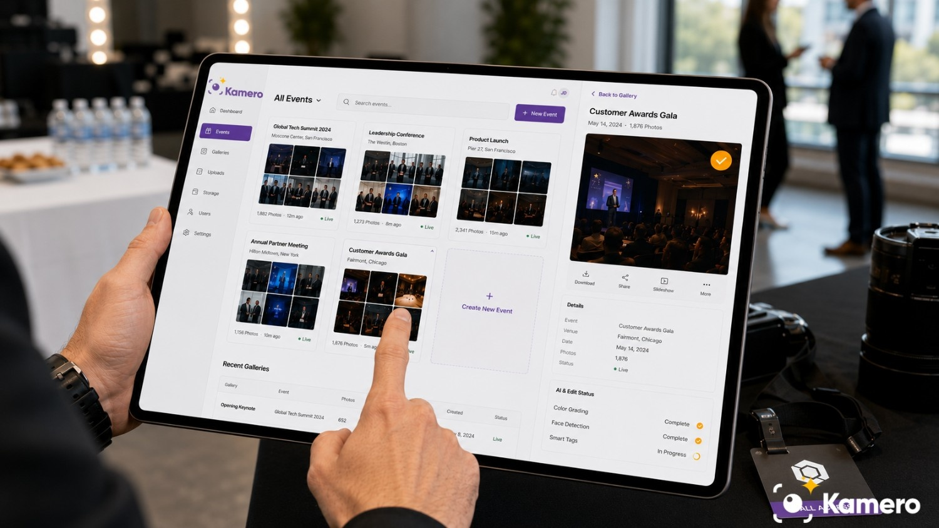
One of the most persistent anxieties for a Studio Head is the "blind spot" of delegation. When you dispatch junior shooters to cover the cocktail hour while you handle the bride's portraits, you have no way of knowing if they are actually capturing the required shot list until the event is already over. You cannot fix a missed VIP shot or a badly exposed sequence tomorrow.
By transitioning your workflow to the cloud, you transform your ingestion software from a passive post-event storage locker into an active management tool. Real-time cloud syncing acts as a live "Director's Monitor."
As images from your entire team trickle into the cloud, the Lead Photographer can pull out an iPad in the green room and instantly review the incoming feeds. This allows you to proactively manage event photographers remotely. If you notice a second-shooter’s white balance is drastically off, or that they are missing wide venue shots, you can text them a correction while the event is still live. This real-time quality control ensures absolute brand consistency, exposure accuracy, and comprehensive coverage across all zones of a massive venue.
Competitive Advantage: Kamero’s Enterprise Controls
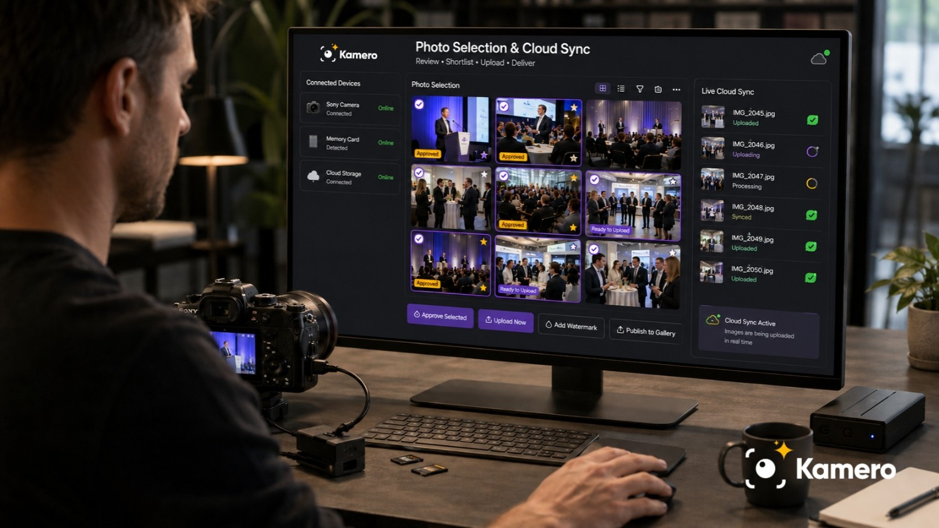
Basic AI photo-sharing apps (such as Kwikpic or Samaro) are built for consumers sharing party photos. They are fundamentally unequipped to handle professional agency demands. When ten high-resolution cameras attempt to upload thousands of files concurrently to a consumer app, the servers frequently throttle the bandwidth, crash entirely, or scramble the EXIF metadata.
Kamero is engineered specifically for the enterprise environment. Our robust backend architecture easily handles massive, concurrent uploads from multiple Kam-Sync FTP connections without bottlenecking, bringing order to your operational chaos.
Collaborative galleries with individual uploader tracking and unified branding.
Kamero provides the precise administrative controls required to scale a media agency efficiently:
- Contractor Accountability: Kamero features deep tracking metrics. Studio Owners can see exactly who uploaded which photo. If a client requests a specific edit on an image, or if you need to calculate performance-based contractor payouts, the dashboard makes QA completely frictionless.
- Unified Output: Despite having ten different people shooting on ten different camera bodies, Kamero ensures the final client gallery is delivered under one cohesive umbrella. The entire digital interface is 100% white-labelled to your Studio Brand, masking the multi-shooter logistics and maintaining the elite prestige of your agency.
Stop letting your software limit the size of the contracts you can accept. Equip your team with the infrastructure built for the enterprise.
Stop sharing passwords and risking lost SD cards. Start your free Kamero trial today to secure your team's ingest process with Kamero’s role-based access and real-time syncing.
End the 2:00 AM SD card shuffle. Consolidate your workflow with Kamero and empower your team to start delivering massive, multi-shooter events faster and more securely than ever before.
Follow us on Instagram for daily tips on scaling your studio:@kamero.ai

About Mayank Oraon
Hi, I’m Mayank, an MBA student exploring the business world with a focus on operations, supply chain, and product strategy (aka the parts of a business that keep things from quietly falling apart).
I’m interested in understanding how systems actually run behind the scenes- and why they sometimes don’t. I also enjoy simplifying complex ideas - partly because it helps others, and partly because if I can’t explain it simply, I probably didn’t understand it in the first place (which is a humbling but effective feedback loop).