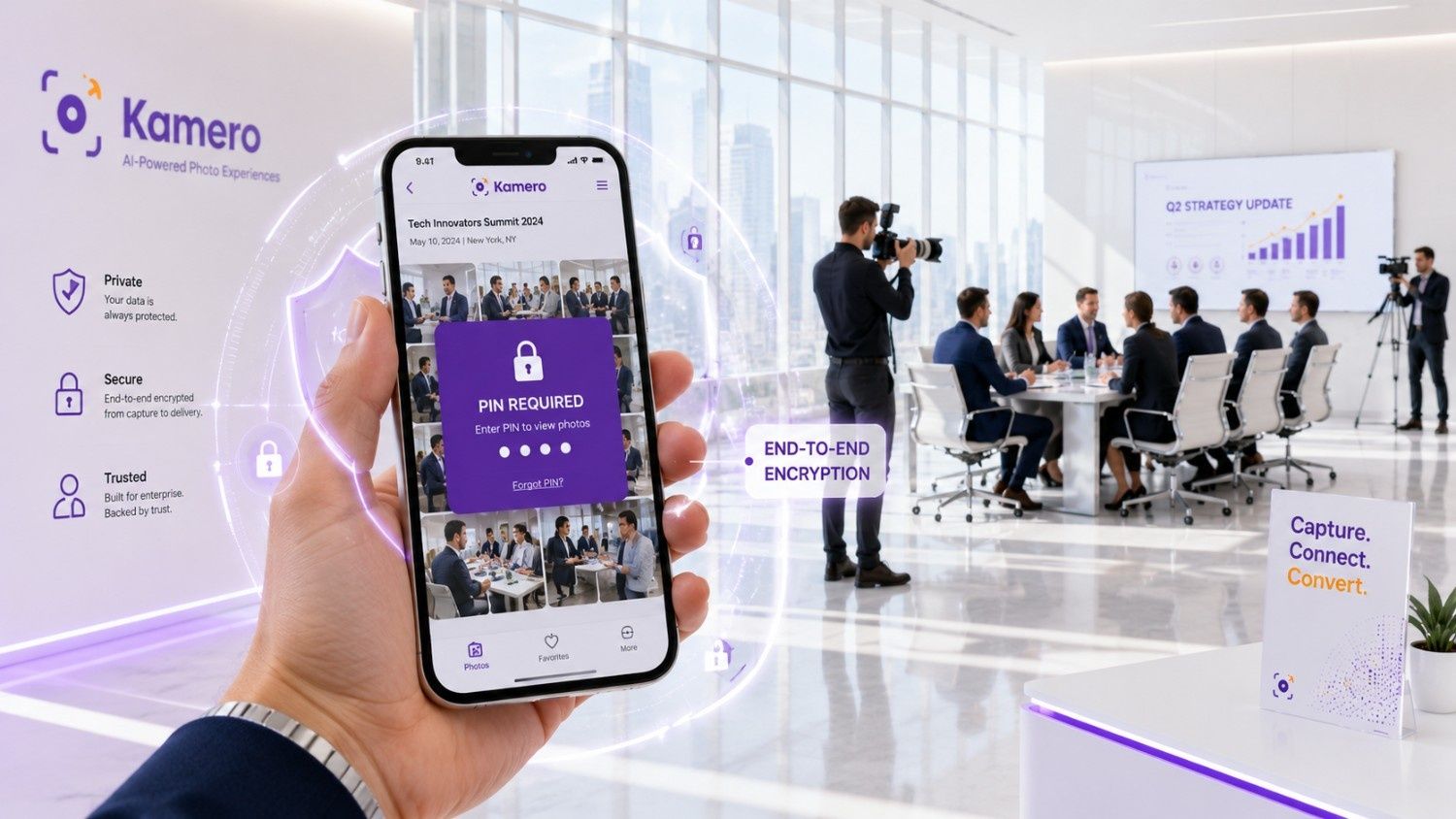
For the modern enterprise, a corporate summit or internal board meeting is a high-stakes environment where data is the most valuable currency. While event photography is essential for branding and internal culture, it often creates a significant "Security Gap." In an age of stringent global privacy laws and aggressive data harvesting, traditional photo-sharing links are no longer just a convenience—they are a liability.
In 2026, IT directors and compliance officers are looking beyond the aesthetic of the gallery. They are demanding enterprise data security in photography that matches the rigors of their existing tech stack. The shift from "open links" to "governed access" is no longer optional; it is a prerequisite for doing business with the world’s leading firms.
The Hidden Risks of Traditional Corporate Photo Delivery
Most legacy photo-sharing platforms were built for consumer use, not for the high-security requirements of a Fortune 500 company.
Public Link Vulnerabilities
The "anyone with the link" model is an unacceptable risk for internal corporate events. If a link to a private strategy session or a leadership retreat is leaked, the company’s internal culture and sensitive discussions are exposed to the public web. Without authenticated access, there is no way to "un-share" those assets once they enter the wild.
Data Scraping and AI Training
There is a growing fear among corporate entities regarding third-party AI scrapers. Publicly accessible galleries are frequently indexed by bots that harvest faces for facial recognition training or data brokerage. For an enterprise, having its employees' or executives' faces scraped into a third-party database is a direct violation of personal privacy and corporate security protocols.
Shadow IT and "WhatsApp Bots"
When a company fails to provide a secure, vetted tool for photo sharing, employees often turn to "Shadow IT"—unvetted personal apps or WhatsApp bots. These tools often lack encryption and data sovereignty, meaning sensitive company imagery lives in unmanaged chat histories, completely outside the control of the IT department.
Implementing Enterprise Data Security in Event Photography
Bridging the security gap requires a shift toward secure corporate photo sharing that prioritizes data integrity over simple social virality.
Understanding Data Sovereignty
In a globalized economy, where your photos are stored matters. Enterprises must ensure that media assets are hosted in compliance with regional mandates like GDPR or CCPA. Enterprise data security in photography means having the ability to specify data residency and ensuring that metadata is handled with the same care as the image itself.
End-to-End Encryption
Data is most vulnerable when it is in transit. A professional workflow must ensure that files moving from the camera to the cloud are protected by end-to-end encryption. This prevents interceptable data leaks, ensuring that the journey from the photographer's shutter to the attendee’s device is a closed, secure loop.
Corporate Event Data Protection
Modern event marketing requires a proactive approach to attendee consent. Using a secure platform allows for the integration of media release forms and consent toggles directly into the gallery access flow. This creates a digital audit trail of corporate event data protection that shields the organization from future legal liabilities.
The Multi-Level PIN Privacy Model: A New Standard
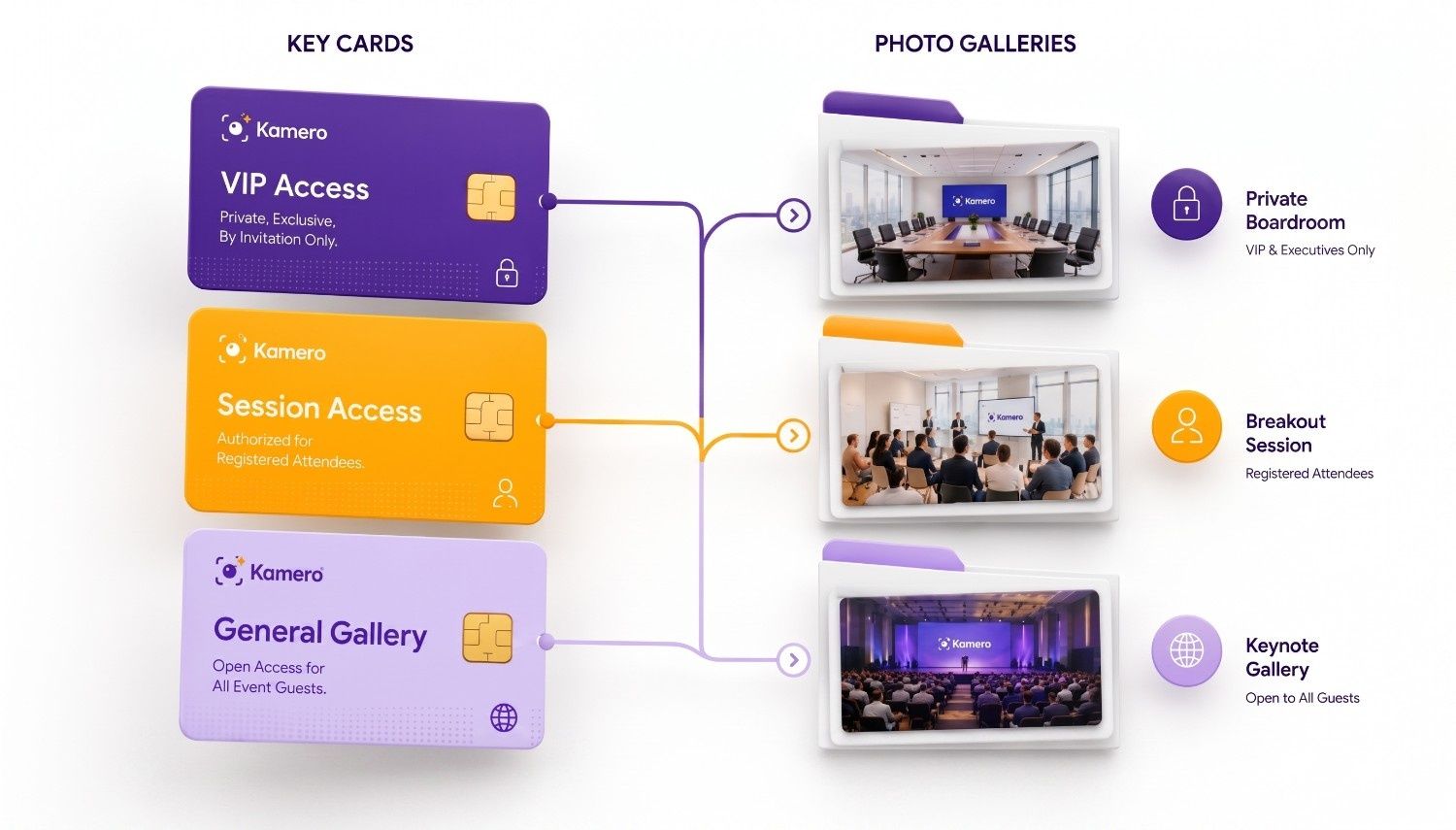
To manage the complex hierarchies of a corporate event, a "one-size-fits-all" password is insufficient. The industry is moving toward a multi-level PIN privacy model.
Tiered Access Control
Not every attendee should see every photo. Multi-level PIN privacy allows administrators to segment the gallery. For example, a "General Access PIN" might allow attendees to see their own shots from the keynote, while a "VIP PIN" or "Executive PIN" is required to view photos from the private board dinner or strategy breakout sessions.
Expiring Links and Geofencing
For high-security meets, access shouldn't last forever. Secure platforms now offer "Time-Bound Access," where links automatically expire after the event concludes. Additionally, geofencing can restrict photo discovery so that face-matching and downloads only function while the user is physically within the venue’s perimeter.
Audit Trails for Compliance
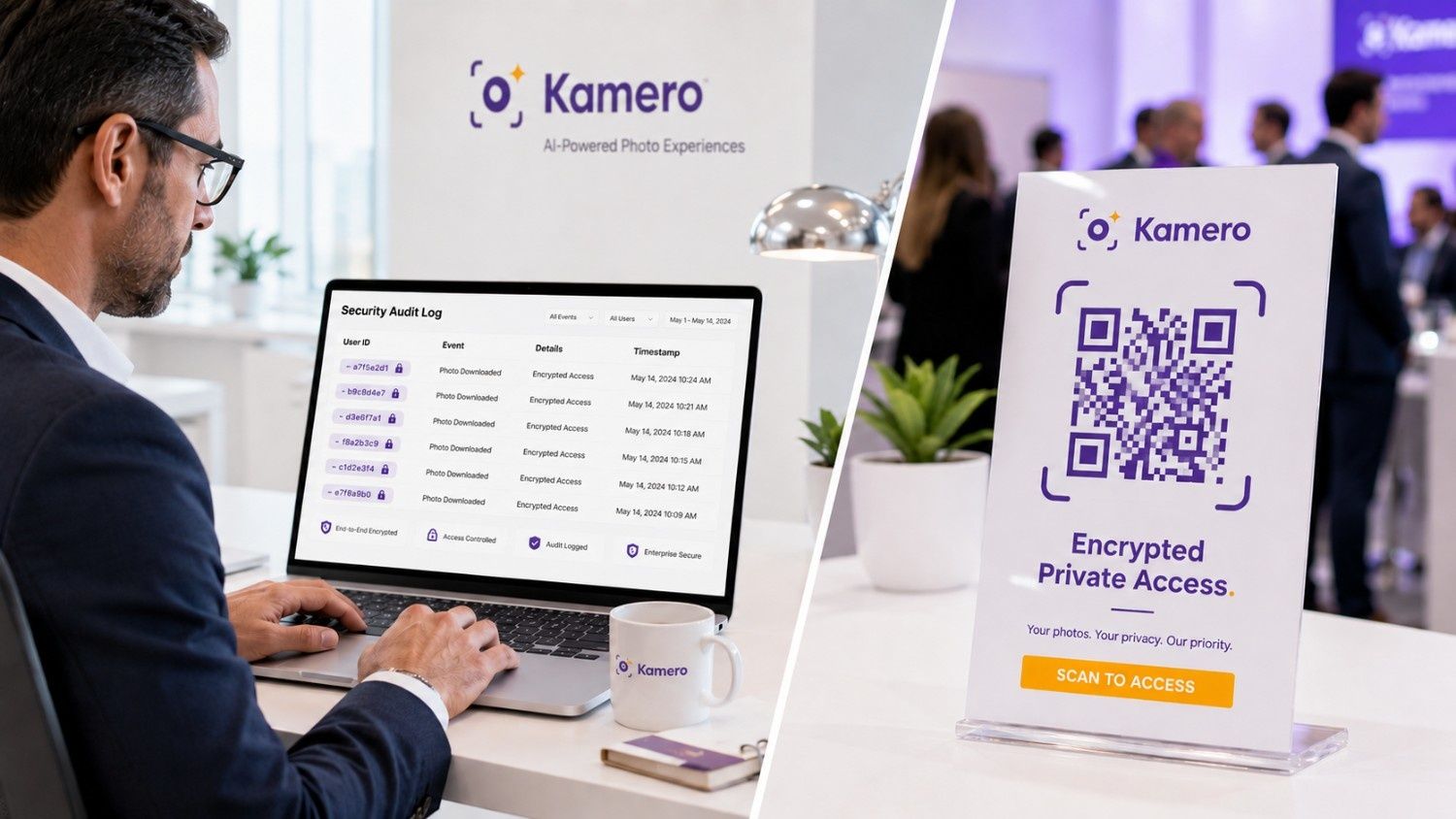
Transparency is the backbone of security. Corporate compliance teams now demand audit trails—detailed logs of who accessed the gallery, which photos were downloaded, and when the interactions occurred. This level of accountability is what transforms a simple gallery into an enterprise-grade asset.
The Kamero Advantage: Why We Outperform the Competition in Security
Kamero was built from the ground up to satisfy the rigorous demands of enterprise IT directors.
- Kamero vs. Samaro: Samaro’s social-first approach is optimized for virality and guest "vibes." Kamero is built for governance. We offer the granular, multi-level PIN controls and administrative oversight that social-heavy platforms simply lack.
- Kamero vs. Kwikpic: Kwikpic focuses on "Public Recognition" and wide-scale sharing. Kamero specializes in Private Discovery, ensuring that AI face-matching occurs within a closed, secure loop that the enterprise admin fully controls.
- Kamero vs. Fotoowl: While Fotoowl focuses on the photographer's upload speed, Kamero focuses on the Client’s Safety. We provide the "Security Whitepaper" level of documentation and technical confidence that enterprise-level procurement teams demand.
Case Study: How a Fortune 500 Firm Used Kamero for a Global Summit
The Challenge
A leading global financial firm hosted a summit across three continents, capturing over 10,000 photos across 50 breakout sessions. Because many sessions involved non-disclosure agreements (NDAs), the firm needed a way to share photos with 2,000 attendees without risking a single "unauthorized" share of sensitive presentation slides or VIP interactions.
The Solution
The firm utilized Kamero to implement secure corporate photo sharing via localized, session-specific QR codes. They deployed multi-level PIN privacy, ensuring that only the respective session attendees could access their specific galleries. Every guest used a one-time-use PIN tied to their corporate email.
The Result
The summit achieved zero data breaches and received a 100% compliance rating from the internal IT audit. Attendees received their professional photos instantly through face-matching, but the firm maintained absolute control over the data lifecycle.
Conclusion: Prioritizing Privacy Without Sacrificing Experience
Securing your event photography does not have to mean slowing down the guest experience. By moving to a model that prioritizes corporate event data protection, organizations can provide the magic of instant delivery without the catastrophic risks of public links. In 2026, the best event experiences are those where the attendees feel both celebrated and protected.
Don't compromise on security. Download our Enterprise Security Brief and see why Kamero is the trusted choice for corporate events.
- Download the Kamero Enterprise Security Brief – Learn more about our encryption and data sovereignty standards.
- Follow us on Instagram @kameroapp for updates on secure event technology and AI discovery.

About Nidhi S
Hey there! I’m an MBA student with a keen interest in the evolving world of digital marketing and business strategy. I enjoy exploring how brands build their online presence and the creative process behind turning strategic goals into engaging stories.
When I’m not caught up in marketing trends, you’ll probably find me down a YouTube rabbit hole or binge-watching sitcoms. I’m a fan of good stories—whether they’re in a marketing campaign or a 20-minute TV episode—and I’m always looking for new perspectives to keep things interesting!