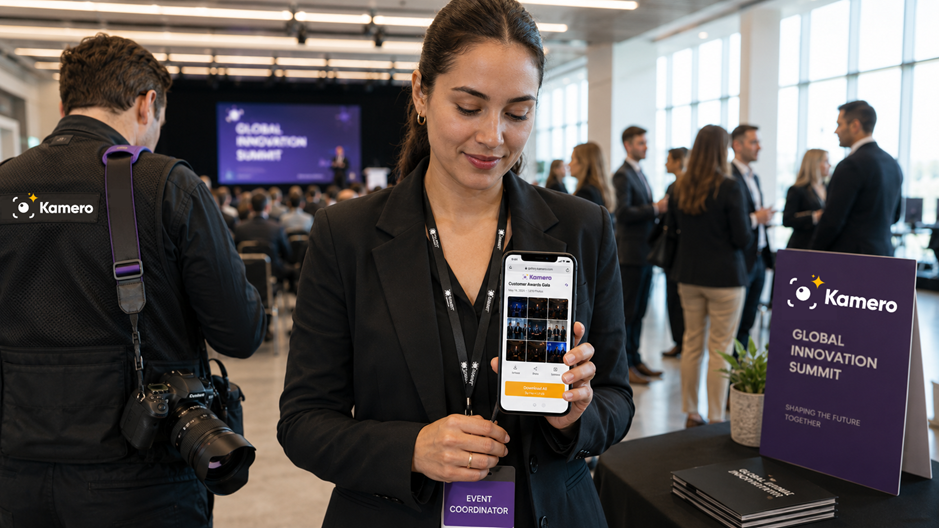
The era of sending a Google Drive or Dropbox link 48 hours after an event is effectively dead. In 2026, enterprise clients, luxury wedding planners, and high-stakes event organizers expect an immersive digital experience, not a digital dumping ground. For the modern photographer, the delivery method is no longer a post-script—it is a core component of the product.
When you deliver a gallery via a basic cloud drive, you aren't just sending files; you are sending a chore. You are asking a busy event organizer or an exhausted bride to act as a middleman, sorting through thousands of images to find specific moments. In a world where client photo sharing expectations are dictated by the speed of social media, "eventually" is no longer an acceptable timeline.
The Massive Shift in Client Photo Sharing Expectations
The Problem with the "Link Dump"
Dumping 5,000 unorganized photos into a cloud folder is the fastest way to kill post-event engagement momentum. When guests receive a generic link, they are immediately hit with "scroll fatigue." Most will look at the first twenty images, fail to find themselves, and close the tab.
Organizers have realized that engagement is the currency of events. If the photos aren't easily accessible, the event’s social reach dies in the cloud. A folder is a storage unit; a modern gallery is a distribution engine.
The PR Delay: Why Next-Day Photos Are Too Late
In 2026, the digital conversation happens in real-time. Attendees want to post their highlights before they even leave the venue. When a photographer takes 48 hours—or even 12 hours—to "upload to the drive," they have missed the viral window. Organizers now demand that high-quality, professional imagery be available for PR teams and VIP guests while the event energy is still at its peak. Speed is the new quality.
Understanding Modern Event Organizer Photo Requirements
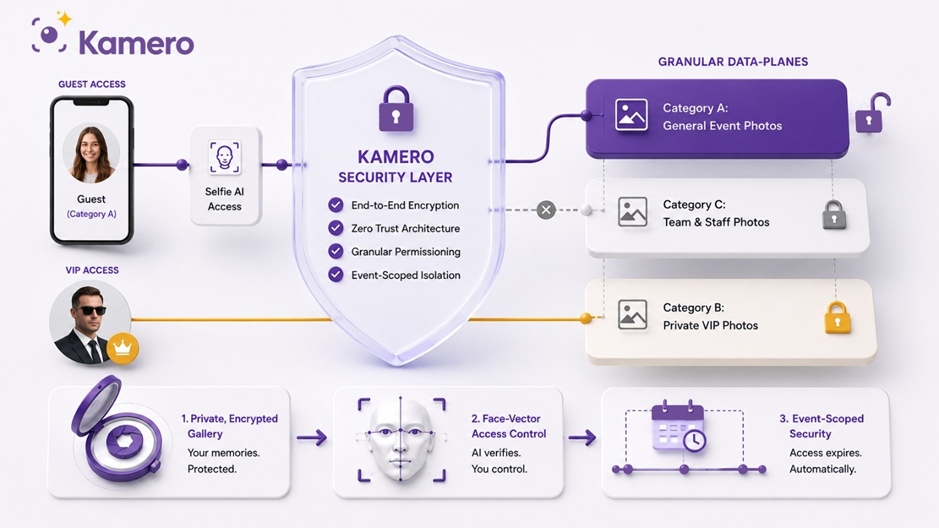
If you look at modern RFPs (Request for Proposals), event organizer photo requirements have become significantly more technical. They are looking for partners who can handle data with the same sophistication as a SaaS company.
Strict Data Privacy & VIP Security
Public drive links are a massive liability. For corporate offsites containing sensitive IP or high-profile weddings with celebrity guests, "security by obscurity" (hoping no one finds the link) is not enough. Organizers now require private, encrypted, and event-scoped access. They need to know that a guest in Category A cannot see the private VIP photos in Category B. Basic cloud drives simply cannot offer this level of granular permissioning.
Frictionless Attendee Distribution
The modern organizer refuses to be a distribution hub. They do not want to receive 500 emails from guests asking, "Where can I find my photo?" They expect a system that handles distribution automatically. The professional photo delivery standard in 2026 mandates a self-serve model where the technology does the work of identifying and notifying the guest, removing the administrative burden from the planner.
The Kamero Advantage: Ditching Consumer Apps for Enterprise Tech
While basic drives and consumer-grade apps like Kwikpic or Samaro focus on simple file transfers, Kamero provides a premium ecosystem built for professional scale.
Face-Matching vs. Folder Hunting
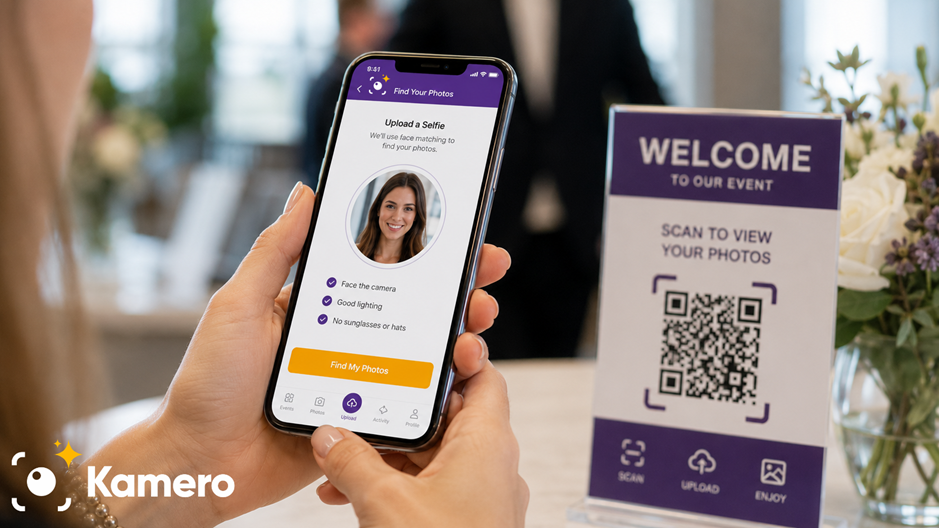
Kamero utilizes the most advanced AI photo tools for events to eliminate the manual search. Instead of a guest hunting through folders, our facial recognition instantly delivers a personalized gallery to their device. By matching a simple selfie to the event database, the guest sees only their best moments. This doesn't just save time; it creates a "magic" moment that reflects positively on the photographer’s brand.
Owning the Brand Experience (White-Labeling)
Event organizers hate third-party branding on premium events. When they hire a top-tier photographer, they don’t want their guests seeing "Kwikpic" or "Dropbox" logos. Kamero operates as a silent partner. Our white-label capabilities allow the gallery to look exactly like the organizer's or photographer’s brand, maintaining a consistent high-end aesthetic from the first flash to the final download.
Kam-Sync: Delivering on the Real-Time Promise
The ultimate differentiator is Kam-Sync. Our camera-to-cloud FTP technology allows photos to move from your camera to the cloud in near real-time. This allows PR teams to download edited images for live-tweeting or press releases while the keynote speaker is still on stage. You aren't just a photographer anymore; you are a live media feed.
How to Meet the 2026 Professional Photo Delivery Standard
Upgrading your workflow isn't just about software; it's about business strategy.
- Phasing out basic drives from your contracts: Explicitly state in your contracts that you use "Secure AI-Discovery Portals" instead of "Cloud Links." This positions your delivery as a high-tech service rather than a commodity.
- Pitching AI delivery as a premium upsell: Don't just give it away. Explain to organizers how AI photo tools for events will save them hours of work and increase their event's social ROI. Clients will pay a premium for "Instant VIP Delivery."
Conclusion: Stop Losing Contracts to Tech-Forward Competitors
The gap between "traditional" photographers and "tech-forward" media partners is widening. In 2026, the photographer who delivers the best experience will win the contract over the photographer who merely takes the best photos. By adopting a professional delivery standard, you secure your place in the luxury and enterprise markets.
Ditch the dead links. Elevate your delivery.
Create Your First AI Event Today
Sign Up on Kamero Ditch the dead links. Upload your first 100 photos for free and experience the speed of AI Face-Matching.
Ask Us on WhatsApp
Chat with Our Support Team Have questions about migrating your data or setting up your first event? Chat with us instantly.
Want to see how the pros do it? Follow us on Instagram for daily workflow tips: @kamero.ai

About Mayank Oraon
Hi, I’m Mayank, an MBA student exploring the business world with a focus on operations, supply chain, and product strategy (aka the parts of a business that keep things from quietly falling apart).
I’m interested in understanding how systems actually run behind the scenes- and why they sometimes don’t. I also enjoy simplifying complex ideas - partly because it helps others, and partly because if I can’t explain it simply, I probably didn’t understand it in the first place (which is a humbling but effective feedback loop).