Introduction: When Conference Content Becomes an Operational Challenge
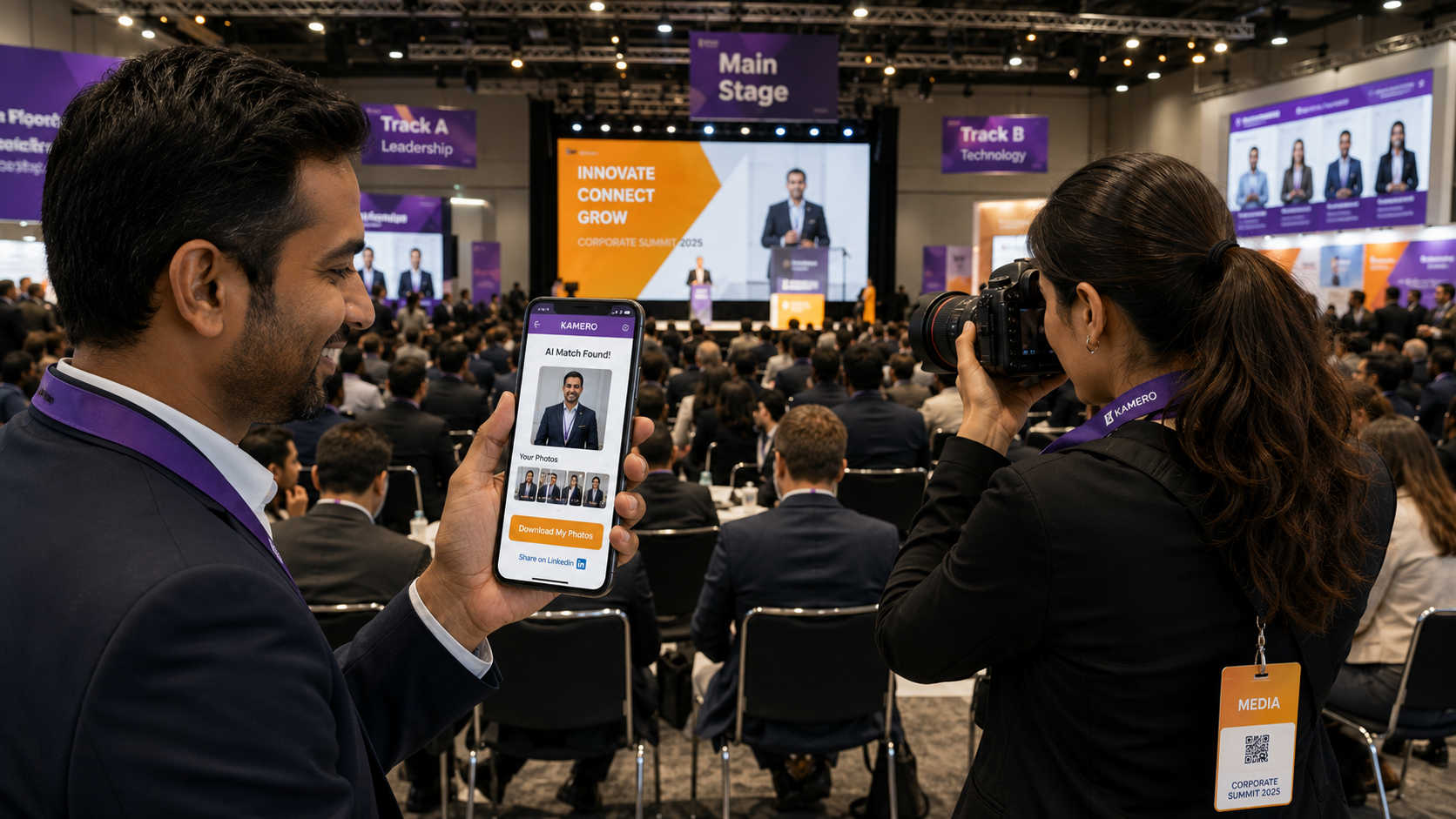
Modern conferences no longer operate from a single stage.
Enterprise summits, leadership forums, technology expos, annual partner conferences, and industry conventions often run multiple keynote tracks, breakout sessions, networking lounges, sponsor activations, media zones, and executive roundtables simultaneously. While this creates richer attendee experiences, it also creates a significant challenge for event organizers: managing the enormous volume of content generated throughout the event.
A single two-day conference can produce tens of thousands of photographs captured by multiple photographers working across different venues and session tracks. Without a structured system, these assets quickly become difficult to organize, search, approve, and distribute.
This is why AI sorting corporate conferences has emerged as one of the most valuable applications of event media technology.
The objective is not simply to store photographs. The goal is to transform thousands of images into organized, searchable, and immediately usable business assets while the event is still generating attention.
For conference organizers, marketing teams, sponsors, PR agencies, and communications departments, the ability to automate conference media workflows can directly impact attendee engagement, sponsor satisfaction, earned media visibility, and overall event ROI.
Why Multi-Track Event Photography Creates Unique Challenges
The Complexity of Simultaneous Content Streams
Unlike weddings or smaller corporate gatherings, conferences generate content from multiple locations at the same time.
One photographer may be covering a keynote presentation while another documents sponsor booths. A third team may be capturing executive networking sessions, while additional photographers work breakout rooms and panel discussions.
By the end of the day, thousands of images exist across multiple devices, memory cards, locations, and timelines.
Without a structured workflow, event teams are forced to manually sort, rename, categorize, and distribute content after the event concludes.
This process consumes valuable time and often delays media distribution during the period when audience attention is highest.
Why Manual Sorting No Longer Scales
Traditional media management methods rely heavily on folder structures, timestamps, manual tagging, and human review.
While these approaches may work for smaller events, they become increasingly inefficient as event complexity grows.
Marketing teams often struggle to locate specific speakers. PR agencies search through hundreds of photographs to find media-ready images. Sponsors wait for branded assets. Internal communications teams request content from multiple departments simultaneously.
The result is administrative overload.
The challenge is not capturing content. The challenge is turning content into actionable assets quickly enough to create value.
Building an AI-Powered Conference Media Workflow
Moving from Storage to Intelligence
Traditional event workflows treat photographs as files.
Modern AI-powered workflows treat photographs as data.
Instead of simply uploading images into folders, intelligent systems can automatically categorize content based on sessions, speakers, attendees, locations, metadata, and event structures.
This dramatically reduces the time required to locate, approve, and distribute content.
For conference organizers, this means marketing teams can access relevant assets immediately instead of waiting days for manual organization.
Automated Conference Photo Sorting at Scale
Large conferences frequently generate tens of thousands of photographs over a short period.
Manual sorting becomes increasingly difficult as event size grows.
AI systems can automatically group related images, organize content by event sessions, classify assets based on participants, and maintain structured media libraries without requiring constant human intervention.
This creates a searchable media environment where stakeholders can locate content quickly regardless of event size.
For enterprise organizations, the value extends beyond convenience.
Faster access to content enables faster communications, stronger social engagement, and better sponsor activation outcomes.
Real-Time Ingestion: The Foundation of Modern Event Media
Eliminating the Traditional Upload Bottleneck
One of the largest delays in event media workflows occurs immediately after content capture.
Photographers traditionally transfer images from memory cards to laptops before uploading them to cloud storage systems. This process introduces delays that can stretch from hours to days.
Modern event infrastructure removes this bottleneck entirely.
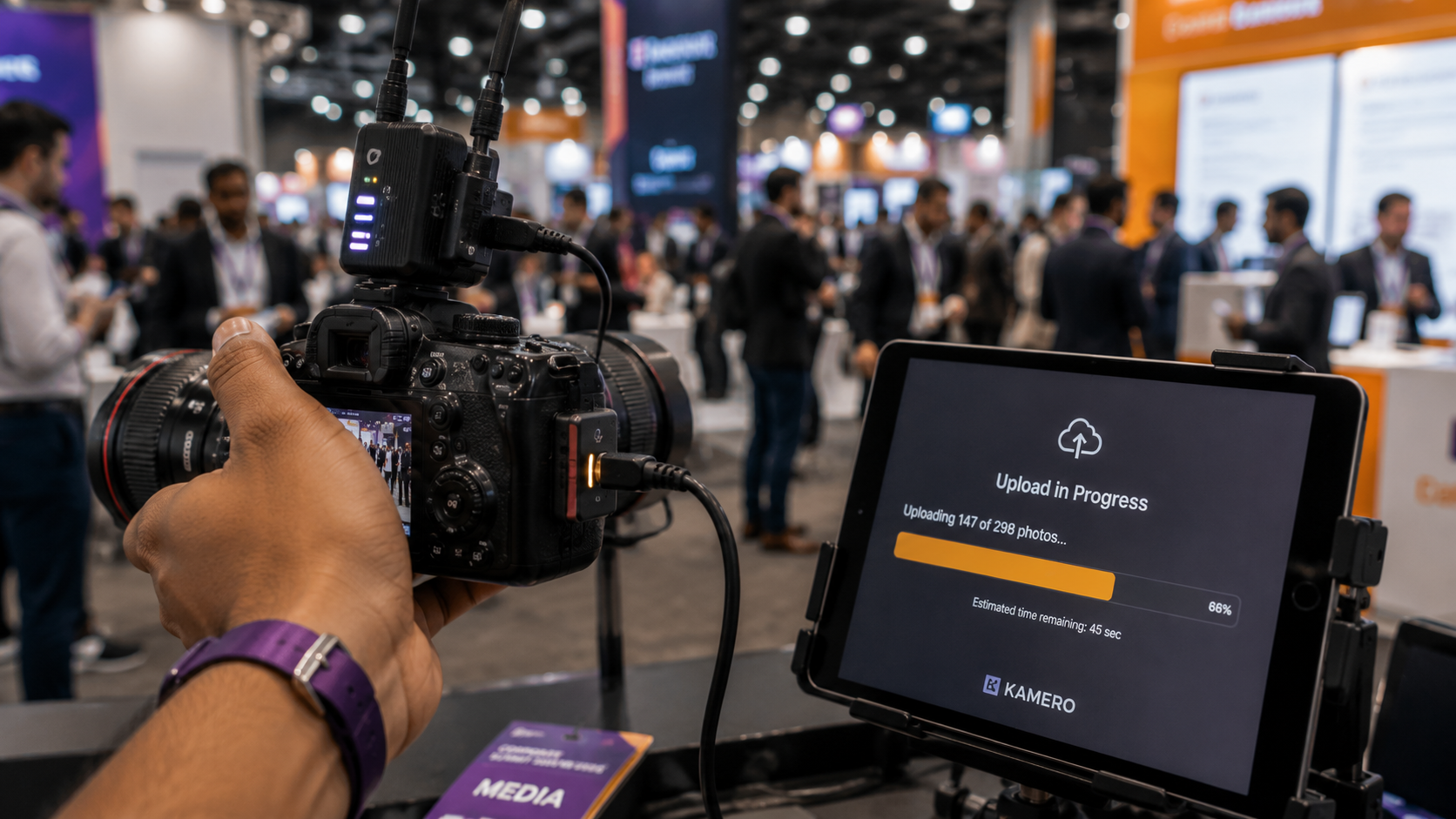
Through camera-to-cloud workflows, images can move directly from professional camera systems into centralized cloud environments while the event is still taking place.
This dramatically shortens the gap between capture and distribution.
Supporting Multiple Photographers Simultaneously
Large conferences rarely rely on a single photographer.
Media teams often consist of multiple photographers covering separate tracks simultaneously.
To support these environments, event infrastructure must handle parallel uploads without disrupting operations.
A scalable system allows multiple shooters to contribute content continuously while maintaining centralized organization and governance.
This creates a unified media environment despite the complexity occurring behind the scenes.
AI Event Media for Attendees, Speakers, and Sponsors
Delivering Relevant Content Faster
Conference attendees increasingly expect rapid access to event content.
Speakers want presentation photos. Sponsors want branded activation assets. Executives want professional headshots and networking coverage.
The challenge is delivering the right content to the right people without requiring manual intervention.
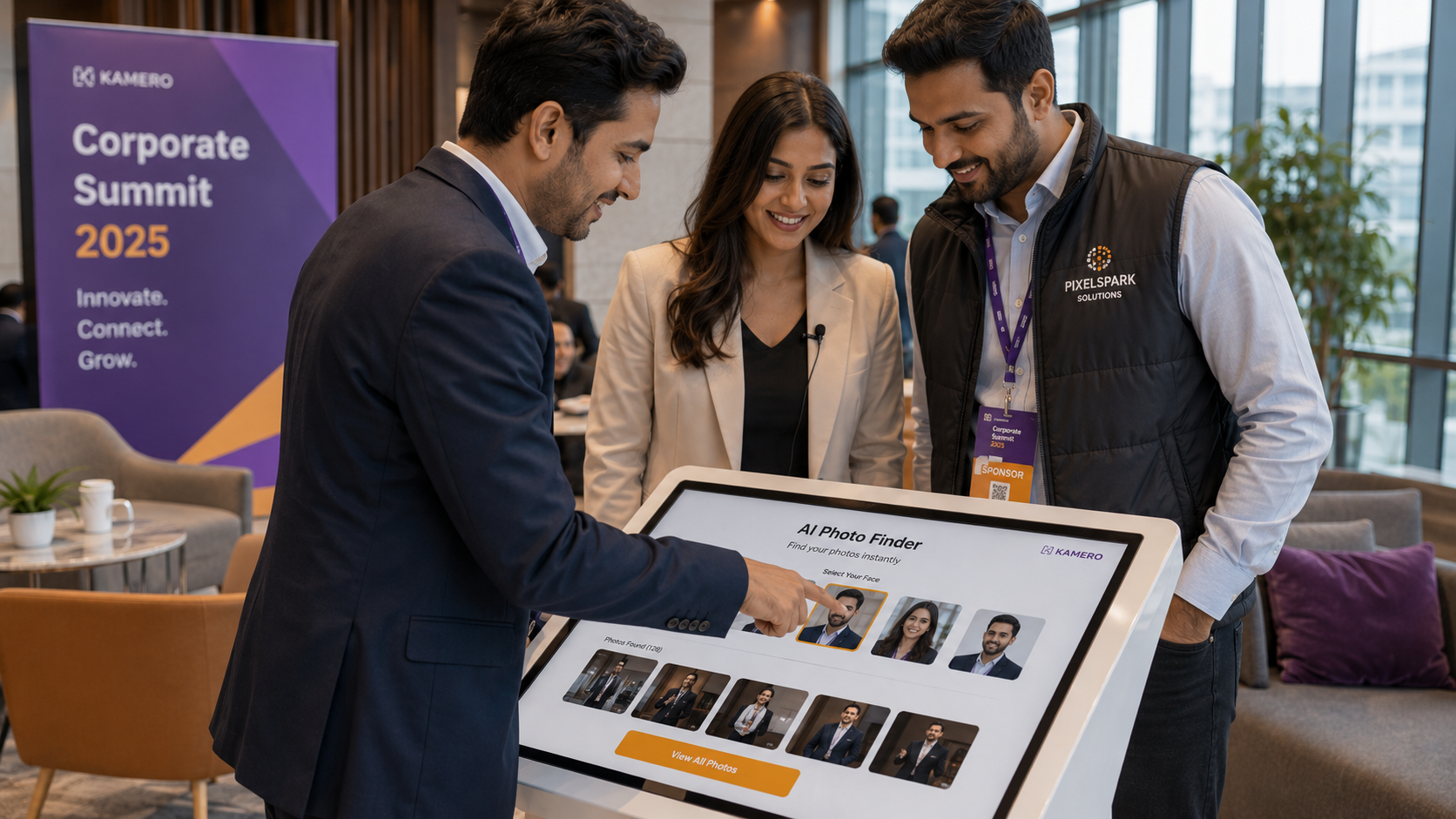
AI-powered discovery systems help automate this process by organizing media around individuals, sessions, and event activities.
Instead of browsing thousands of images, users can quickly locate content relevant to them.
Maintaining Privacy and Enterprise Governance
Corporate events require a higher standard of privacy than consumer events.
Attendee information, executive participation, sponsor involvement, and corporate branding all require careful management.
Modern AI event media platforms address this challenge through event-scoped matching systems, controlled permissions, and governance frameworks that limit access appropriately.
The result is a more secure environment that supports personalization without compromising compliance requirements.
For enterprise events, this balance between convenience and governance is critical.
The Kamero Advantage for Multi-Track Conferences
Designed for Enterprise-Scale Operations
Many gallery platforms were originally designed for consumer events.
Large conferences have significantly different requirements.
They require multiple contributors, centralized governance, sponsor branding, approval workflows, attendee personalization, and large-scale content distribution.
Kamero addresses these challenges through infrastructure specifically designed for complex event environments.
Real-Time Multi-Shooter Ingestion
Kamero's Kam-Sync architecture enables photographers to stream high-resolution files directly from professional cameras into centralized cloud environments through hardware-level FTP workflows.
This allows multiple photographers to contribute simultaneously without relying on delayed browser uploads or manual transfer processes.
Files up to 50 MB can be processed while preserving image quality, enabling enterprise teams to work with publication-ready assets immediately.
Enterprise Governance and Brand Control
Corporate events often involve multiple stakeholders.
Sponsors require visibility. Communications teams require approvals. Brand managers require consistency.
Kamero supports role-based permissions, maker-checker workflows, customizable branding, and dynamic dual-logo watermarking that allows organizations to maintain governance without slowing distribution.
This ensures content remains secure while still moving at the speed required by modern event marketing.
Native Mobile Experiences
Many traditional gallery systems rely entirely on web interfaces.
Kamero extends the experience through dedicated mobile applications that provide faster access, better user experiences, and stronger engagement opportunities for attendees, sponsors, and event stakeholders.
This creates a more professional experience while increasing overall content consumption.
Measuring the Business Impact of Automated Conference Media
Faster Communications and PR Execution
The speed at which media becomes available directly impacts communication effectiveness.
When photographs are accessible during the event, marketing teams can publish content faster, PR agencies can secure media placements sooner, and sponsors can activate campaigns while attention remains high.
This improves the overall value generated by conference content.
Improved Sponsor ROI
Sponsors increasingly expect measurable value from event participation.
Providing rapid access to branded content improves sponsor visibility and increases the likelihood that sponsored assets will be shared across professional networks.
This strengthens sponsor relationships while improving event monetization opportunities.
Reduced Administrative Costs
Manual sorting, organization, tagging, and distribution require significant labor.
Automation reduces these requirements substantially.
By consolidating ingestion, organization, governance, distribution, and reporting into a single system, organizations reduce operational complexity while improving outcomes.
Stronger Long-Term Marketing Assets
Conference media does not lose value when the event ends.
Well-organized media libraries become valuable assets for future marketing campaigns, event promotions, sponsor acquisition efforts, and internal communications.
The easier content is to locate and reuse, the greater its long-term value.
Conclusion: The Future of Conference Photography Is Automated
Conference content volumes continue to grow every year.
At the same time, audiences expect faster access, sponsors expect greater visibility, and communications teams are under pressure to deliver content in real time.
Manual media management simply cannot keep pace with these expectations.
Organizations that adopt automated conference photo sorting and intelligent AI event media workflows gain a significant operational advantage.
They distribute content faster, improve attendee experiences, strengthen sponsor value, and reduce administrative burden.
Most importantly, they transform event photography from a documentation exercise into a strategic business asset.
Ready to Simplify Multi-Track Conference Media Management?
Book a Demo: Click Here
Start Your Free Trial: Click Here
Follow Kamero on Instagram: Click Here

About Mayank Oraon
Hi, I’m Mayank, an MBA student exploring the business world with a focus on operations, supply chain, and product strategy (aka the parts of a business that keep things from quietly falling apart).
I’m interested in understanding how systems actually run behind the scenes- and why they sometimes don’t. I also enjoy simplifying complex ideas - partly because it helps others, and partly because if I can’t explain it simply, I probably didn’t understand it in the first place (which is a humbling but effective feedback loop).