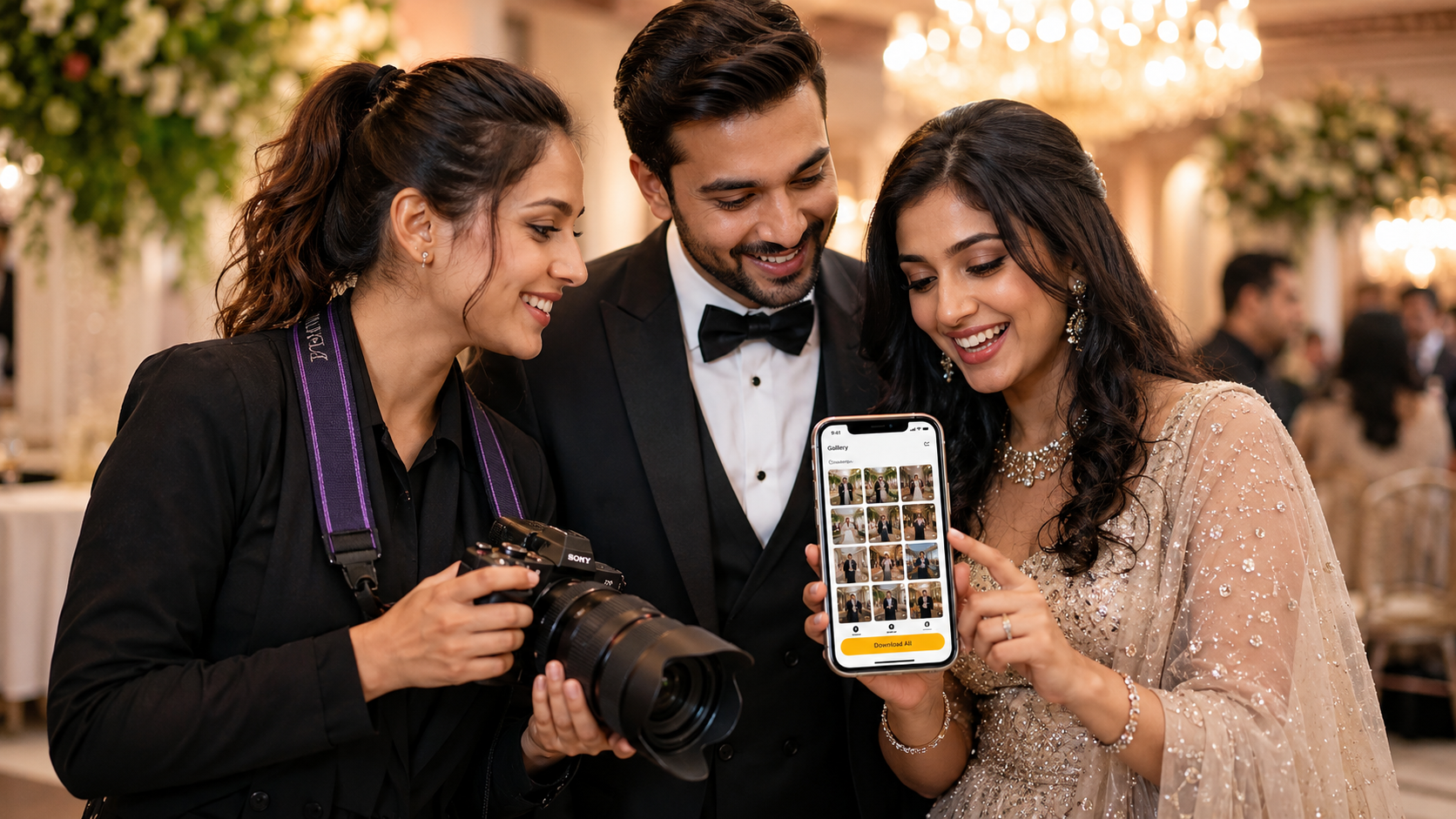
High-volume event production has outgrown traditional delivery mechanics. For decades, professional event studios, production agencies, and enterprise organizers have treated media handover as a fragmented, post-event administrative burden. After spending days capturing thousands of high-resolution RAW assets across multi-day summits, luxury destination weddings, or massive sports arenas, the delivery workflow ground to a halt. The resulting standard became the "link dump"—an unorganized, flat-directory cloud folder containing thousands of mixed files sent to clients weeks after the physical event concluded.
In a mobile-first environment, this delivery lag is no longer viable. Today’s event attendees expect near-zero latency, demanding access to visual assets while the emotional energy of the event is still at its peak. Relying on sluggish manual culling, third-party desktop galleries, and open-loop consumer chat scraping tools introduces severe brand vulnerabilities, kills referral loops, and leaves critical post-event revenue uncaptured.
Transitioning from flat file storage to an automated face recognition photo delivery engine fundamentally transforms media logistics. By integrating high-speed hardware ingestion with localized mathematical vectorization and in-gallery commerce, forward-thinking photography businesses are turning the delivery bottleneck into their most effective engine for inbound customer acquisition and recurring revenue.
The Legacy Ingestion Crisis: Why Flat Folders Damage Premium Brands
The fundamental breakdown in modern photography operations rarely occurs behind the camera lens; it occurs in the post-production pipeline. High-end capture hardware allows multi-shooter teams to generate tens of thousands of frames in a single weekend. However, the software infrastructure used to organize, cull, and distribute these assets has historically failed to scale alongside sensor capabilities.
The Friction of Manual Culling and Multi-Thousand Image Dumps
Dumping massive, unorganized digital folders onto clients creates immediate decision paralysis. When a wedding couple or corporate marketing director receives an unindexed gallery link housing 8,000 mixed images, the burden of discovery is shifted directly onto the client.
- Attendee Cognitive Fatigue: Guests must manually scroll through thousands of irrelevant crowd shots, stage rehearsals, and external guest portraits just to locate the two or three frames featuring themselves.
- Plummeting Engagement: Friction-heavy navigation leads to rapid session drop-offs, drastically reducing gallery revisit rates and organic social sharing.
- Compounding Technical Debt: Production teams spend 15 to 30 unbillable hours per event sorting, flagging, and manually organizing folders instead of shooting new commercial contracts.
The Delivery Lag Cost Matrix and Studio Profitability
The financial impact of traditional delivery lag extends beyond administrative payroll. In the premium event sector, Time-to-Deliver (TTD) serves as a direct indicator of brand value and organic referral generation.
When visual assets are locked in post-production queues for 4 to 12 weeks, the peak emotional momentum of the event evaporates. Attendees move on, marketing teams finalize campaign cycles without your official imagery, and the organic word-of-mouth loop that naturally occurs during and immediately after a marquee event is lost.
Broken Guest Engagement and Client Acquisition Funnels
Static cloud storage directories act as passive data silos. They offer zero native marketing architecture, no dynamic brand attribution, and no mechanism to capture qualified attendee contact details. Every guest viewing an unbranded, generic gallery represents an uncaptured customer lead. Furthermore, failing to integrate an on-gallery digital marketplace eliminates high-margin print sales and personalized download transactions right when user interest is highest.
The Science of the Search: How Smart Photo Clustering Software Changes Everything
To resolve the industrial scaling crisis of media distribution, platforms must move beyond simple EXIF-based sorting and embrace dedicated neural clustering. High-performance smart photo clustering software reengineers raw pixel data into structured, instantly discoverable visual networks.
Deconstructing the Image Processing Pipeline Natively
Visual recognition engines analyze pixel data without storing unencrypted, identifiable facial profiles. The ingestion framework processes native, high-resolution media (supporting lossless source files up to 50 MB) through an encrypted processing queue:
- Landmark Topology Extraction: The neural engine maps micro-spatial coordinates—measuring inter-pupillary distance, cheekbone curvature, jawline angles, and the structural depth of the nasal bridge.
- Vector Coordinate Generation: These geometric landmarks are converted into an isolated mathematical array (a high-dimensional vector embedding).
- Non-Destructive Parallel Clustering: Thousands of vector embeddings are cross-indexed simultaneously against incoming media streams, sorting massive multi-shooter batches in real time without causing processing bottlenecks.
Vector-Based Mathematics vs. Global Biometric Scraping
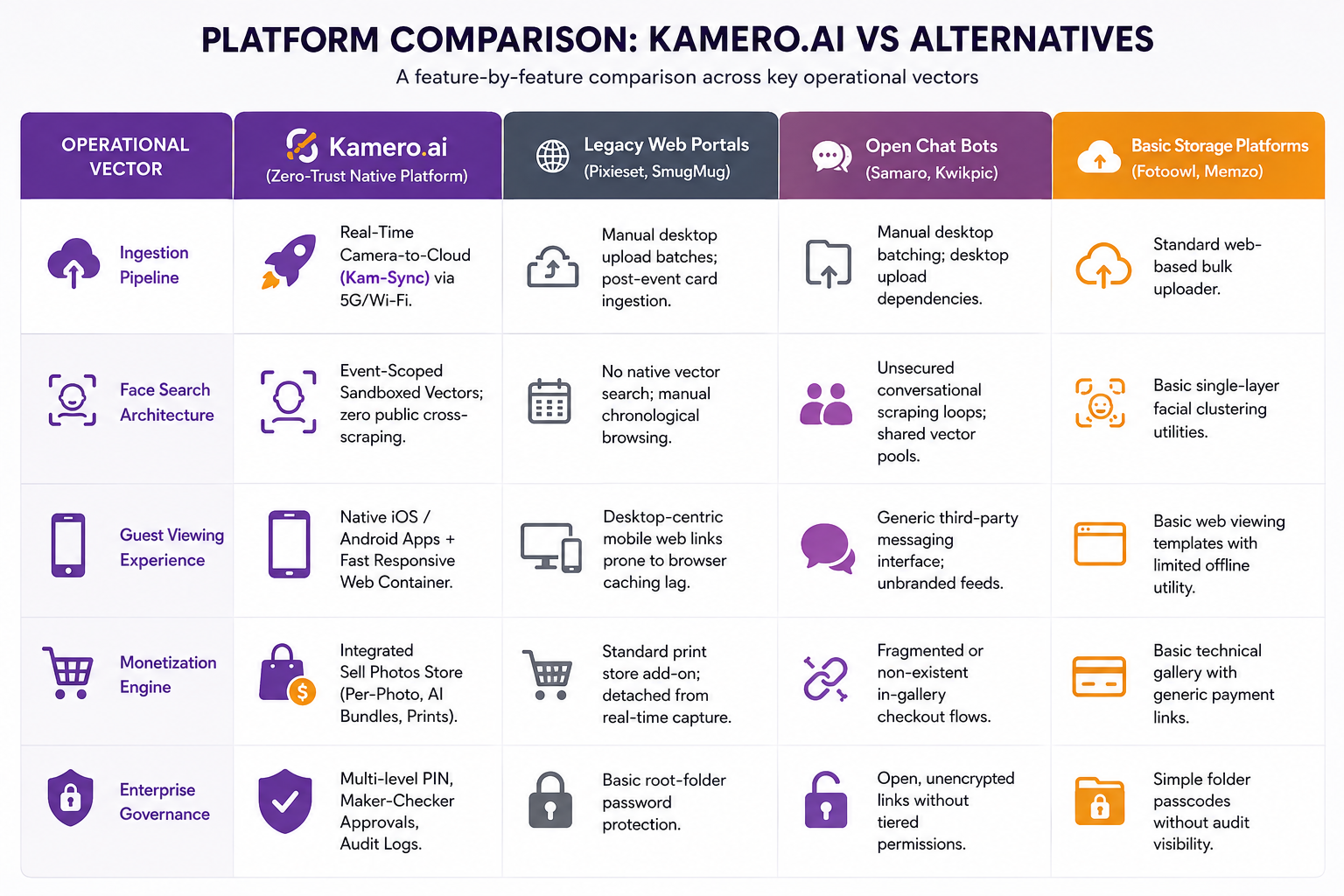
Generic artificial intelligence tools and unvetted consumer chat plugins often utilize open scraping frameworks. These models cross-reference uploaded attendee selfies against broad, multi-tenant public datasets, permanently cataloging consumer biometric data across unrelated databases.
Setting Precision Confidence Thresholds for Flawless Accuracy
Live event production introduces volatile shooting variables: low-light banquet halls, dynamic strobe sequences, heavy backlighting, and partial facial occlusions.
By deploying adjustable confidence scoring parameters, the clustering engine balances strict false-positive elimination against high-recall matching. The result is over 99% facial discovery accuracy across complex multi-camera shoots, ensuring attendees immediately locate their photos without surfacing unrelated guests.
The Real-Time Pipeline: Deploying Kam-Sync from Camera Chassis to Cloud
The primary bottleneck in event photography has always been physical storage media. Relying on physical SD and CFexpress card swaps leaves assets trapped inside the camera body until the production day concludes.
Eliminating Cables with Real-Time FTP Ingestion
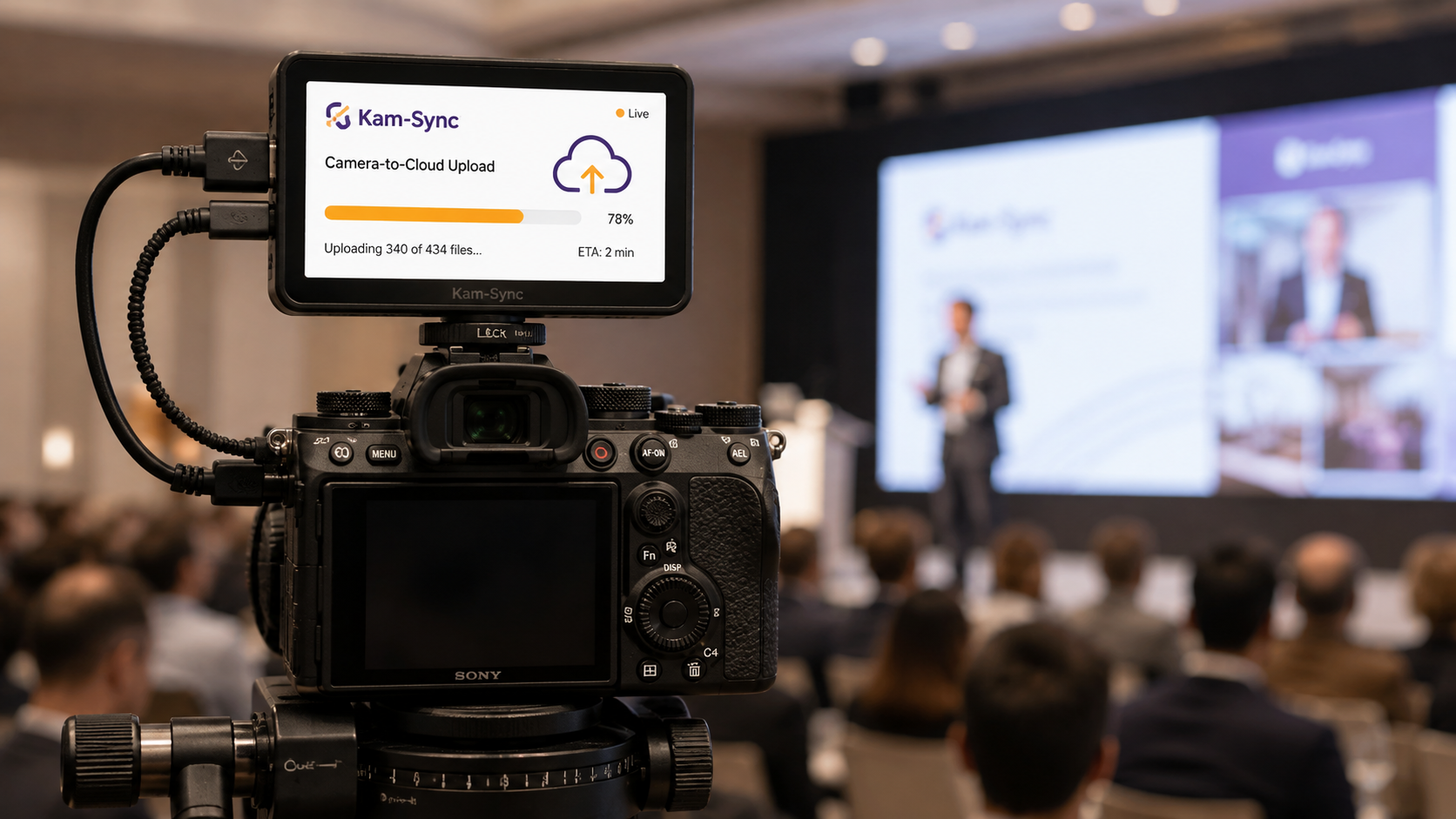
By utilizing Kam-Sync, professional mirrorless camera bodies connect directly to cloud storage endpoints over venue Wi-Fi or high-speed 5G mobile hotspots.
- Shutter Release: The photographer captures an action frame during a keynote, bridal entrance, or race finish line.
- Hardware-Level FTP Stream: The camera chassis pushes the native JPEG or companion file straight to the ingestion server via background FTP protocols.
- Instant Automated Processing: The moment the byte stream lands, automated watermarking, vector extraction, and gallery clustering execute in the background—bypassing overnight manual imports entirely.
Mitigating Network Dropouts in Remote Luxury Venues
Destination wedding resorts, rural retreats, and high-density stadiums frequently suffer from intermittent network drops. Kam-Sync uses smart offline caching and resilient queue management to protect workflow continuity:
- Zero-Loss Retries: If connectivity drops, capture queues automatically buffer in hardware memory and seamlessly resume the moment signal is restored.
- Traffic Management: Systems dynamically balance upload threads to prevent server back-pressure and packet loss during rapid shutter bursts.
- Bandwidth Optimization: Visual metadata and preview proxies upload first to trigger instant AI clustering, while high-resolution print files stream continuously behind the scenes.
Multi-Camera Metadata Optimization and Sorting
Large events require synchronized coordination across multiple operators. The system normalizes disparate camera clocks, organizes chronological timelines across all team members, and maps structured metadata tags instantly. This creates a unified visual timeline before the client or event organizer even accesses the central administrative console.
Designing an AI-Driven Wedding Photo Gallery for High-Net-Worth Clients
High-end private gatherings and luxury weddings require absolute discretion combined with effortless guest usability. Deploying an ai driven wedding photo gallery elevates the client experience from a basic utility to a luxury service touchpoint.
The Self-Serve Selfie: Instant Photo Finder for Wedding Guests
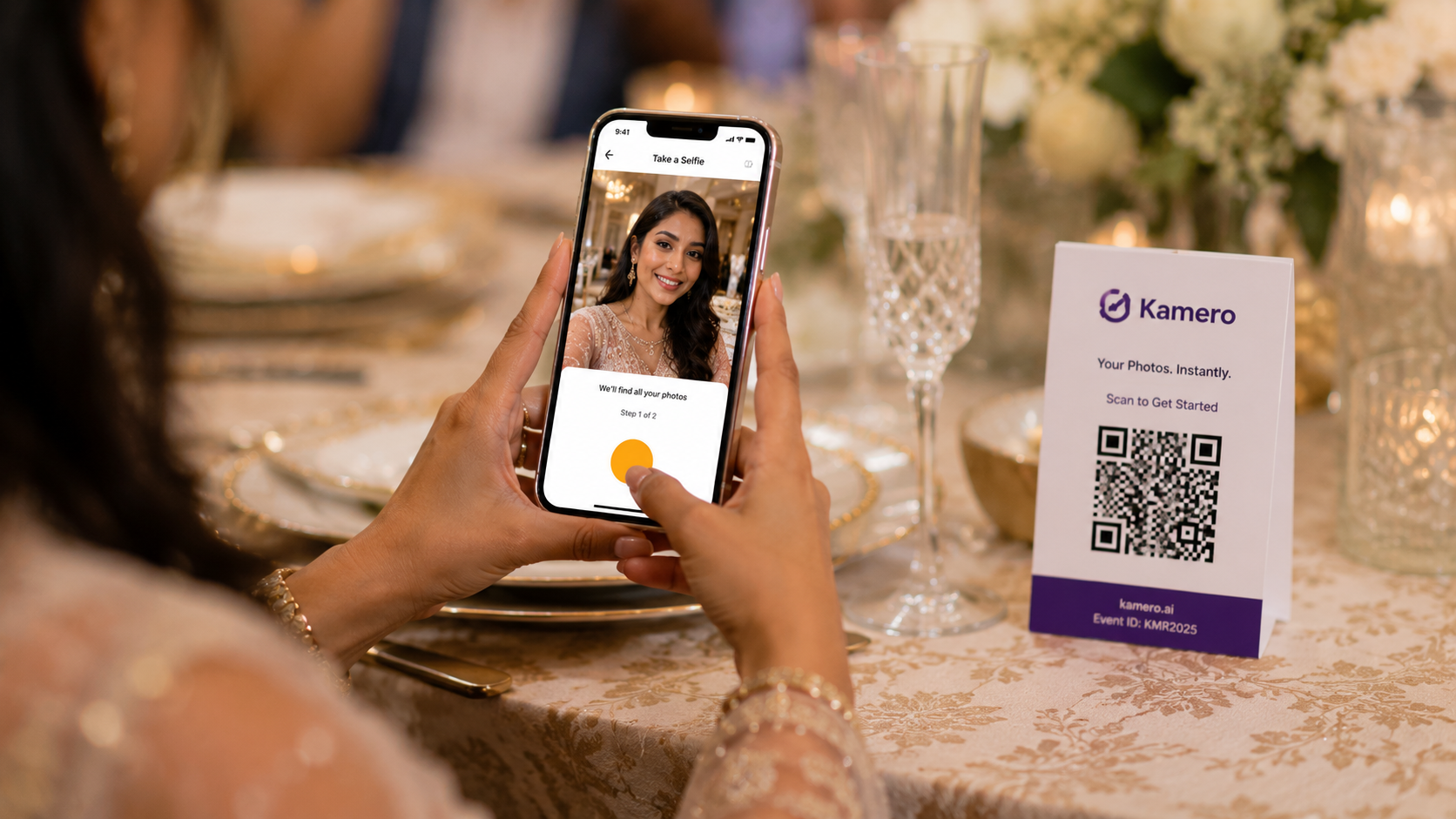
Instead of wading through thousands of images, attendees utilize a device-bound instant photo finder for wedding guests. Guests scan a branded event QR code, capture a quick reference selfie directly on their smartphone, and receive a curated, personalized gallery containing every frame they appear in within seconds.
The reference photo is used exclusively to query that isolated event index; it is never visible to other attendees and is never indexed across external web directories.
Protecting Client Boundaries with Multi-Level PIN Privacy Enclosures
Privacy is non-negotiable for high-profile clients, celebrities, and enterprise leaders. Multi-level PIN controls establish secure access boundaries across distinct sub-galleries:
- VIP & Inner-Circle Enclosures: Sensitive family sessions, bridal prep, and private moments remain locked behind administrative passcodes.
- Public Guest Tiers: Broad reception, cocktail, and venue photos remain accessible to general attendees via standard QR entry.
- Maker-Checker Approvals: Studio leads and event hosts can review and approve sensitive image sets before making them visible across guest dashboards.
Maintaining Platform Integrity with Dynamic Dual-Logo Watermarking
Uncontrolled screenshot piracy devalues professional creative assets. Dynamic watermarking overlays customized studio branding alongside corporate sponsor marks or couple monograms. Watermark scale, opacity, and positioning adjust dynamically across screen sizes, protecting the creator's intellectual property while maintaining crisp aesthetic presentation across mobile viewports.
Unlocking Post-Event Revenue: Integrated Digital and Print E-Commerce
Modern delivery platforms should function as profit centers rather than overhead costs. Built-in commerce tools convert attendee attention into direct revenue while engagement is at its peak.
Capitalizing on Real-Time Engagement Traffic
The likelihood of an attendee purchasing a print or digital download drops sharply with each passing week. By surfacing personalized photos in real time, guests can purchase high-resolution downloads, social media packs, and bespoke prints directly through the native gallery interface.
Maximizing Average Revenue Per User (ARPU) via Dynamic Monetization
Configurable store settings allow organizers and studios to deploy tiered commercial structures tailored to the event format:
- Per Photo Purchases: Individual high-resolution file licensing for editorial, commercial, or personal usage.
- "All My Photos" AI Selfie Bundles: A single-click checkout that bundles every photo identified with the attendee's face into a discounted digital package.
- All Event Photo Passes: Unrestricted media access designed for event sponsors, corporate PR desks, and immediate family members.
- Automated Print Fulfillment: Built-in print lab routing handles production and direct-to-doorstep shipping without manual studio intervention.
Eliminating Print Album Inertia and Choice Paralysis
Finalizing physical wedding and corporate print albums often stalls for months because clients struggle to select favorites from bloated web links. Integrated album shortlisting tools let clients favorite, comment on, and approve album layouts directly within the app. This collapses proofing cycles by up to 80%, accelerating contract close-outs and milestone payment releases.
Architecture Review: Selecting Infrastructure Purpose-Built for Enterprise Scale
Choosing an event delivery architecture impacts your client experience, data security, and long-term business valuation.
The 30-Day Transition Playbook: Modernizing Your Studio's Media Workflow
Upgrading your production stack from legacy manual delivery to real-time automated clustering requires a structured transition plan:
- Days 1–10: Hardware & Sync Staging Configure the built-in FTP engines on your mirrorless camera bodies to communicate directly with Kam-Sync endpoints. Run field tests over venue Wi-Fi and mobile 5G hotspots to establish baseline connection speeds and automatic reconnect rules.
- Days 11–20: Brand Assets & Gallery Configuration Set up your Dynamic Business Profile. Apply custom brand colors, upload primary studio logos and secondary sponsor watermarks, and configure tiered access rules for upcoming events. Generate branded on-ground QR standees and signage for venue registration desks and table placements.
- Days 21–30: Live Rollout & In-Gallery Monetization Deploy real-time ingestion at your next live event. Enable in-gallery commerce by configuring digital download prices, "All My Photos" selfie bundles, and print SKUs. Monitor the administrative dashboard to review live engagement, track downloads, and capture qualified inbound inquiries through your integrated lead generation form.
The New Standards of Premium Event Production
The era of shipping unorganized, multi-thousand-photo link dumps weeks after an event is over. Modern event guests, high-profile couples, and enterprise clients demand instant, secure, and personalized access to their visual memories.
Deploying an automated face recognition photo delivery pipeline built on isolated mathematical vectorization allows you to eliminate post-production backlogs, protect attendee data privacy, and monetize client engagement while it is at its absolute peak.
Do not let manual post-production delays compromise your studio's operational growth. Switch to an advanced ai driven wedding photo gallery that turns real-time media delivery into an automated client acquisition strategy.
Transform Your Studio's Media Workflow
- Start a Free Trial: Sign up on Kamero to deploy real-time, event-scoped galleries for your upcoming bookings.
- Schedule a Walkthrough: Book a Demo with our technical team to see how Kam-Sync and enterprise privacy controls elevate large-scale events.
- Explore Workflow Breakdowns: Follow us on Instagram for behind-the-scenes production guides, feature updates, and event tech strategies.
About Mayank Oraon
Hi, I’m Mayank, an MBA student exploring the business world with a focus on operations, supply chain, and product strategy (aka the parts of a business that keep things from quietly falling apart).
I’m interested in understanding how systems actually run behind the scenes- and why they sometimes don’t. I also enjoy simplifying complex ideas - partly because it helps others, and partly because if I can’t explain it simply, I probably didn’t understand it in the first place (which is a humbling but effective feedback loop).