1. Introduction: The Luxury Paradox of Heritage & Remote Venues
1.1 The High-End Aesthetic vs. Thick Stone Walls & Zero Cellular Coverage
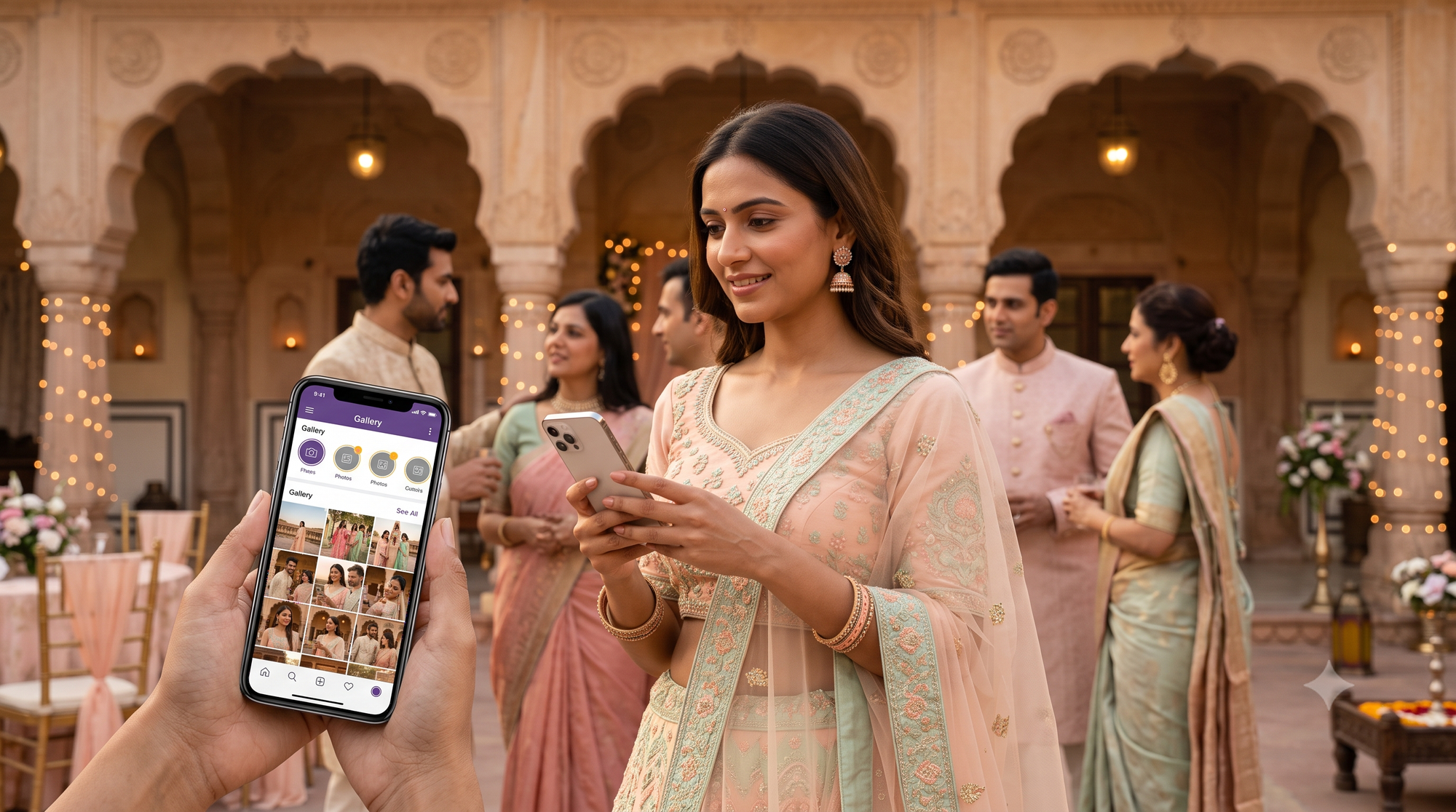
Centuries-old stone forts in Rajasthan, cliffside villas along the Amalfi Coast, and secluded havelis deliver unmatched architectural grandeur. Yet, these physical assets present an unforgiving obstacle to modern digital infrastructure: three-foot-thick stone masonry functions as an accidental Faraday cage. Radio frequencies degrade rapidly within historic courtyards, transforming scenic multi-acre estates into cellular dead zones.
1.2 The Guest Expectation: Instant Gratification & Live Social Sharing
Modern luxury events no longer operate on traditional turnaround schedules. Guests arrive dressed in haute couture and expect frictionless, real-time media distribution. When a portrait is captured during the sundowner or sangeet, the expectation is immediate access for private viewing and social sharing—not a gallery link sent via email three weeks after returning home.
1.3 The Technical Bottleneck: Why Traditional Cloud Galleries Crash in Bandwidth Deserts
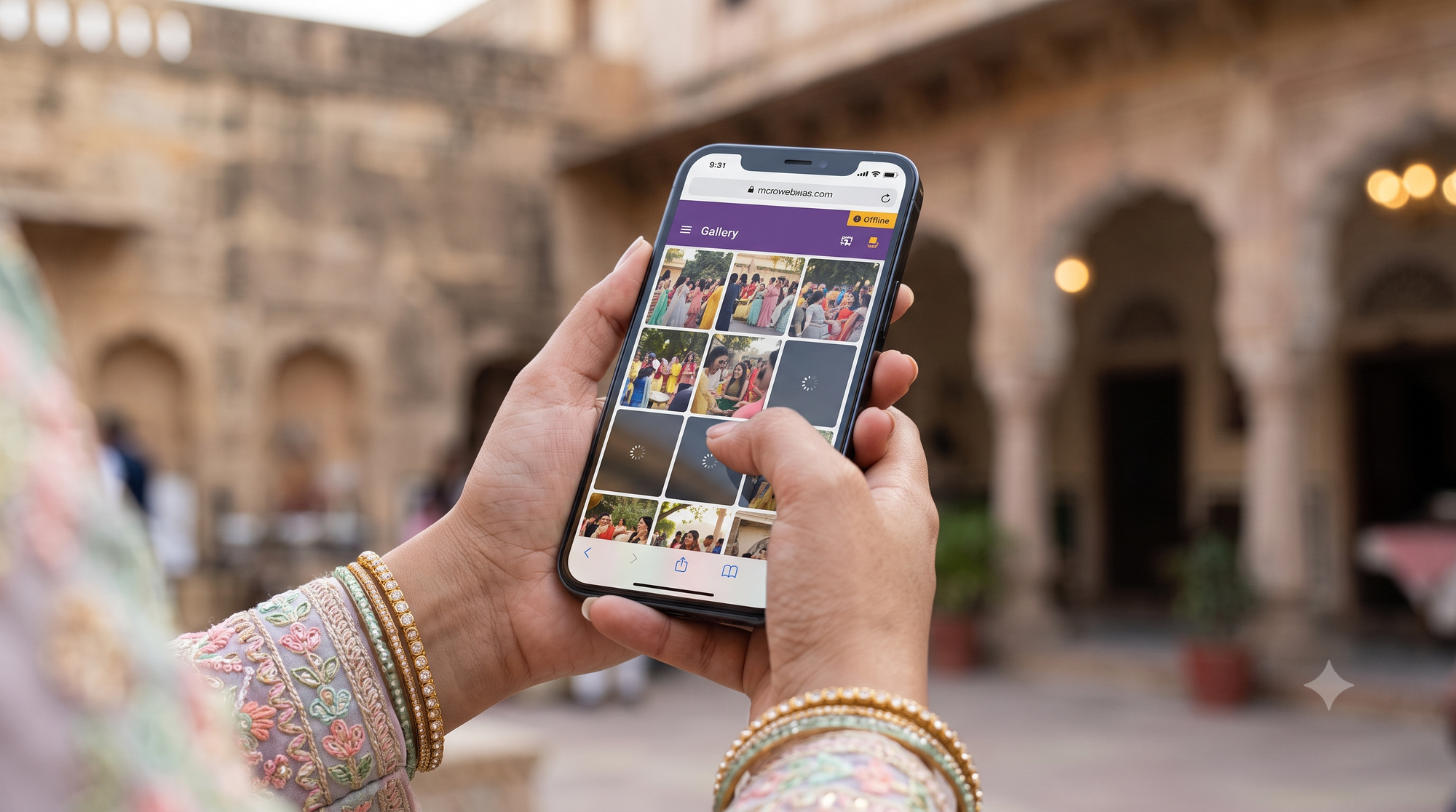
Conventional gallery platforms operate on a single, fragile assumption: an unbroken, high-throughput uplink to cloud infrastructure. At a remote destination wedding hosting 400 guests, cell towers saturate instantly. When traditional platforms attempt to serve raw assets or uncompressed media over an overloaded uplink, HTTP requests time out, asset rendering halts, and guest engagement drops to zero.
2. The Mechanics of Spotty Network Event Photo Sharing
2.1 The Bandwidth Trap: Heavy RAW/JPEG Files Over Congested 2G/3G Slices
High-resolution mirrorless cameras produce JPEG preview files ranging from 15MB to 30MB each. Attempting to pipe thousands of these files over local cellular connections degraded to 2G/3G speeds chokes the connection. Uplink speeds drop below 100 kbps, creating massive queuing backlogs where photos captured at 5:00 PM are still buffering in the upload pipe well past midnight.
2.2 Client-Side Friction: Failed Uploads, Stalled Downloads, and Broken QR Codes
The point of failure is equally severe on the guest side:
- Stalled DNS Resolution: Scanning an onboarding QR code in a weak network corridor causes browser timeouts.
- Partial Cache Corruption: Mobile browsers fail to load heavy JavaScript bundles, yielding blank white screens.
- Failed Binary Transfers: High-resolution asset downloads terminate mid-stream without auto-resume capabilities.
For an event planner, this failure creates immediate friction, turning what should be a premium hospitality experience into an IT support bottleneck.
2.3 The Core Solution: Local Network Caching vs. Continuous Cloud Pinging
Solving spotty network event photo sharing requires decoupling on-site user access from active cloud dependencies. Instead of requiring each guest interaction to ping a remote cloud database thousands of miles away, modern infrastructure relies on local edge distribution. Assets are indexed, cached, and pre-rendered locally, ensuring zero dependency on unstable cellular towers.
3. Architecture Deep-Dive: How Offline Cache for Gallery Apps Works Under the Hood
3.1 Progressive Web Apps (PWA) vs. Native App Local Storage
Native apps often introduce high friction: asking luxury guests to download an 80MB native binary over a spotty network is unrealistic. Modern architectures utilize lightweight Progressive Web Apps combined with IndexedDB and Service Worker cache layers:
3.2 Dynamic Local Asset Indexing: Enabling Guest Browsing Without Active Uplinks
Using persistent client-side storage, an offline cache for gallery apps downloads lightweight compressed metadata schemas (<50 KB) once. Photos are transformed into optimized micro-thumbnails (20–40 KB) that load instantly from the browser's local memory. Guests can scroll hundreds of images smoothly at 60 FPS, completely insulated from fluctuating cellular signal strengths.
3.3 Asynchronous Background Sync: Queuing Deliverables Until Connectivity Restores
When connectivity drops entirely, the background sync API intercepts outgoing requests and queues them in a persistent local store. Once signal integrity reaches a stable ping threshold:
- Queued tasks execute sequentially in micro-batches.
- Asset uploads resume at the exact byte offset where they disconnected.
- Background worker threads manage data transfer silently without degrading UI responsiveness.
3.3.1 Resolving Concurrency Conflicts in High-Traffic Live Streams
In live event streams where multiple shooters upload simultaneously, local edge buffers utilize logical clocks (Lamport timestamps) to reconcile image sequences. Even if images reach the server out of order due to variable network packet drops, the viewer's gallery maintains strict chronological order.
3.3.2 Battery & Memory Management on Guest Mobile Devices
Aggressive caching can drain smartphone batteries or trigger memory crashes in mobile Safari and Chrome. Advanced systems mitigate this through virtualized list rendering (DOM recycling) and automated cache eviction policies: only recently viewed thumbnails are retained in active memory, while older assets are swapped into persistent storage.
4. Competitive Analysis: Traditional Platforms vs. Next-Gen Resilient Tech
4.1 The Legacy Stack: Total Dependency on Uninterrupted Uplinks
Platforms like Pixieset, Pass, and Google Drive were built for desktop broadband delivery days after an event concludes. When deployed for live distribution in remote forts and palaces, they hit an operational wall. Guests stare at infinite loading spinners, while photographers watch file transfer queues crash and restart in an endless loop.
4.2 The Kamero Advantage: Built-in Edge Resilience & Seamless Guest Experience
Kamero was engineered specifically to solve the constraints of real-time event delivery across remote geographies:
- Intelligent Edge Syncing: Ingestion pipelines handle intermittent packet drops without corrupting uploads or forcing complete file restarts.
- Zero-Lag QR Access: Guests scan a QR code once; the lightweight progressive web interface loads immediately, even over degraded 2G/3G connections.
- On-Device AI Face Recognition: Rather than sending high-resolution images back and forth to remote servers for identification, Kamero utilizes high-efficiency facial vector matching. Guests upload a single selfie and instantly view their personal photo stream without burning precious network bandwidth.
5. Practical SOP: Venue Playbook for Bulletproof Photo Delivery
To guarantee an uninterrupted media workflow, production teams and heritage venues should implement this standard three-step operating framework:
5.1 Pre-Event Connectivity Audits: Mapping Dead Zones Across Heritage Courtyards
- Conduct an RF signal survey across all event spaces 48 hours prior to guest arrival.
- Identify high-attenuation areas created by stone columns, underground banquet halls, and open courtyards.
- Designate secondary fallback zones where local data routers can be installed without disrupting event aesthetics.
5.2 Deploying Local Edge Relays & Smart Router Buffers for Photographers
- Configure multi-SIM bonding routers (combining local networks such as Jio and Airtel) dedicated exclusively to the photography crew.
- Establish a local staging hub on-site that functions as a cache buffer between camera memory cards and cloud ingress endpoints.
- Separate production upload pipelines from public guest Wi-Fi networks to prevent bandwidth contention.
5.3 On-Ground Signage & Seamless QR Onboarding Setup
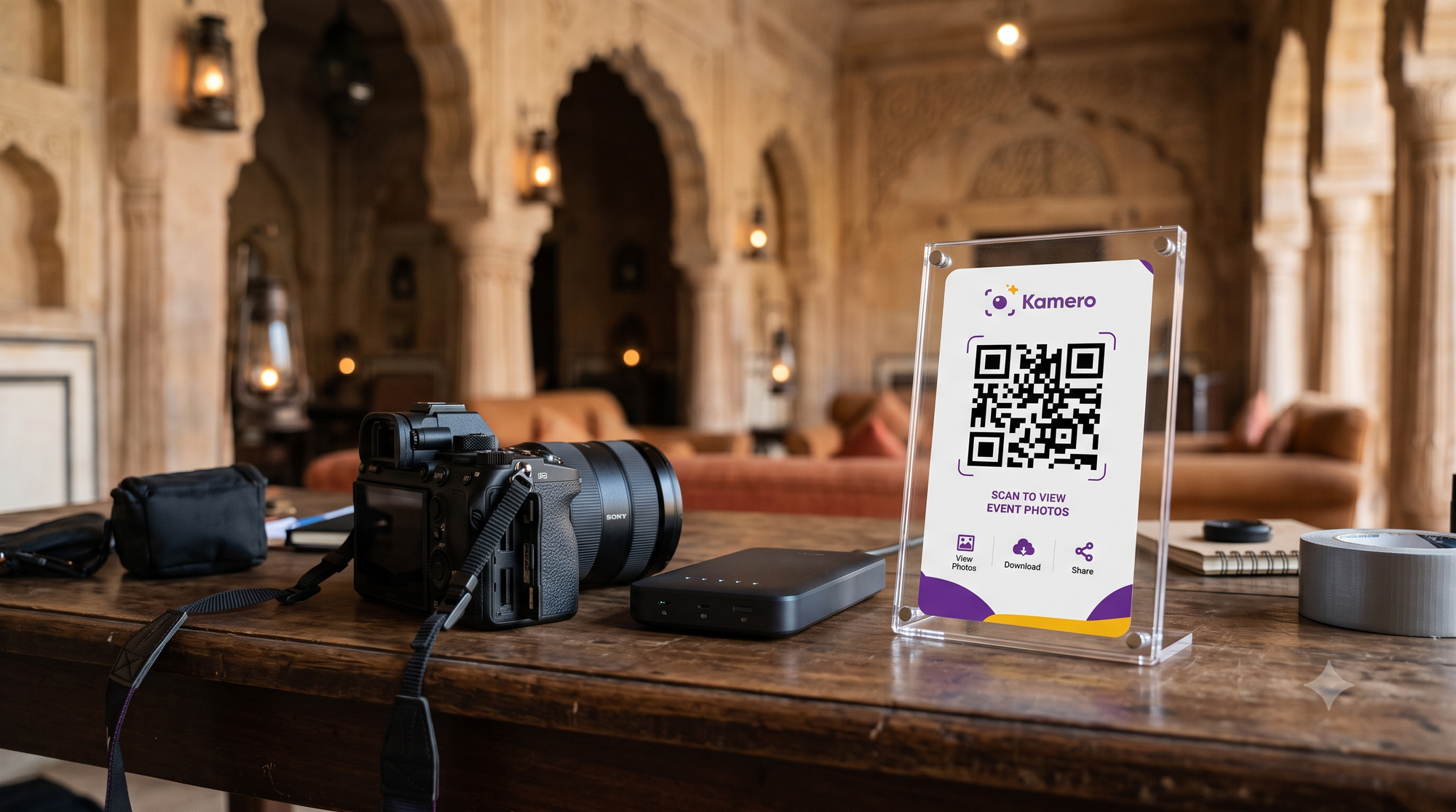
- Place high-contrast QR codes at natural transition points (welcome lounges, bar counters, and dinner tables).
- Include clear micro-copy instructing guests to register once upon arrival so their personal gallery can begin caching in the background immediately.
- Ensure all onboarding assets are hosted on ultra-lightweight CDN nodes that resolve in under 500 milliseconds.
6. Conclusion: Delivering Luxury Guest Experiences Regardless of Geography
Remote heritage venues and destination weddings will always present severe network challenges. However, weak cellular infrastructure no longer has to dictate the quality of guest engagement. By moving beyond outdated, cloud-dependent platforms and adopting purpose-built remote destination wedding tech, venues and event professionals can deliver immediate, personalized photo delivery in any setting.
Equip your upcoming luxury destination events with gallery infrastructure built to perform seamlessly anywhere.
Ready to Eliminate Gallery Buffering at Your Next Destination Event?
Ensure your guests enjoy instant, AI-powered photo delivery regardless of cellular conditions.
- Book a 1-on-1 Demo to explore Kamero's offline-tolerant live sync architecture.
- Start Your Free Trial on Kamero and set up your first live event gallery in minutes.
- Follow our team on Instagram @kamero.ai for behind-the-scenes event tech breakdowns and workflow updates.
About Pavani Nagar
Hey there! Pavani Nagar, a Digital Marketing Manager who enjoys working on content, social media, and figuring out what makes people pay attention. I like trying new ideas, learning along the way, and keeping things simple.