
Fast on-site delivery is no longer optional for high-tier event photography; it is a core commercial demand. When an attendee checks their phone minutes after a keynote or red-carpet arrival, immediate access drives social reach, sponsor visibility, and client retention. However, relying exclusively on biometric automation introduces a critical vulnerability: mandatory facial recognition creates a compliance bottleneck that alienates attendees and exposes studios to legal liability.
Securing six-figure corporate contracts, institutional galas, and luxury private events requires an architecture that refuses to compromise between automated speed and strict data rights. Enterprise event delivery demands a dual-engine pipeline—one that delivers instant, frictionless access to users who opt in, while providing an equally fast, privacy-safe manual discovery path for those who do not.
The Evolving Compliance Landscape for Event Media
Data privacy enforcement has caught up with event production. Regulators globally—from GDPR in Europe to state-level statutory frameworks like BIPA in the United States and the Digital Personal Data Protection (DPDP) Act in India—classify facial geometries as sensitive biometric identifiers.
These frameworks mandate explicit, informed, and freely given consent before capturing or processing a biometric vector. Defaulting attendees into biometric scans without an affirmative choice strips them of digital agency and places direct legal liability on the studio and event host.
Corporate security officers and school district procurement committees increasingly reject generic delivery portals that rely on open public galleries or unregulated, consumer-grade scraping plug-ins. Winning institutional business requires verifiable audit logs, clear opt-out mechanisms, and strict local access containment.
Privacy-by-Design and Opt-In Selfie Photo Matching
The foundation of a compliant workflow is opt in selfie photo matching built on a strictly scoped vector boundary. Rather than indexing a guest's likeness into a perpetual database, a privacy-first infrastructure confines mathematical facial topology exclusively within an event-scoped sandbox.
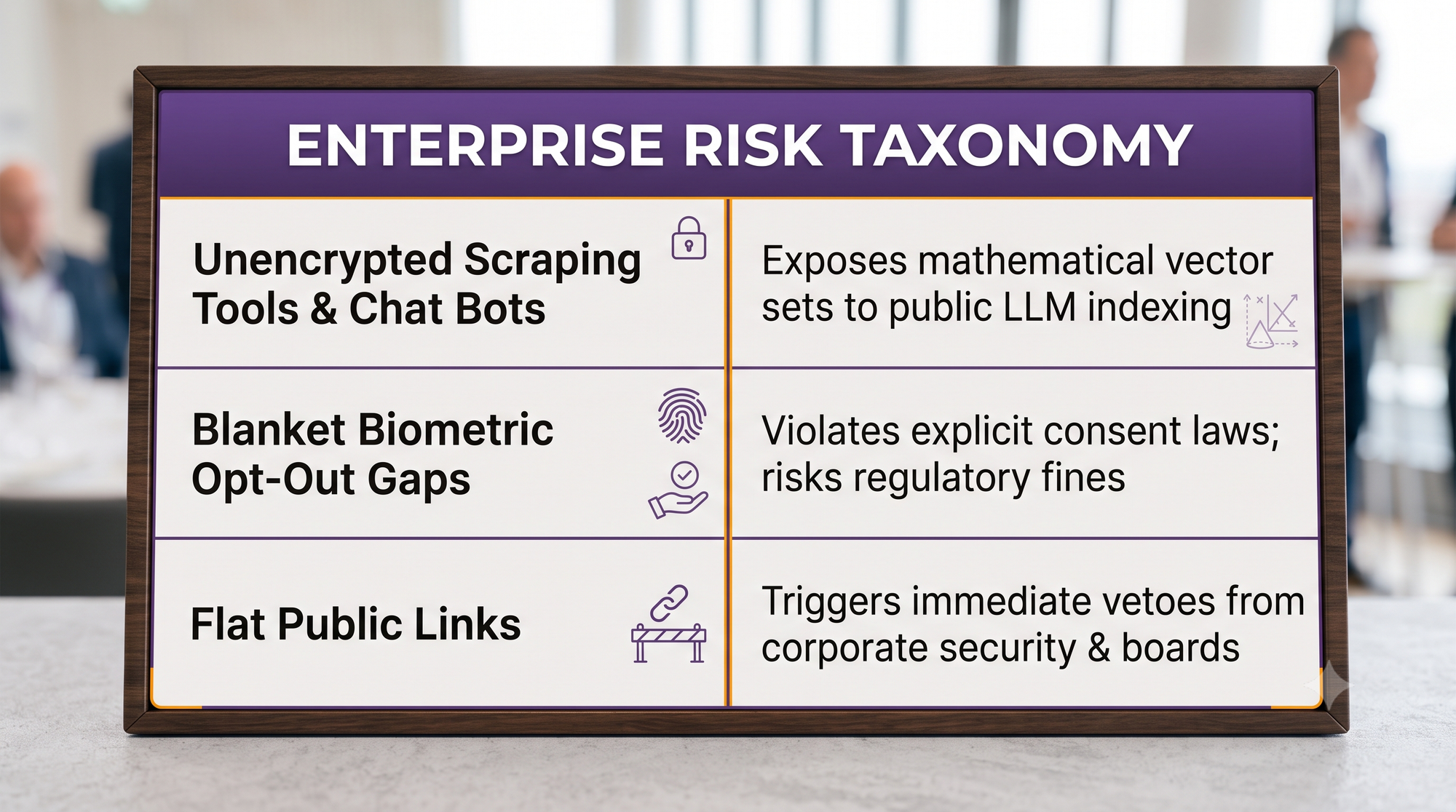
- No Global Cross-Referencing: A reference selfie uploaded by an attendee at a private trade summit cannot, under any circumstances, be queried across other albums, public indexes, or platform-wide user profiles.
- Session-Bound Storage: The reference selfie operates as a single-use verification asset. It resides in an encrypted, session-bound partition rather than an open web server.
- Automated Mathematical Vector Purging: Once an event closes, the system executes an automated purge, permanently dissolving facial coordinates and reference tokens.
- Verifiable Audit Records: Studio directors can supply enterprise clients with signed, timestamped data destruction certificates, confirming zero biometric residue remains on file.
Deep Dive into Non-FR Photo Discovery Mode Architecture
A fallback cannot feel like a penalty box. When an attendee, VIP, or minor declines biometric processing, their experience must match the speed and polish of the automated track. High-performance event engines resolve this through a dedicated nonfr photo discovery mode that runs parallel to the AI pipeline.
By decoupling metadata extraction from biometric parsing, the engine indexes incoming high-resolution camera files along non-biometric parameters the millisecond they hit the cloud:
- Hierarchical Time-and-Zone Trees: Galleries automatically segment by dynamic sub-venues (e.g., Main Stage, VIP Lounge, Breakout Room B) mapped directly to camera metadata and the master production itinerary.
- Smart EXIF and IPTC Filtering: Photographers push live tags directly from modern camera bodies, categorizing sequences by scene, keynote speaker, or session title without opening a desktop editor.
- Rapid-Filter Facets: Attendees who decline facial scans filter the gallery using intuitive time-slice selectors, stage tags, and photographer tags. This narrows an 8,000-image library down to their specific 15-minute window in less than three clicks, completely eliminating queue back-pressure.
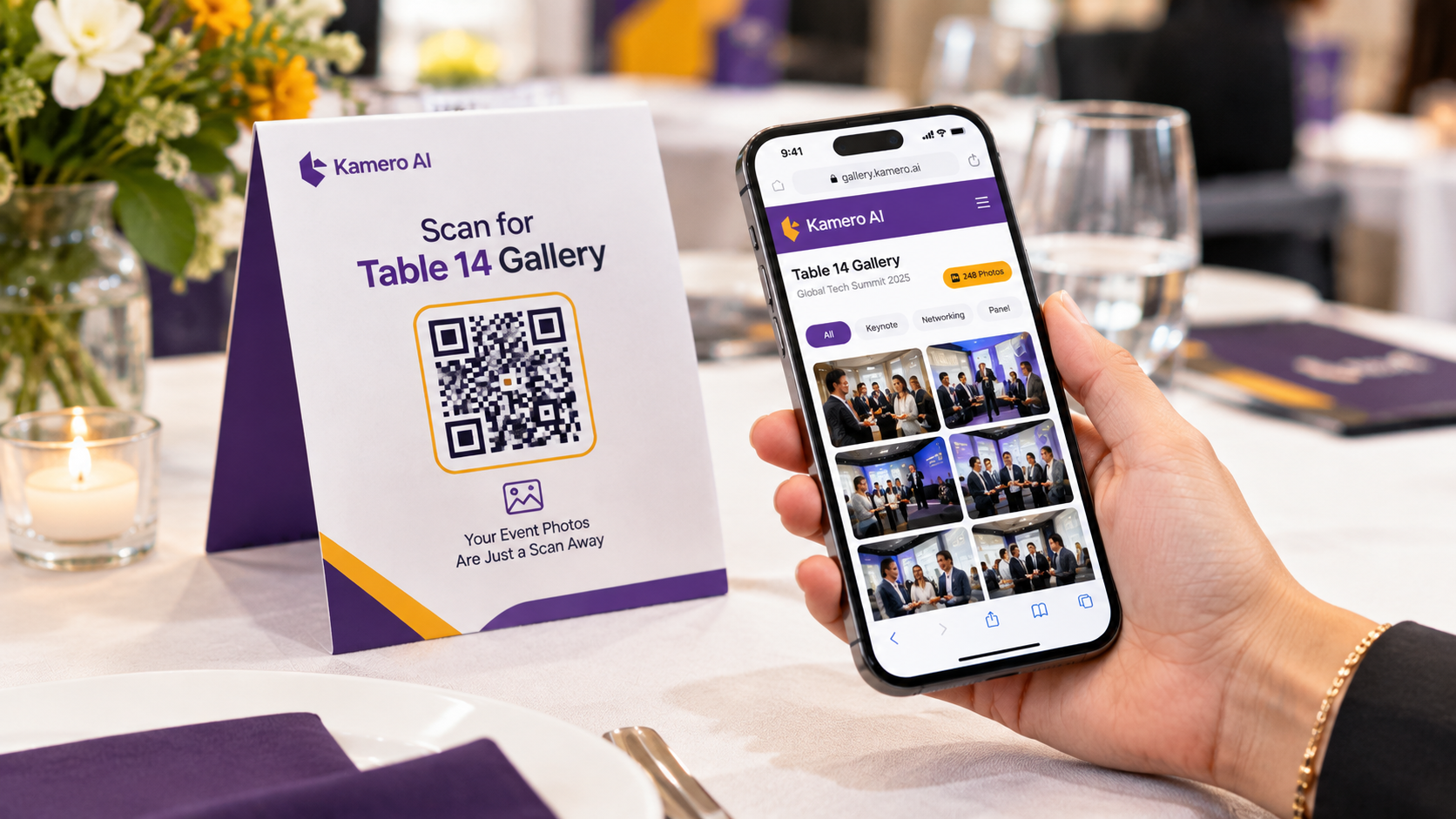
Precision QR Code Photo Delivery Systems
Bridging the physical-to-digital gap without requiring personal data hinges on an intelligent qr code photo delivery system.
Sub-Zone Distribution
Instead of printing a single link for an entire 1,500-person gala, studios place dynamic, location-specific QR codes across individual tables, track zones, or activation booths. A quick scan routes the guest directly to their immediate sub-zone folder, bypassing the rest of the asset catalog.
OCR Bib and Credential Routing
For marathons, endurance races, and credentialed corporate expos, the system swaps facial identification for deterministic Optical Character Recognition (OCR). The pipeline identifies visible alphanumeric strings on badges or bibs, instantly populating private sub-streams without mapping a single facial coordinate.
Web-First Onboarding
Forcing guests to download native mobile apps creates massive drop-off and friction. High-conversion workflows launch straight into lightweight, progressive web delivery via the native camera app, reserving dedicated application downloads strictly for advanced enterprise asset management.
Practical Deployment Scenarios in High-Stakes Environments
Deploying privacy sensitive event photo delivery safeguards your clients and protects your studio's operational reputation across demanding sectors:
- Educational Institutions: School boards require strict parental consent controls. Studio administrators leverage role-based permissions, locking classrooms or grade levels behind separate alphanumeric PIN walls to ensure student assets remain isolated.
- Corporate Brand Activations: Enterprise marketing teams must balance real-time PR publishing with strict compliance audits. Clean access logs and white-label client portals allow corporate communications teams to retrieve verified media quickly without exposing guest records to public scraping.
- Ultra-High-Net-Worth Weddings: When high-profile clients mandate zero public leakage, access links rely on unique guest tokens paired with dynamic watermarking. Dynamic, on-the-fly rendering thwarts screen recording and unauthorized asset duplication directly at the viewport level.
The Unified Workflow: Speed Meets Governance
Enterprise reliability collapses if modern security features slow down on-site asset distribution. The solution is integrating hardware directly into the distribution engine.
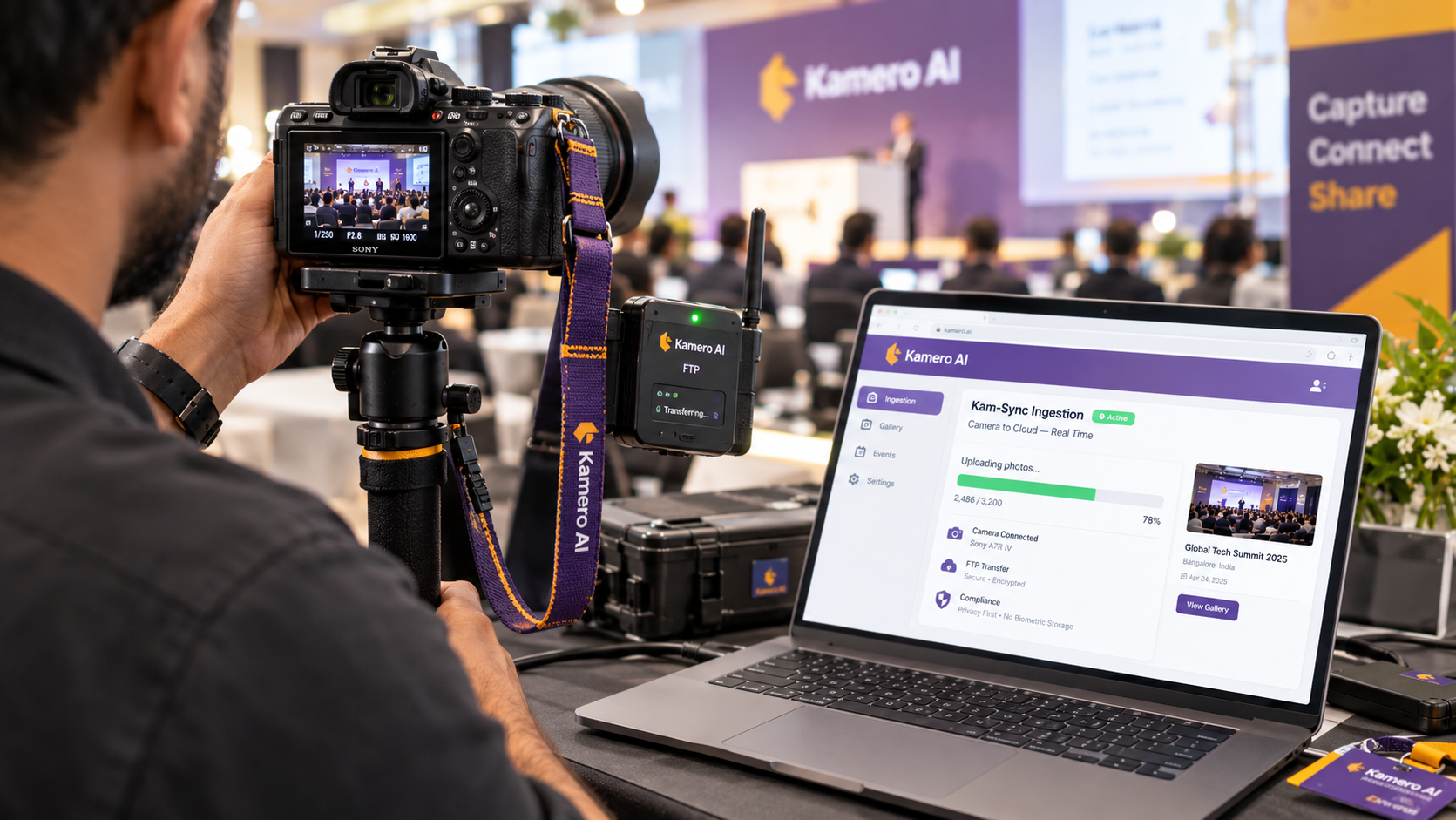
- Instant Hardware Ingestion with Kam-Sync: Photographers bypass end-of-day card dumping entirely. Modern mirrorless systems push full-resolution assets via direct FTP over wireless networks straight to the cloud processing pipeline as the shutter clicks.
- Dynamic Brand Customization: White-label interfaces apply the studio’s bespoke CSS, brand color palettes, and subdomains across both the biometric portal and manual discovery modes, maintaining visual consistency throughout.
- Integrated Business Capture: Every public or semi-private delivery interface doubles as an inbound lead engine. Custom call-to-action cards, lead inquiry forms, and opt-in newsletter triggers seamlessly convert guest impressions into future commercial bookings.
Enterprise Platform Architecture: True Privacy vs. Consumer Scrapers
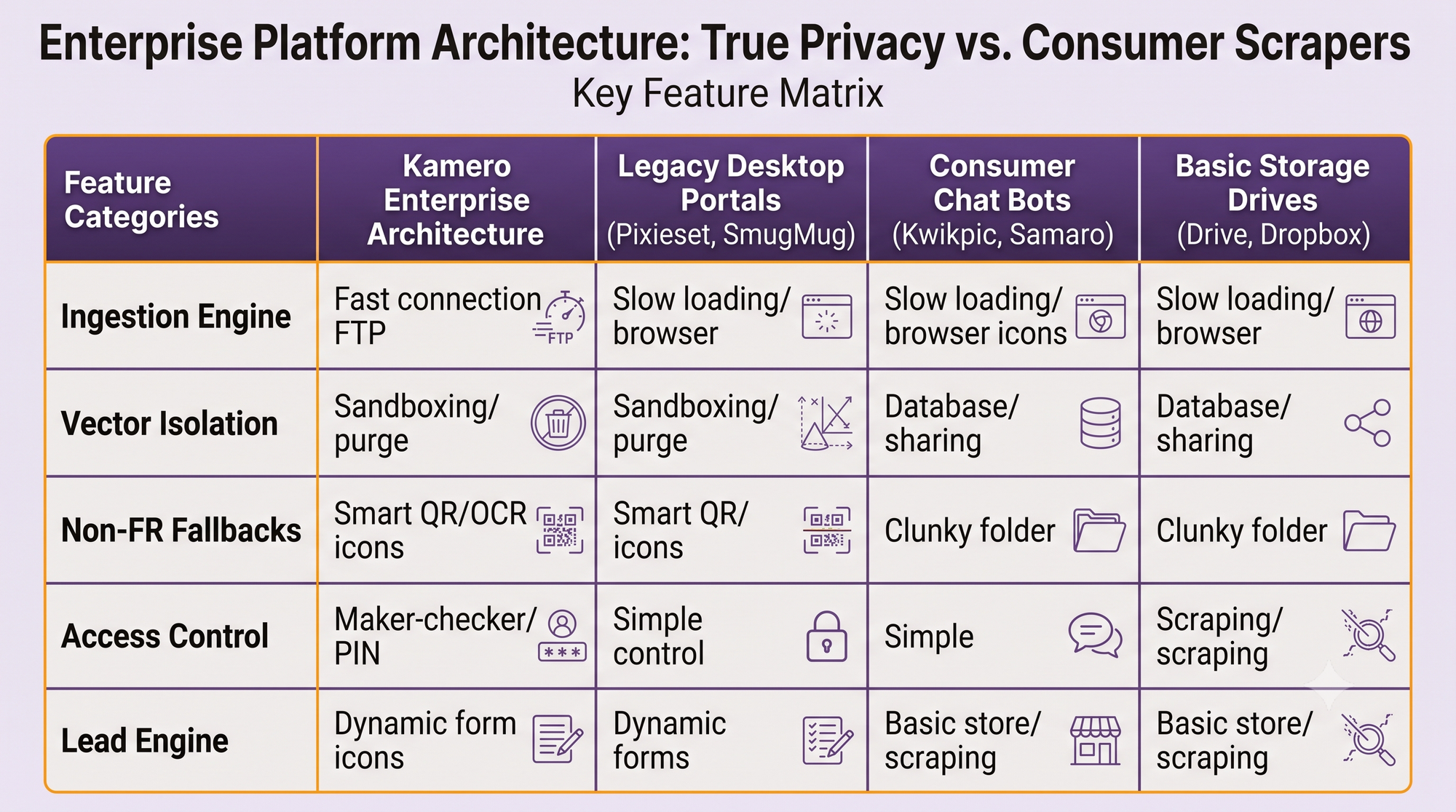
Technical Setup Checklist: Deploying a Resilient Multi-Option Gallery
- Activate Dual Ingestion: Enable camera-to-cloud FTP routing via your hardware profile, setting the engine to process facial vectors and EXIF metadata facets simultaneously.
- Configure Consent Gates: Toggle the opt-in verification step for facial indexing. Set your event-scoped vector destruction policy (e.g., 7, 14, or 30 days post-event).
- Establish Tiered Enclosures: Set distinct, alphanumeric PIN security gates for restricted sub-folders, such as private back-stage sessions or minor-focused events.
- Deploy Physical Routing Signage: Print dynamic, zone-specific QR codes mapped to custom venue sub-tags. Position them at registration desks, media walls, and dining areas to give opted-out guests immediate manual entry.
- Verify the Opt-Out Path: Confirm that the public fallback mode presents an intuitive, high-speed discovery interface driven by time slices, sub-venue tags, and OCR parameters before opening the gallery to guests.
Never force your enterprise corporate clients or private event hosts to choose between rapid media delivery and strict data compliance. Deploy an infrastructure that balances seamless biometric automation with ironclad manual fallbacks.
Elevate your brand integrity, eliminate compliance risk, and secure high-value event contracts. Book a Demo with Kamero today, or follow us on Instagram @kamero.in to see enterprise-grade photo delivery in action.
About Pavani Nagar
Hey there! Pavani Nagar, a Digital Marketing Manager who enjoys working on content, social media, and figuring out what makes people pay attention. I like trying new ideas, learning along the way, and keeping things simple.