
Introduction
The average wedding photography business invests heavily in cameras, lenses, lighting, and creative talent. Yet one of the biggest threats to profitability often hides in plain sight: software fragmentation.
Many studios unknowingly build operations around a collection of disconnected tools. One platform handles storage, another manages galleries, a third supports proofing, a fourth processes payments, and yet another manages client communication. Individually, each tool solves a problem. Together, they create an operational maze.
As booking volumes increase, these inefficiencies become harder to ignore. Teams spend more time managing workflows than creating memorable client experiences.
This is why the conversation around AI photography tools is shifting. The goal is no longer simply automating individual tasks. The goal is consolidating workflows into a single ecosystem that helps reduce photographer admin, improve delivery speed, and support long-term growth.
The Hidden Cost of Running a Fragmented Studio
Why Tool Bloat Is Becoming a Growth Problem
Many studios reach a point where adding new software feels like progress. A better proofing tool, a smarter gallery platform, a specialized editing application—each promises incremental improvements.
The problem is that every new platform introduces another login, another subscription, another workflow, and another place where information can become disconnected.
What starts as a solution eventually becomes operational debt.
For a growing wedding photography business, the challenge isn't managing one wedding. It's managing hundreds. At that scale, even small inefficiencies compound into significant costs.
The Real Cost of Context Switching
Photographers often underestimate the impact of constantly moving between platforms.
Files are exported from one system, imported into another, downloaded again for editing, uploaded again for delivery, and then managed separately for sales or proofing. Each transition introduces delays, opportunities for mistakes, and unnecessary administrative work.
The result is longer turnaround times, slower client approvals, and less time available for creative work.
How Modern Studios Are Replacing Admin with Automation

Moving Beyond Manual Ingestion and Culling
One of the largest bottlenecks in photography operations occurs immediately after an event.
Memory cards need to be transferred. Files need to be backed up. Thousands of images require sorting before any meaningful editing can begin.
Modern studio workflow automation solutions eliminate much of this manual effort by automating ingestion, organization, and discovery. Instead of spending hours preparing files for production, photographers can move directly into higher-value creative tasks.
This becomes especially valuable during peak wedding season when even minor delays can create significant backlogs.
Why Studio Workflow Automation Starts Before Editing
Many photographers associate automation exclusively with editing.
In reality, the biggest efficiency gains often occur before editing begins.
The ability to automatically organize content, group images, prepare galleries, and streamline communication can save more time than any editing shortcut. The most successful studios are redesigning their workflows around automation from the moment images are captured.
The Rise of Unified Photography Business Software
From Camera-to-Cloud to Client Delivery
Modern photography business software is evolving beyond simple gallery hosting.
The industry's leading platforms now connect multiple stages of the workflow into a single system. Images can move directly from capture to cloud environments, reducing dependence on memory card transfers and overnight uploads.
Instead of treating delivery as a final step, modern workflows begin preparing content while events are still underway.
This dramatically shortens timelines and improves operational efficiency.
Automating Guest Discovery and Client Proofing
Client proofing is another area where fragmentation creates friction.
Many photographers still manage album selections through emails, spreadsheets, or messaging apps. While workable at a small scale, these processes become increasingly difficult to manage as booking volumes grow.
Unified platforms simplify this experience by centralizing proofing, selections, approvals, and communication within a single environment. Clients spend less time navigating workflows and more time making decisions.
Why Kamero Replaces Multiple Photography Tools
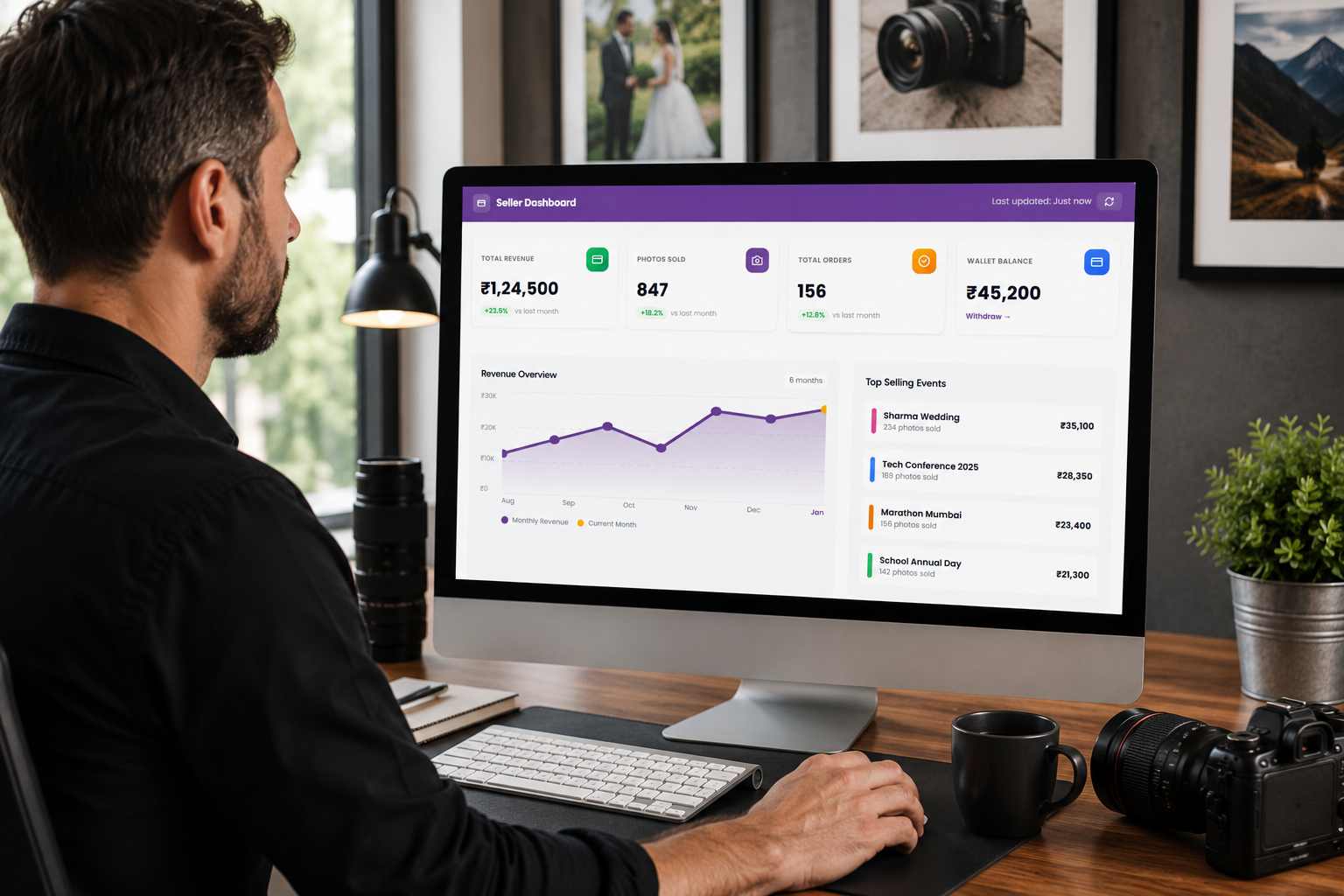
The Problem with Stitching Together 7 Different Platforms
Many photographers rely on a combination of gallery software, editing tools, proofing systems, payment processors, watermarking applications, cloud storage services, and communication platforms.
The challenge is not that these tools are ineffective. The challenge is that they were never designed to work together.
Every handoff creates friction. Every export creates delays.
As businesses scale, the operational burden grows alongside them.
A Unified Capture-to-Commerce Ecosystem
Kamero approaches the workflow differently.
Rather than focusing on a single stage of the photography process, the platform connects ingestion, delivery, discovery, branding, and commerce within one ecosystem.
Kam-Sync enables real-time camera-to-cloud workflows. AI-powered guest discovery improves photo accessibility. Dynamic watermark controls, branded galleries, mobile applications, and integrated commerce capabilities reduce dependence on multiple third-party systems.
Instead of managing a collection of disconnected tools, photographers gain a unified environment built specifically for event media businesses.
The Financial ROI of Consolidation
Reducing Software Costs and Administrative Overhead
Software subscriptions rarely appear expensive individually.
Collectively, however, they can become a meaningful operating expense.
Consolidation reduces the number of subscriptions required while simultaneously decreasing administrative workload. Teams spend less time managing systems and more time delivering value to clients.
For growing studios, this can create significant savings over the course of a year.
Turning Operational Efficiency into Revenue Growth
Efficiency alone is valuable. Efficiency combined with revenue growth is transformational.
Faster delivery improves client satisfaction. Better guest experiences increase engagement. Simplified purchasing workflows support additional sales.
Modern galleries are increasingly becoming lead-generation and commerce platforms rather than simple delivery destinations.
Every guest interaction becomes an opportunity for future business.
Building a Leaner Studio for the Next Decade
A Practical Consolidation Roadmap
Studios looking to modernize their operations should begin by auditing their current software stack.
Identify where information is being duplicated, where files are repeatedly transferred, and where communication becomes fragmented. These areas often reveal the greatest opportunities for consolidation.
The goal is not eliminating technology.
The goal is eliminating unnecessary complexity.
Future-Proofing Your Photography Business
The future of photography operations will belong to businesses that prioritize simplicity, speed, and scalability.
As client expectations continue rising, fragmented workflows will become increasingly difficult to sustain. Unified systems that combine automation, delivery, branding, and commerce will become the foundation of modern studio operations.
The studios that embrace this shift today will be the ones best positioned to grow tomorrow.
Ready to Simplify Your Photography Workflow?
Stop juggling multiple platforms and start building a workflow designed for scale.
• Book a Demo: See how Kamero consolidates your entire workflow
• Start Your Free Trial: Experience unified event media management firsthand
• Follow Us on Instagram: Stay updated on photography technology and business growth strategies

About Mohit Prakash Lal
Hi, I’m Mohit, an MBA student at TAPMI, Manipal, exploring the world of business with a focus on marketing and strategy. I’m interested in understanding how brands connect with people and create meaningful, lasting impact in a competitive landscape. I enjoy working on real-world projects across marketing, sales, and business development, where I can apply ideas in practical settings.
I also enjoy simplifying ideas into clear, practical insights. Outside of work, I like travelling, reading, and taking time to recharge.