Introduction: The Production Lag of Legacy Educational Photography
For decades, school photography has operated on a delivery model that accepts delays as normal. Images are captured during picture day, transferred manually after the event, sorted into folders, matched to students, reviewed by administrators, and eventually distributed to parents weeks later.
The process may be familiar, but it is increasingly difficult to justify.
Modern schools expect faster communication. Parents expect digital access. Studios need stronger cash flow and greater operational efficiency. Yet many high-volume photography businesses still rely on workflows that create bottlenecks at every stage of production.
The challenge is no longer capturing photographs. The challenge is moving thousands of images through the pipeline quickly, accurately, and securely.
This is where the concept of 24-hour school portraits is transforming the industry.
Understanding the Core Turnaround Bottleneck
Most delivery delays originate long before galleries reach parents.
Why Traditional School Photography Workflows Slow Down
After picture day, photographers typically spend hours transferring files, organizing folders, renaming images, matching students, correcting errors, and preparing galleries for distribution.
Every manual step introduces additional complexity.
As schools scale across multiple grades, campuses, and student groups, administrative workloads increase dramatically. What begins as a simple sorting exercise quickly becomes a major operational burden.
The Hidden Cost of Slow Delivery
Extended delivery cycles affect more than customer satisfaction.
Delayed galleries postpone purchasing decisions, slow invoice collection, increase support requests, and consume valuable staff hours answering status inquiries. Parents begin asking when photos will arrive. School administrators follow up repeatedly. Studio teams spend more time managing communication than processing images.
The longer the delivery cycle becomes, the more operational friction accumulates throughout the business.
Moving Toward Automated Processing Pipelines
Leading studios are replacing manual production workflows with automated infrastructure designed for speed and scale.
Establishing the Under-24-Hour Standard
The goal of a modern workflow is straightforward: move images from capture to delivery in less than a day.
Achieving that outcome requires more than faster editing. It requires automation throughout the entire production chain, from image ingestion and sorting to gallery generation and parent notifications.
Instead of treating picture day as the beginning of a lengthy post-production process, automated systems transform delivery into a continuous workflow that starts the moment a photograph is captured.
Why Speed Creates Competitive Advantage
Fast delivery generates benefits across every stakeholder group.
Parents receive photographs while excitement remains high. Schools experience fewer administrative follow-ups. Studios improve cash flow and reduce operational overhead. Most importantly, faster turnaround becomes a powerful differentiator when competing for new contracts.
In a market where many providers still operate on multi-week timelines, delivering portraits within 24 hours creates a meaningful competitive advantage.
Building the Automated Processing Engine
High-speed delivery requires infrastructure capable of processing thousands of files without introducing delays.
Real-Time Camera-to-Cloud Integration
Traditional workflows depend on memory cards and manual uploads. Images remain trapped on devices until photographers return to their workstations.
Modern camera-to-cloud systems eliminate this dependency.
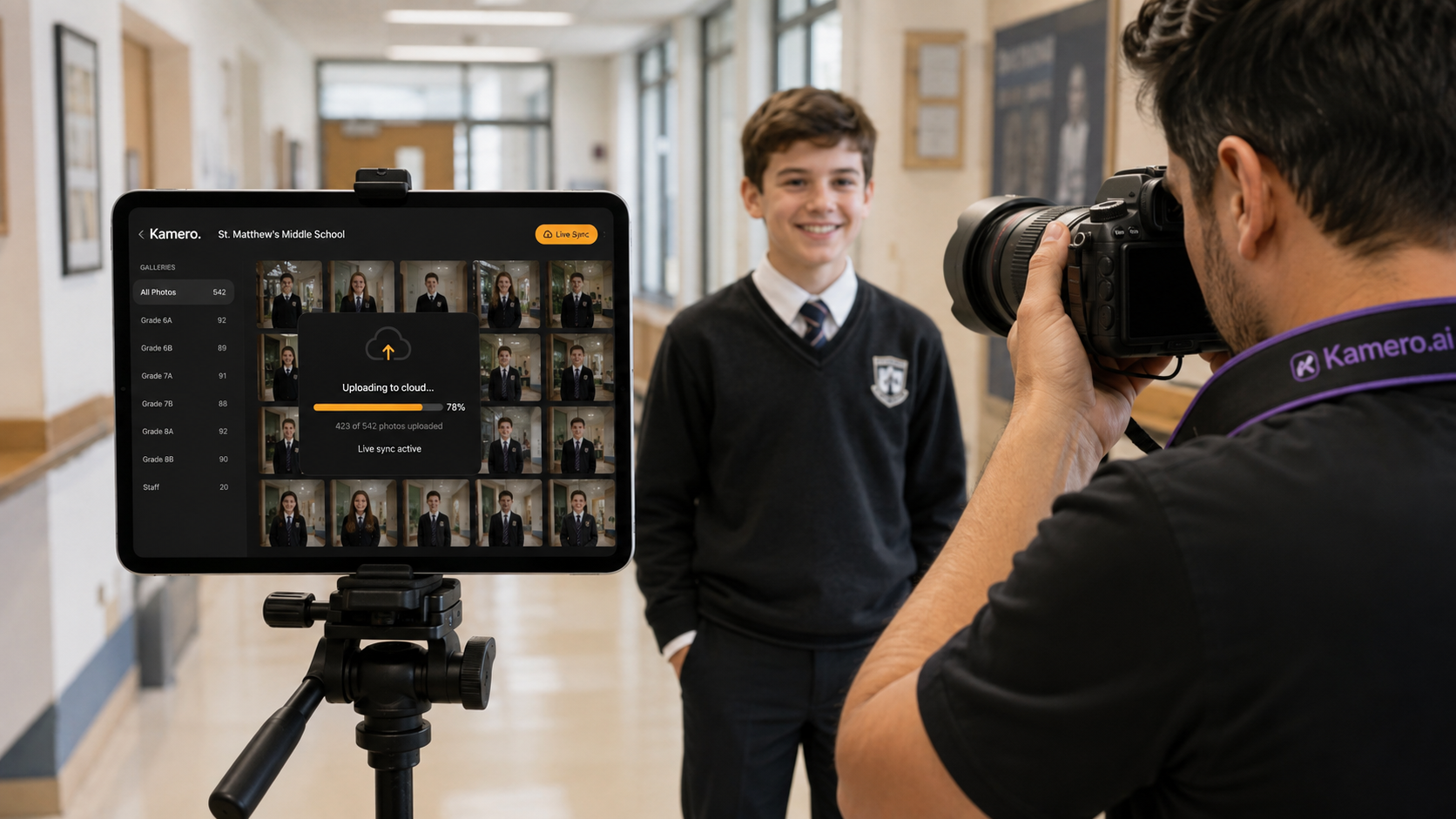
Through hardware-level FTP synchronization such as Kam-Sync, images can move directly from the camera into secure cloud environments as they are captured. Instead of waiting until the event ends, processing begins immediately.
This significantly reduces the time between image creation and gallery availability.
Automated Sorting and Student Matching
Once images enter the cloud, automation becomes critical.
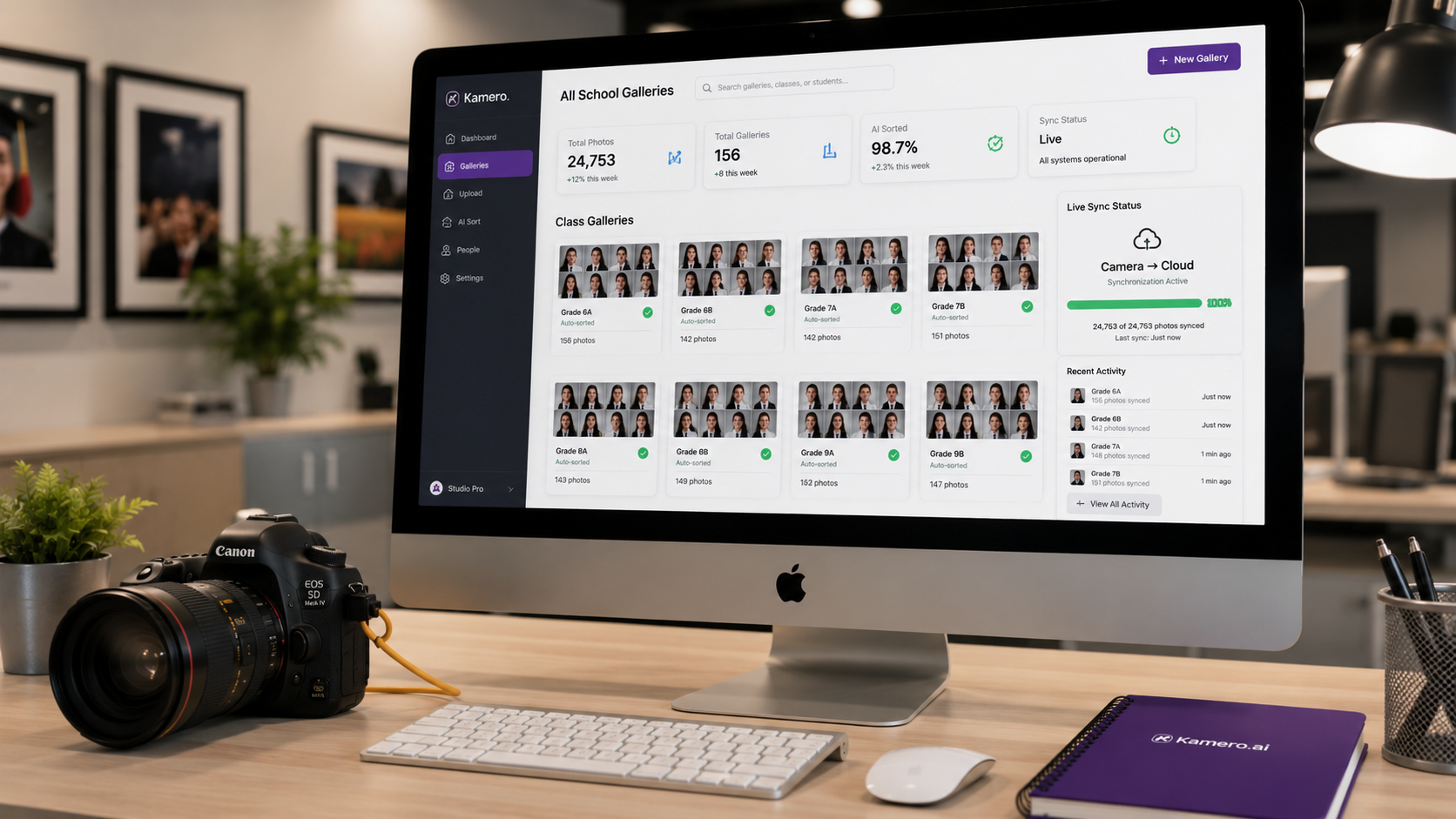
AI-powered identification systems can organize photographs, group related assets, and route files into predefined class structures without requiring extensive manual intervention.
Student records, classroom information, and roster data can be integrated directly into the workflow, ensuring images are placed in the correct locations automatically.
The result is a streamlined production pipeline capable of handling large volumes with far greater accuracy than manual sorting alone.
Accelerating the Path to Parents
Fast processing creates value only if images can reach families quickly and securely.
Private Student Access Through Intelligent Identification
Parents do not want to search through hundreds of images to find their child.
Modern school photography platforms simplify discovery by creating private viewing experiences linked to individual students. Families can access relevant images directly without navigating large public galleries.
This improves user experience while supporting stronger privacy controls for student data.
Automated Communication Workflows
Delivery speed also depends on how effectively parents are notified.
Instead of relying on manual emails or printed instructions, automated communication channels can alert families as soon as photographs become available.
Integrated notification systems help reduce support requests while ensuring parents know exactly when and where to access their images.

The Kamero Advantage: High-Speed Delivery Without Operational Complexity
Many photography platforms focus primarily on gallery hosting. Kamero approaches school photography as a complete production workflow.
Using Kam-Sync camera-to-cloud technology, images can move directly from capture devices into secure cloud environments without requiring manual transfers. Automated matching systems help organize content at scale, while structured workflows support rapid delivery without sacrificing accuracy.
Role-based permissions, dynamic watermarking, white-label experiences, automated notifications, and secure access controls enable studios to manage large school programs from a single operational environment.
For high-volume photography businesses, this creates a faster and more scalable alternative to fragmented post-production workflows.
Turning Faster Delivery into Business Growth
The value of rapid portrait delivery extends far beyond convenience.
Reducing Administrative Overhead
Studios often maintain multiple tools for storage, communication, proofing, watermarking, and gallery delivery.
Consolidating these functions into a unified workflow reduces software costs, simplifies operations, and minimizes the number of systems staff must manage.
This allows teams to focus on growth rather than administration.
Creating a Competitive Sales Advantage
Schools increasingly evaluate photography vendors based on turnaround speed and operational reliability.
A studio capable of consistently delivering portraits within 24 hours presents a compelling value proposition compared to competitors operating on traditional timelines.
Faster delivery becomes more than an operational benefit—it becomes a sales tool.
Strengthening Long-Term School Relationships
When schools experience fewer administrative headaches, communication becomes easier and satisfaction improves.
Reliable delivery timelines build trust, strengthen client relationships, and increase the likelihood of contract renewals and referrals across school networks.
Conclusion: Setting the New Standard for School Photography
The future of school photography belongs to studios that can combine speed, accuracy, security, and automation into a single workflow.
Traditional production models built around manual transfers, sorting delays, and lengthy delivery timelines are becoming increasingly difficult to sustain. Schools expect faster service. Parents expect immediate access. Studios need greater operational efficiency.
The 24-hour school portrait model addresses all three requirements simultaneously.
By combining camera-to-cloud technology, automated organization, intelligent matching, and streamlined delivery systems, photography businesses can transform picture day from a logistical challenge into a highly scalable operation.
The result is faster turnaround, stronger margins, improved customer satisfaction, and a sustainable competitive advantage in the modern school photography market.
Ready to Deliver School Portraits in 24 Hours Instead of 24 Days?
Book a Demo: See how automated camera-to-cloud workflows can dramatically reduce delivery timelines for your school photography business.
Start Your Free Trial: Experience faster sorting, intelligent matching, secure delivery, and streamlined operations from a single platform.
Follow Kamero on Instagram: Discover how leading volume studios are using AI-powered automation to transform school photography workflows.

About Mayank Oraon
Hi, I’m Mayank, an MBA student exploring the business world with a focus on operations, supply chain, and product strategy (aka the parts of a business that keep things from quietly falling apart).
I’m interested in understanding how systems actually run behind the scenes- and why they sometimes don’t. I also enjoy simplifying complex ideas - partly because it helps others, and partly because if I can’t explain it simply, I probably didn’t understand it in the first place (which is a humbling but effective feedback loop).