Introduction: The Technological Paradigm Shift in High-Volume Portraiture
School photography has historically relied on a surprisingly fragile production environment. Cameras connect to laptops through cables. Memory cards move between operators. Files are manually transferred, renamed, sorted, and eventually uploaded after picture day concludes.
For years, these workflows were accepted as standard practice.
Today, however, volume studios are operating under very different expectations. Schools demand faster delivery. Parents expect digital access. Studios need greater efficiency without increasing administrative headcount. The result is a growing shift away from tethered hardware ecosystems and toward fully connected cloud-based production pipelines.
What was once considered advanced studio infrastructure is quickly becoming outdated.
The future of high-volume portraiture belongs to wireless, cloud-connected workflows that move images directly from the camera to secure cloud environments without relying on physical transfer points.
The Hidden Costs of Traditional School Portrait Technology
Many studios continue to operate with systems that create unnecessary bottlenecks throughout the production cycle.
Why Tethered Workflows Create Operational Friction
Traditional school photography setups often depend on physical cables, local storage devices, and laptop-based transfer stations.
While functional, these systems introduce multiple points of failure. Cables disconnect during active shooting. Laptops freeze or crash under heavy workloads. Memory cards must be transported, copied, and verified before processing can begin.
Each handoff creates another opportunity for delays, errors, or data loss.
As photography volume increases, these inefficiencies compound across the entire operation.
The Business Cost of Manual Transfers
The impact extends beyond technology.
Every hour spent downloading files, sorting folders, verifying records, and manually organizing images is time that cannot be spent acquiring new clients, servicing schools, or expanding operations.
Manual workflows increase labor costs while reducing scalability. The larger the school program becomes, the more difficult it is to maintain efficiency using traditional infrastructure.
Embracing the Modern Mirrorless School Photography Workflow
The transition to mirrorless camera systems has unlocked new possibilities for school photography operations.
The Rise of Wireless School Portrait Transfer
Modern mirrorless cameras are no longer isolated capture devices. They function as connected endpoints capable of transmitting images directly into cloud environments while photography sessions remain active.
Instead of waiting for photographers to return to workstations, files begin moving immediately after capture.
This significantly reduces the gap between image creation and image availability.
The result is a workflow where processing can begin during picture day rather than after it.
Creating a Unified Cloud Workflow for Schools
Cloud-based infrastructure centralizes every stage of production.
Images, student records, administrative controls, approvals, galleries, and communication channels can all exist within a single environment. Teams no longer need to coordinate across laptops, storage drives, spreadsheets, and messaging applications.
This unified approach simplifies operations while improving visibility across the entire production pipeline.
Inside the Kam-Sync Camera-to-Cloud Architecture
The speed and reliability of wireless workflows depend on the infrastructure powering them.
Direct Camera-to-Cloud Connectivity
Traditional upload systems rely on browser-based forms that require manual intervention after image capture.
Camera-to-cloud workflows eliminate this requirement.
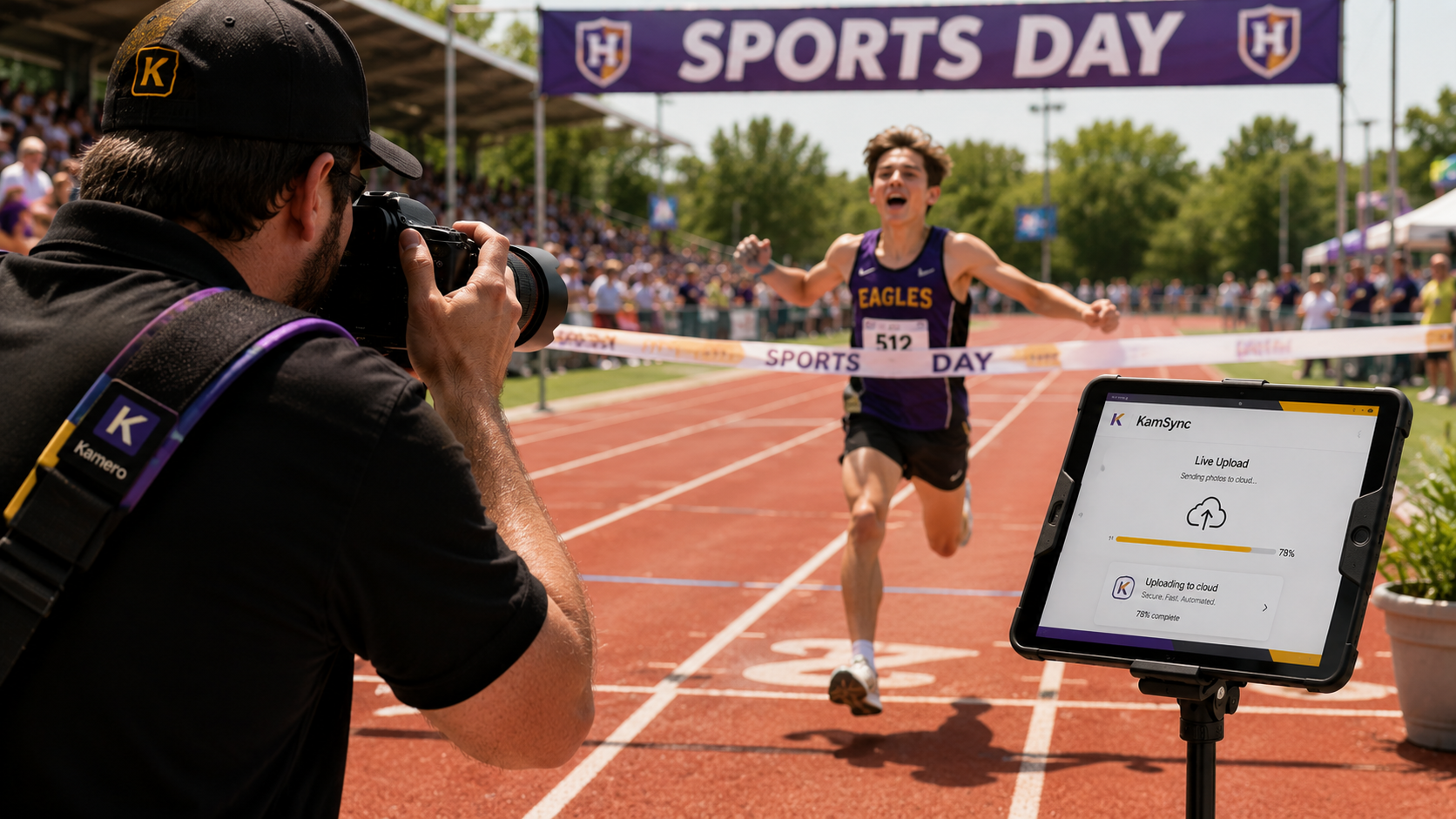
Using technologies such as Kam-Sync, images can move directly from compatible mirrorless cameras into secure cloud environments through hardware-level FTP connections. Files begin transferring automatically without requiring memory card extraction or laptop-based uploads.
This creates a true real-time production environment where content remains in motion throughout the event.
Maintaining Performance in High-Volume Environments
School photography programs often involve thousands of students captured across multiple stations and shooting lines.
A modern cloud workflow must remain stable even when large volumes of high-resolution images are uploaded simultaneously.
By continuously transferring content in the background, cloud-based systems reduce bottlenecks while maintaining consistent throughput across active production environments.
The result is faster processing without disrupting the pace of photography operations.
Eliminating Manual Sorting Through Intelligent Asset Routing
The benefits of cloud workflows extend beyond image transfer.
Automating Student-Based Organization
One of the most time-consuming aspects of school photography is organizing images after capture.
Traditionally, teams spend hours creating folders, renaming files, and matching photographs to student records.
Modern AI-assisted systems automate much of this process.
By combining roster information, student metadata, and intelligent matching technologies, images can be organized into predefined structures automatically as they arrive in the cloud.
This dramatically reduces administrative workloads while improving accuracy.
Building Scalable Production Pipelines
Automation becomes increasingly valuable as volume grows.
Whether a studio manages a single campus or an entire school district, structured cloud workflows allow production processes to scale without requiring proportional increases in staffing.
The same infrastructure can support thousands of images with minimal manual intervention.
Maintaining Security and Administrative Control
Faster workflows must also remain secure.
Structured Approval Workflows
Not every image should move directly from capture to distribution.
Schools and photography providers often require review stages to verify image quality, ensure compliance with privacy policies, and maintain operational standards.
Approval workflows provide these safeguards without slowing down production.
Assets can be reviewed, approved, and released through controlled processes while still benefiting from real-time cloud infrastructure.
Role-Based Access Management
Different stakeholders require different levels of access.
Photographers, administrators, school staff, customer support teams, and parents all interact with content differently. Structured permission systems help ensure each group sees only the information relevant to their responsibilities.
This creates stronger governance while simplifying day-to-day operations.
The Kamero Advantage: Wireless Infrastructure Built for Scale
Many photography platforms focus primarily on gallery delivery. Kamero focuses on the entire operational ecosystem.
Through Kam-Sync, images move directly from compatible mirrorless cameras into secure cloud environments without waiting for manual uploads. Intelligent routing systems help organize content automatically, while structured permissions, approval workflows, and security controls ensure that data remains protected throughout the process.
Features such as dynamic watermarking, role-based access controls, white-label branding, secure parent access, and automated notification systems allow studios to manage high-volume school programs from a single platform.
Instead of relying on disconnected tools, studios gain an integrated infrastructure designed specifically for large-scale photography operations.
Turning Better Workflows into Better Business Outcomes
Technology improvements create value only when they improve business performance.
Faster Turnaround and Stronger Cash Flow
When images move through production more quickly, galleries reach families sooner and purchasing cycles accelerate.
Studios spend less time waiting for approvals, fewer resources managing support requests, and more time generating revenue.
Faster delivery directly contributes to healthier cash flow and improved operational efficiency.
Creating New Revenue Opportunities
Modern cloud platforms also create monetization opportunities that extend beyond traditional package sales.
Integrated proofing systems, digital purchases, bundled offerings, and streamlined checkout experiences allow studios to generate additional revenue from existing photography programs.
This transforms technology infrastructure from an operational necessity into a business growth engine.
Conclusion: Building the Connected Studio Environment
The shift from tethered workflows to cloud-connected production systems represents one of the most significant changes in modern school photography.
Traditional infrastructure built around cables, laptops, memory cards, and manual transfers cannot match the speed, scalability, and efficiency required by today's high-volume studios.
Wireless workflows remove bottlenecks, automate repetitive tasks, improve security, and accelerate delivery timelines without increasing administrative complexity.
As schools continue to embrace digital-first operations, connected camera-to-cloud ecosystems are becoming the new standard for professional volume photography.
Studios that adopt these workflows gain more than operational efficiency. They gain the ability to scale faster, serve schools more effectively, and compete in a market where speed and reliability increasingly determine success.
Ready to Upgrade from Cables and Memory Cards to Real-Time Cloud Workflows?
Book a Demo: Discover how camera-to-cloud technology can transform your school photography operations.
Start Your Free Trial: Experience faster delivery, automated organization, and secure cloud-based workflows from a single platform.
Follow Kamero on Instagram: See how leading school photography studios are building the next generation of connected production environments.

About Nidhi S
Hey there! I’m an MBA student with a keen interest in the evolving world of digital marketing and business strategy. I enjoy exploring how brands build their online presence and the creative process behind turning strategic goals into engaging stories.
When I’m not caught up in marketing trends, you’ll probably find me down a YouTube rabbit hole or binge-watching sitcoms. I’m a fan of good stories—whether they’re in a marketing campaign or a 20-minute TV episode—and I’m always looking for new perspectives to keep things interesting!