Introduction
School photography has evolved far beyond taking student portraits. Today, photography businesses are expected to deliver a complete digital experience—from collecting student information before picture day to organizing thousands of photos and delivering them quickly to parents.
Whether you're capturing annual student portraits, ID card photos, yearbook images, graduation portraits, class group photos, or staff headshots, managing the administrative side of school photography can be just as demanding as the photography itself.
Many studios still rely on paper registration forms, handwritten student details, spreadsheets, and manual image organization. While these methods may feel familiar, they often create unnecessary delays, data entry errors, mismatched student records, and time-consuming post-production work.
As schools increasingly adopt digital systems, photography businesses need workflows that are faster, more accurate, and easier to scale.
A modern school photography workflow replaces paperwork with digital portrait forms, automated student databases, cloud-based image management, and intelligent photo organization. The result is a smoother experience for photographers, school administrators, parents, and students alike.
What Is School Photography?
School photography is a specialized photography service designed to create official, memorable, and organized portraits throughout the academic year. Unlike traditional portrait photography, school photography requires photographers to manage large groups of students while maintaining accurate records and delivering images efficiently.
Depending on the institution, school photography may include:
- Student portrait photography
- Student ID card photos
- Yearbook portraits
- Graduation photography
- Staff and faculty portraits
- Class group photos
- Sports team photography
- Club and extracurricular group photos
- Event photography for annual school functions
Unlike individual portrait sessions, school photography often involves photographing hundreds—or even thousands—of students within a limited timeframe. Every photograph must be linked to the correct student, class, grade, and parent while maintaining an organized workflow.
This combination of photography and data management is what makes school photography unique.
Why Traditional School Photography Workflows No Longer Work
Many photography studios have invested in modern cameras, lenses, and lighting equipment but still rely on administrative processes that haven't changed in years.
Picture day often begins with printed registration forms, handwritten student information, attendance sheets, and manual spreadsheets. While these methods may seem manageable for smaller projects, they quickly become inefficient as the number of students increases.
Common challenges include:
- Missing or incomplete student information
- Illegible handwriting on registration forms
- Incorrect spelling of student names
- Duplicate student records
- Lost paperwork during picture day
- Manual image sorting after every shoot
- Delayed photo delivery
- Time-consuming administrative work
- Increased customer support requests from parents
Each manual step increases the likelihood of mistakes, creating additional work for both photographers and school administrators.
For photography businesses handling multiple schools, campuses, or districts, these inefficiencies can significantly impact productivity and profitability.
The Hidden Cost of Paper-Based School Photography
Paper forms may appear inexpensive, but they often create hidden operational costs that affect every stage of the photography workflow.
When student information is collected manually, photographers frequently spend hours verifying names, correcting spelling mistakes, updating spreadsheets, organizing folders, and matching images with the correct student profiles.
Even a small mistake—such as assigning a photo to the wrong student or entering an incorrect class—can delay deliveries and lead to additional support requests from parents and schools.
As photography businesses grow, these manual processes become increasingly difficult to manage.
Instead of focusing on photographing more schools or improving customer service, teams spend valuable time correcting avoidable administrative errors.
Why School Photography Businesses Are Going Digital
Modern schools expect more than professionally captured portraits—they expect a seamless digital experience.
Parents want simple online registration. School administrators need accurate student records. Photography studios require faster workflows that reduce manual work without compromising accuracy.
A digital school photography workflow helps studios:
- Replace paper registration forms with online portrait forms
- Collect accurate student information before picture day
- Reduce manual data entry
- Organize student records automatically
- Improve photo management
- Accelerate image processing
- Deliver school photos faster
- Scale operations across multiple schools and campuses
Instead of managing separate tools for registration, storage, communication, and photo delivery, studios can centralize their operations into one connected workflow.
The result is greater efficiency, fewer administrative errors, and a better experience for everyone involved.
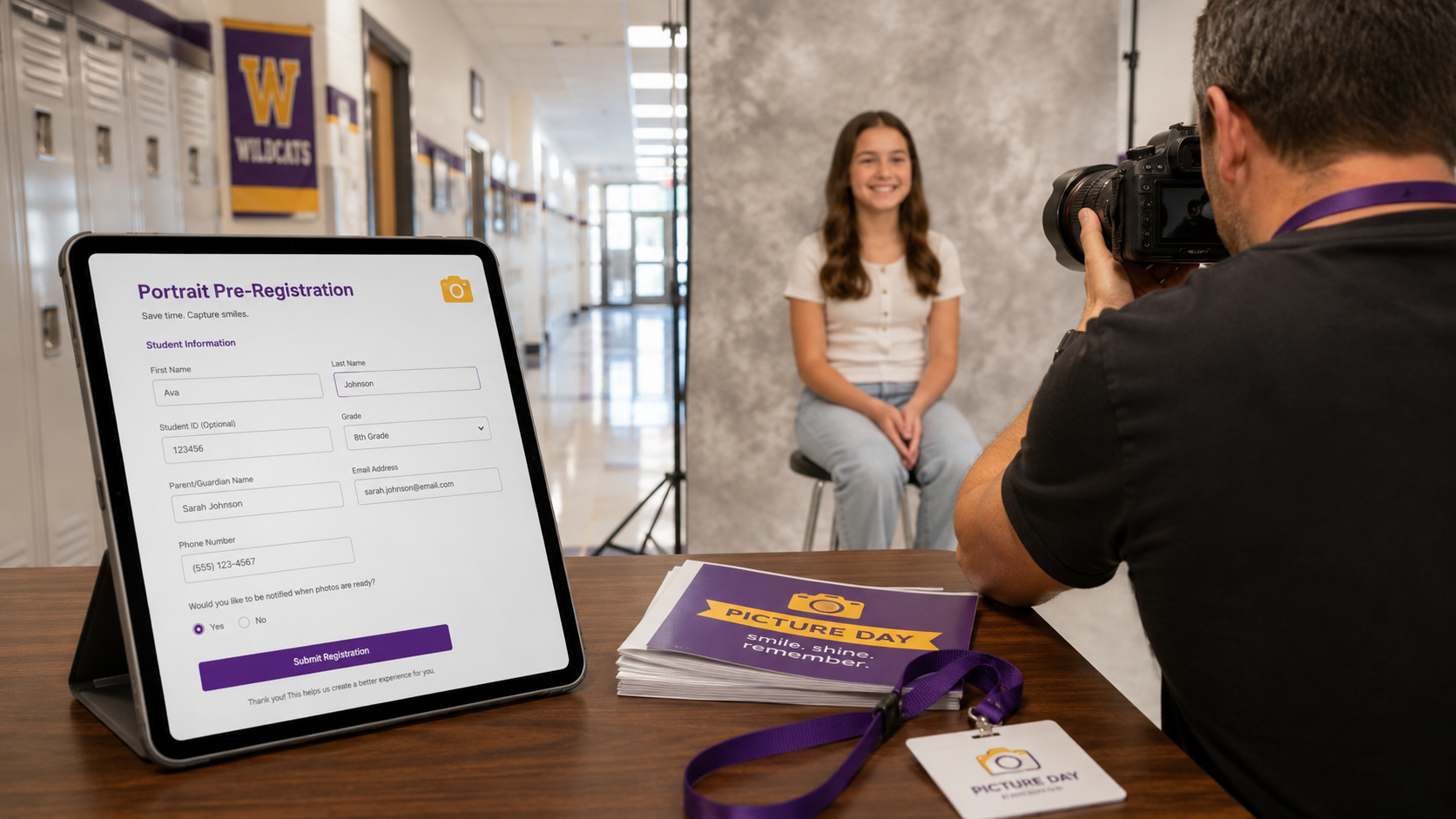
Simplify Student Registration with Digital Portrait Forms
Picture day runs much more smoothly when student information is collected before the first photo is taken.
Digital portrait forms allow parents or school administrators to submit student information online instead of completing paper forms on the day of the shoot.
Information such as:
- Student name
- Grade and section
- Roll number
- Student ID
- Parent or guardian details
- Contact number
- Email address
- Special instructions
can be collected digitally, validated automatically, and organized before photography begins.
By replacing paper forms with digital registration, photographers spend less time managing paperwork and more time capturing portraits.
Schools also benefit from improved accuracy, while parents enjoy a faster and more convenient registration process.
Build an Organized Student Database Before Picture Day
Once student information has been collected, the next challenge is keeping it organized.
Modern school photography software automatically creates structured student records that make it easy to manage large photography projects.
Student information can be organized by:
- School
- Campus
- Academic year
- Grade
- Section
- Classroom
- Student ID
- Roll number
Having a centralized student database eliminates the need to search through spreadsheets or handwritten records when organizing images after picture day.
It also creates a reliable foundation for photo matching, gallery creation, and online delivery.
For photography businesses managing multiple schools simultaneously, structured student data becomes essential for maintaining accuracy while scaling operations.
Connect Your Camera to the Cloud for Faster School Photography
Once student information is organized, the next challenge is managing thousands of photos captured on picture day.
Traditionally, photographers transfer images from memory cards to a computer after every session. The files are then renamed, sorted into folders, uploaded to cloud storage, and shared with the editing team. While this process works, it is slow, repetitive, and prone to errors—especially when multiple photographers are covering different schools or campuses.
Camera-to-cloud technology eliminates these manual steps.
Instead of waiting until the end of the day, photos are uploaded securely to the cloud as they are captured. Editing teams can begin reviewing images immediately, reducing turnaround time and keeping projects moving without interruption.
For school photography businesses handling high-volume shoots, camera-to-cloud workflows help:
- Reduce manual file transfers
- Start editing sooner
- Minimize the risk of missing files
- Improve collaboration between photographers and editors
- Deliver photos to schools and parents faster
By removing unnecessary delays, photographers can focus more on capturing great portraits and less on managing storage devices.
Automatically Match Student Photos with AI Face Recognition
One of the biggest challenges in school photography is ensuring every student receives the correct photos.
Manually matching thousands of portraits with student records is time-consuming and increases the risk of errors. A single mismatched image can create confusion for parents, generate additional support requests, and delay photo delivery.
Modern school photography software uses AI face recognition to simplify this process.
Instead of manually searching through folders, AI helps match student portraits with their registered profiles, making image organization faster and more accurate.
Benefits of AI-powered photo matching include:
- Faster student identification
- Reduced manual sorting
- Improved accuracy
- Fewer delivery errors
- Better experience for parents and schools
For photography studios handling multiple schools, AI automation can save hours of administrative work while improving overall workflow efficiency.
Organize Thousands of School Photos Automatically
A typical school photography project can generate thousands—or even tens of thousands—of images in a single day.
Without a structured system, photographers often spend hours creating folders, renaming files, and organizing images manually.
Modern school photography software automatically organizes images into predefined folder structures based on student data, including:
- School
- Campus
- Academic Year
- Grade
- Section
- Classroom
- Student Name
- Student ID
Automatic folder organization reduces administrative work while making it easier for photographers, editors, and schools to locate specific images whenever they are needed.
Instead of spending time managing files, teams can focus on editing, delivery, and customer service.
Deliver School Photos Online Through Secure Digital Galleries
Parents today expect a simple, digital experience when viewing and downloading school photos.
Sending photos through messaging apps or large file-sharing links often creates confusion, security concerns, and unnecessary support requests.
Modern school photography platforms provide secure online galleries where parents can access their child's portraits from any device.
Digital galleries offer several advantages:
- Faster photo delivery
- Secure online access
- Organized student albums
- Mobile-friendly viewing
- Easy downloads and sharing
- Reduced administrative queries
A well-organized online gallery improves the parent experience while reducing the time photography teams spend responding to delivery-related questions.
How Kamero Simplifies School Photography Workflows
Managing school photography often requires multiple tools for registration, student records, photo storage, image organization, and delivery.
Kamero brings these processes together into a single platform designed to simplify high-volume photography workflows.
With Kamero, photography businesses can:
- Collect student information using digital portrait forms
- Manage structured student databases
- Upload images directly from compatible cameras with KamSync (Camera-to-Cloud)
- Automatically organize school photos
- Use AI Face Recognition to match students with their portraits
- Share photos through secure branded online galleries
- Monitor gallery activity and photo engagement
- Scale operations across multiple schools and campuses
Instead of switching between disconnected software, photographers can manage their entire school photography workflow from one centralized platform.
Benefits of a Digital School Photography Workflow
Moving from paper-based processes to a digital workflow delivers measurable improvements across every stage of school photography.
Faster Operations
Digital registration, automated organization, and cloud-based workflows significantly reduce manual work.
Better Accuracy
Automated student records and AI-powered matching reduce errors and improve data consistency.
Improved Parent Experience
Parents can register online, access secure galleries, and receive photos more quickly.
Easier School Management
Schools benefit from organized student records, simplified communication, and faster project completion.
Greater Business Scalability
By reducing administrative overhead, photography businesses can handle more schools, larger projects, and higher photo volumes without proportionally increasing staffing.
Conclusion
As schools continue embracing digital technology, photography businesses must modernize the way they manage student information, images, and deliveries.
Replacing paper forms with digital portrait registration, automating student data management, using camera-to-cloud technology, and organizing images with AI creates a faster, more accurate, and more scalable workflow.
The most successful school photography businesses are no longer defined only by the quality of their portraits. They stand out by delivering a seamless experience for schools, parents, and students while efficiently managing thousands of images behind the scenes.
Investing in a modern school photography workflow helps reduce administrative work, improve customer satisfaction, and create the foundation for long-term business growth.
Conclusion: The Future of School Photography Is Paperless
The traditional paper-based school photography workflow was built for a different era.
As schools become increasingly digital, photography businesses must adapt their operational infrastructure to match modern expectations. Digital portrait forms, automated student databases, cloud-based image processing, and structured delivery systems allow studios to reduce administrative burden while improving accuracy and scalability.
The most successful school photography businesses are no longer defined solely by image quality. They are defined by how efficiently they manage information, automate workflows, and deliver results at scale.
A paperless digital workflow is quickly becoming the new standard for modern school picture day operations.
Ready to Modernize Your School Photography Workflow?
Book a Demo: Discover how a paperless workflow can help your studio eliminate manual administration and scale school photography operations with confidence.
Start Your Free Trial: Experience digital portrait forms, automated organization, and faster school photo delivery from a single platform.
Follow Kamero on Instagram: See how leading school photography businesses are simplifying picture day with modern digital workflows.

About Mayank Oraon
Hi, I’m Mayank, an MBA student exploring the business world with a focus on operations, supply chain, and product strategy (aka the parts of a business that keep things from quietly falling apart).
I’m interested in understanding how systems actually run behind the scenes- and why they sometimes don’t. I also enjoy simplifying complex ideas - partly because it helps others, and partly because if I can’t explain it simply, I probably didn’t understand it in the first place (which is a humbling but effective feedback loop).