Introduction: Shifting from Simple Day-Rates to High-Yield Corporate Revenue Models
For decades, commercial event photography has operated on a relatively simple business model. A client hires a photographer or agency for a fixed day rate, the event is covered, the images are delivered, and the project ends.
While this approach remains common, it leaves significant revenue untapped.
Corporate events, trade expos, leadership summits, dealer meets, award ceremonies, and industry conferences generate thousands of high-value visual assets. Yet many studios monetize only the initial assignment while overlooking the larger commercial opportunity created by sponsors, exhibitors, delegates, VIP attendees, and corporate marketing teams.
As enterprise events become increasingly digital, forward-thinking studios are shifting from project-based billing to revenue-generating delivery ecosystems. Instead of treating photos as a final deliverable, they are transforming event galleries into active sales channels.
The result is a new model for corporate photography revenue—one that combines instant delivery, AI-powered discovery, and integrated commerce to create recurring monetization opportunities long after the event concludes.
The Flat-Fee Ceiling in Commercial Photography Studio Operations
Traditional pricing structures create predictable income, but they also impose natural limits on growth.
Why Day-Rate Models Eventually Restrict Scale
A studio can only photograph a finite number of events each month. Revenue growth therefore becomes directly tied to increasing prices or increasing workload.
Neither strategy scales efficiently.
Large conferences often host thousands of attendees, dozens of sponsors, multiple exhibitors, keynote speakers, and executive stakeholders. Every one of these participants represents a potential customer for event photography assets. Yet under conventional workflows, this demand remains largely unmonetized.
The studio completes the assignment, delivers the gallery, and leaves substantial revenue on the table.
The Hidden Value Inside Corporate Event Audiences
Corporate attendees increasingly expect personalized digital experiences.
Sponsors want branded content for marketing campaigns. Exhibitors need event visuals for social media. Speakers require professional images for thought leadership posts. Executives often need photographs for internal communications and public relations initiatives.
When these audiences can easily discover and purchase relevant assets, the economics of event photography change dramatically.
The opportunity shifts from a single client transaction to a broader ecosystem of buyers.
Transitioning Into an Integrated B2B E-Commerce Model
Modern event photography is evolving beyond content creation.
Studios that consistently grow revenue are increasingly focusing on content distribution and monetization infrastructure.
Creating Continuous Revenue Opportunities
The most successful event businesses no longer rely exclusively on assignment fees. Instead, they build systems that allow attendees, sponsors, and stakeholders to access relevant content immediately.
This creates additional purchase opportunities without increasing shooting hours.
Each image captured becomes a potential commercial asset capable of generating value beyond the original project scope.
Combining Delivery and Commerce
Traditional galleries separate viewing from purchasing.
Users browse images in one location and complete transactions elsewhere, introducing friction that reduces conversion rates.
Modern event commerce platforms remove these barriers by integrating discovery, viewing, purchasing, and delivery into a single workflow. When the purchasing process becomes seamless, more users complete transactions while interest remains high.

Setting Up the Checkout Engine for B2B Event Photo Sales
A successful monetization strategy depends on making purchasing simple.
Moving Beyond Single-Photo Sales
Historically, event photography stores focused on selling individual images.
While this approach works in some markets, corporate attendees generally seek convenience. They are less interested in purchasing one image at a time and more interested in accessing every relevant image from the event.
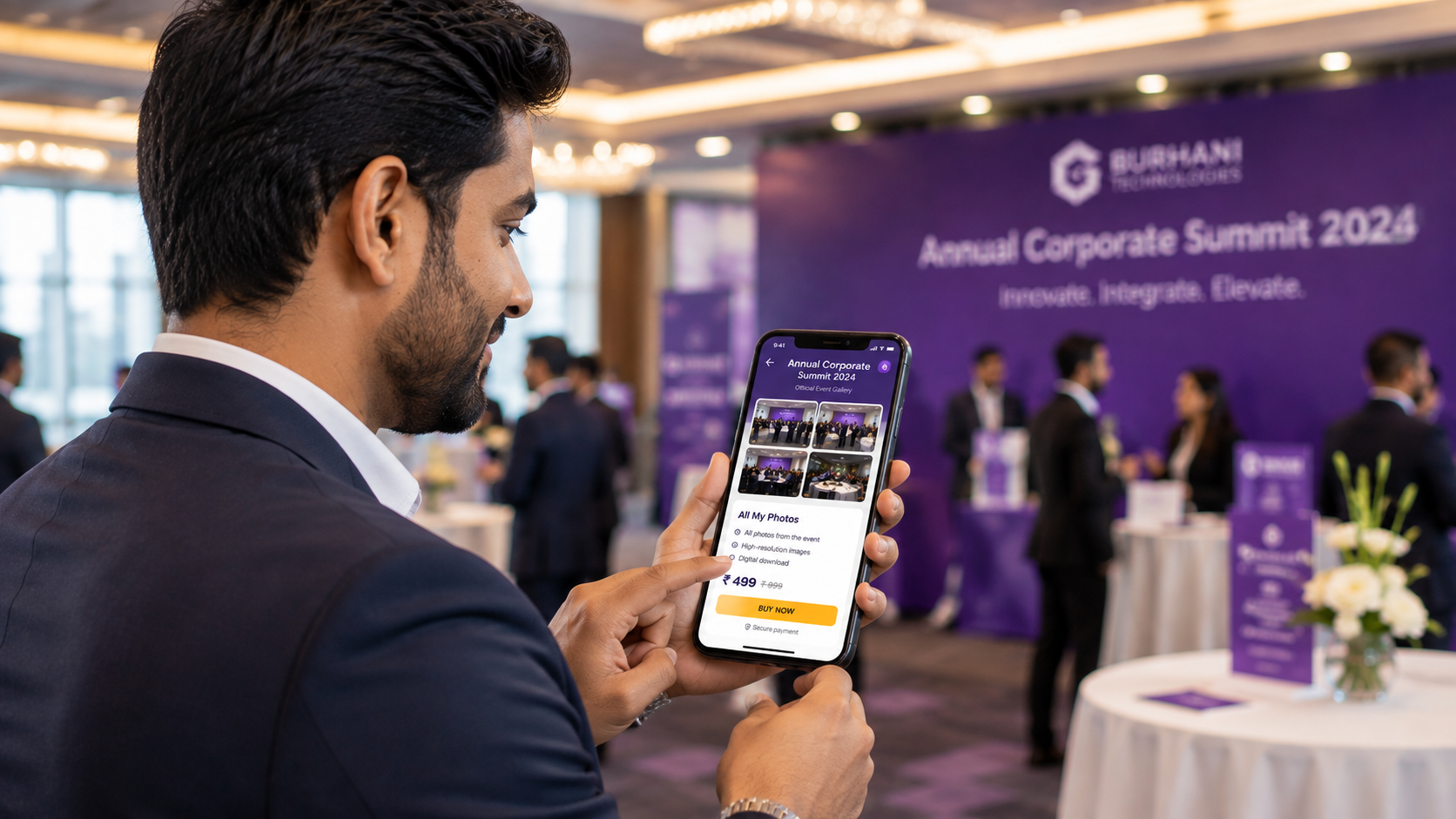
This has created demand for bundled experiences such as "All My Photos" packages, where attendees gain instant access to every image containing them.
The convenience significantly improves conversion potential while increasing average transaction value.
Using Pricing Strategies to Increase Revenue
Successful event stores often leverage structured pricing models.
Early-access offers, bundled downloads, sponsor-specific packages, and time-sensitive promotions can encourage faster purchasing decisions while maintaining healthy margins.
These strategies allow studios to generate additional revenue without increasing operational complexity.
Removing Friction from the Payment Experience
Even highly interested buyers abandon purchases when checkout becomes complicated.
Supporting Local and Global Payment Preferences
Corporate events frequently attract attendees from multiple regions.
Providing access to trusted payment methods improves purchase confidence and reduces abandonment rates. Whether buyers prefer domestic payment solutions or international gateways, the checkout experience should remain fast and familiar.
The easier it is to complete a transaction, the higher the likelihood of conversion.

Delivering Assets Instantly After Purchase
The moment payment is completed, buyers expect immediate access.
Manual approval processes, delayed downloads, and administrative intervention create unnecessary friction.
Automated delivery workflows ensure that purchased content becomes available immediately, improving customer satisfaction while reducing operational workload for studios.
Driving Conversions Through AI-Powered Discovery
One of the biggest barriers to photo sales is search friction.
When attendees cannot quickly find their images, purchasing intent declines.
The Power of Selfie-Based Discovery
AI-powered face matching changes this dynamic entirely.
Instead of scrolling through thousands of photographs, attendees can upload a selfie and instantly view relevant images from the event.
This creates a highly personalized experience that dramatically reduces search effort.
More importantly, it places users directly in front of content they are most likely to purchase.
Capturing Peak Purchase Intent
Timing plays a critical role in conversion.
Attendees are most likely to engage with event content while excitement remains high. When relevant images are surfaced instantly, purchasing decisions occur naturally during this peak engagement period.
Removing discovery delays helps transform interest into action.
Using Real-Time Promotion to Increase Gallery Traffic
Even the best storefront requires visitors.
Successful event monetization strategies combine AI discovery with proactive audience engagement.
Simplifying Access During the Event
QR codes, registration touchpoints, and branded access links allow attendees to enter galleries quickly without navigating complicated workflows.
The shorter the path between event participation and gallery access, the stronger the engagement rates.
Leveraging Automated Notifications
Many attendees forget to revisit galleries after an event concludes.
Automated notifications help solve this problem by bringing users back when new content becomes available.
Timely alerts can significantly increase gallery traffic, improve engagement, and generate additional sales opportunities throughout the event lifecycle.
The Kamero Advantage: Transforming Galleries into Revenue Engines
Many gallery platforms were originally built for storage and sharing rather than monetization.
Kamero approaches the challenge differently by treating event media as a commercial asset.
Through Kam-Sync, photographers can move images directly from compatible camera systems into cloud environments without waiting for manual uploads. High-resolution files can begin flowing into organized galleries while events are still in progress, enabling near-instant access for attendees and clients.
AI-powered discovery helps attendees find their photos quickly, while integrated commerce workflows enable seamless purchases without redirecting users to external systems. Dynamic watermarking protects intellectual property, role-based controls support enterprise operations, and white-label environments allow studios to maintain complete brand ownership throughout the customer experience.
For commercial agencies and enterprise event photographers, this creates a direct path from image capture to revenue generation.
Operational Scaling: Converting Media Assets Into a Continuous Lead Funnel
The most valuable event galleries do more than generate photo sales.
They also create opportunities for future business.
Turning Viewers Into Qualified Leads
Every visitor who accesses an event gallery demonstrates a level of interest.
By integrating branded profiles, agency information, and lead capture opportunities directly within the viewing experience, studios can transform passive audiences into prospective clients.
This extends the value of each event far beyond immediate sales revenue.
Supporting Faster Client Approvals
Corporate clients often spend weeks reviewing and approving final selections.
Long email chains, repeated revisions, and fragmented communication slow down project completion and delay payments.
Centralized proofing workflows simplify approvals, reduce administrative overhead, and help studios accelerate billing cycles.
The result is improved cash flow alongside a more professional client experience.
Conclusion: The New Economic Standard for Commercial Photography Studios
Corporate event photography is no longer limited to assignment fees and final gallery delivery.
Modern studios have an opportunity to build scalable revenue systems that generate value throughout the entire event lifecycle. By combining instant-access corporate delivery, AI-powered photo discovery, integrated commerce, and streamlined client workflows, photographers can unlock new income streams without increasing production workload.
As corporate events continue to grow in scale and complexity, the studios that succeed will be those that treat media delivery as a business platform rather than a post-production task.
The future of commercial photography belongs to organizations that can capture, distribute, monetize, and manage visual assets from a single operational ecosystem.
Ready to Turn Every Corporate Event Into a Revenue Opportunity?
Book a Demo: See how AI-powered photo discovery and integrated sales workflows can help your studio generate revenue beyond the initial event contract.
Start Your Free Trial: Experience instant delivery, seamless attendee purchases, and enterprise-grade event commerce from one platform.
Follow Kamero on Instagram: Explore how leading photographers and agencies are transforming event galleries into scalable business growth engines.

About Nidhi S
Hey there! I’m an MBA student with a keen interest in the evolving world of digital marketing and business strategy. I enjoy exploring how brands build their online presence and the creative process behind turning strategic goals into engaging stories.
When I’m not caught up in marketing trends, you’ll probably find me down a YouTube rabbit hole or binge-watching sitcoms. I’m a fan of good stories—whether they’re in a marketing campaign or a 20-minute TV episode—and I’m always looking for new perspectives to keep things interesting!