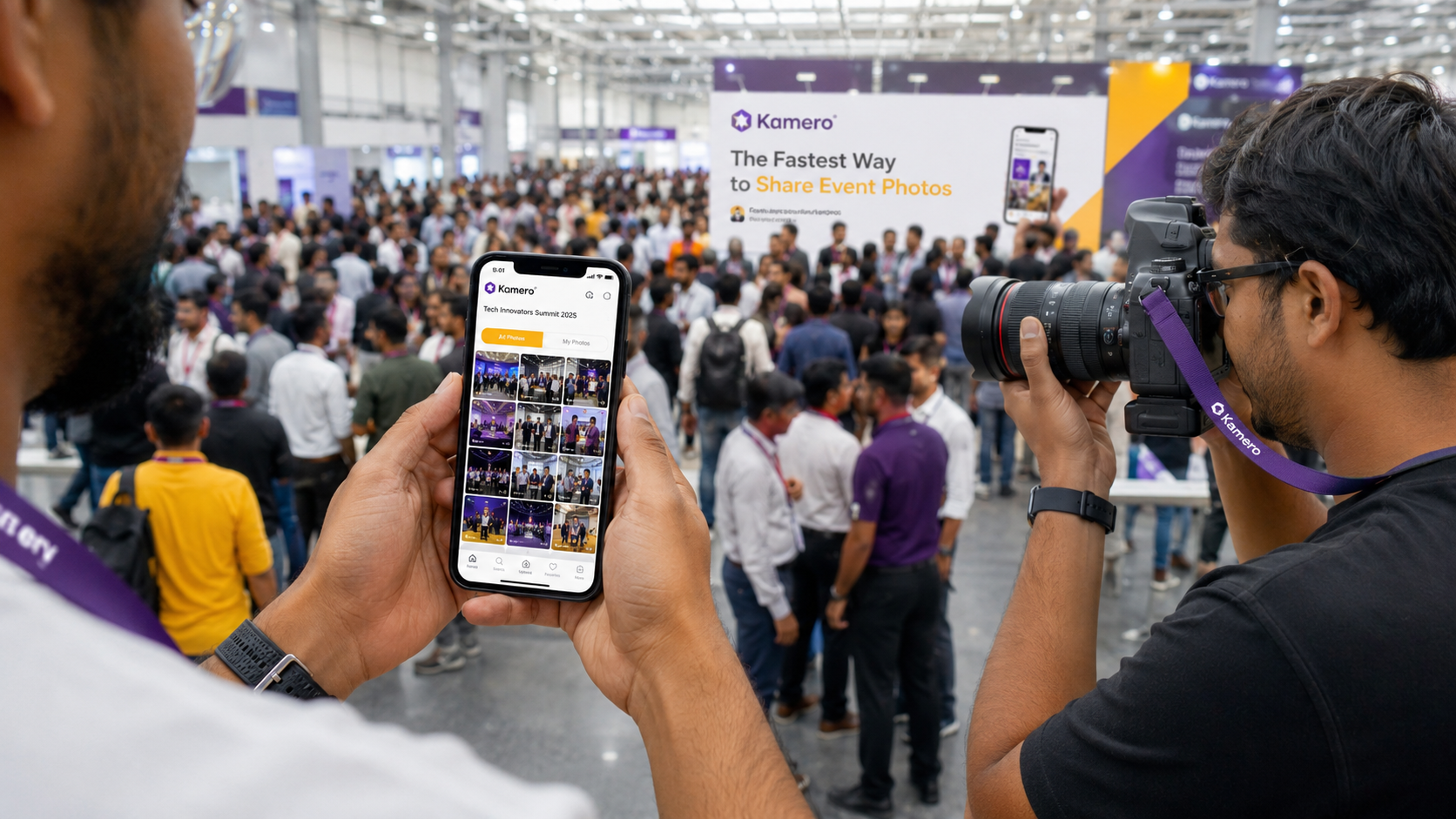
Introduction: The Operational Breaking Point of Massive Event Media Distribution
As exhibitions, trade fairs, industry expos, and corporate conventions continue to grow in scale, media distribution has become one of the most overlooked operational challenges in event management.
Capturing thousands of photographs is no longer difficult. Distributing them instantly to thousands of attendees is.
A modern exhibition can easily attract 10,000 to 50,000 attendees across multiple halls, sponsor booths, keynote stages, networking lounges, and experiential zones. Hundreds of gigabytes of content may be generated within a single day.
Unfortunately, many event organizers still rely on infrastructure originally designed for small-scale galleries. Shared cloud folders, browser-based upload tools, and consumer-grade photo portals often struggle under heavy traffic loads. What works for a wedding or private event quickly breaks down when thousands of users attempt to access content simultaneously.
The challenge is no longer storage.
The challenge is scale.
Organizations that successfully solve massive event photo distribution gain a competitive advantage in attendee engagement, sponsor visibility, lead generation, and post-event communication. This has created demand for a new operational standard: zero-latency event sharing.
Understanding the Challenges of Massive-Scale Photo Distribution
Large exhibitions place unique demands on digital infrastructure.
Why Traditional Platforms Fail Under Heavy Load
Many gallery systems were never engineered for enterprise-scale concurrency.
When thousands of attendees receive access links simultaneously, server requests spike dramatically. Pages load slowly, image rendering stalls, search functions become unreliable, and in extreme cases entire systems become inaccessible.
The attendee experience deteriorates rapidly.
Visitors expect instant access to event content. Delays of even a few seconds can reduce engagement, increase abandonment rates, and significantly lower overall gallery participation.
The Network Challenge Inside Large Venues
Massive exhibitions introduce another problem: network congestion.
Convention centers routinely host thousands of connected devices competing for bandwidth across venue Wi-Fi infrastructure and mobile networks. Photographers, exhibitors, organizers, attendees, live-streaming teams, and event technology providers all consume network resources simultaneously.
Without intelligent infrastructure design, upload queues form quickly. Files become delayed, transfers fail, and operational bottlenecks emerge throughout the content pipeline.
For event organizers managing large-scale productions, network resilience becomes just as important as storage capacity.
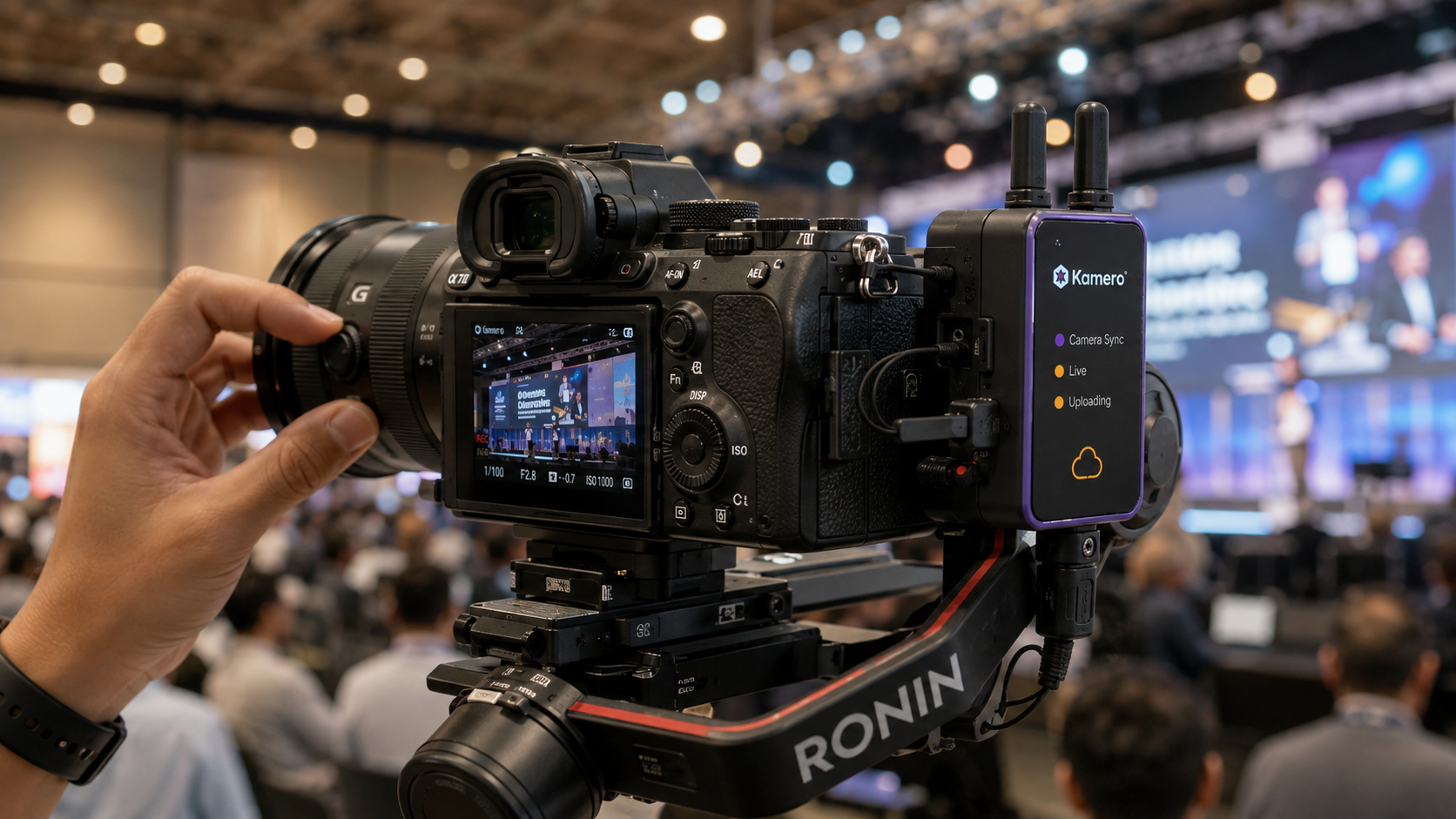
Defining the Modern Standard for 10,000+ Attendee Photo Delivery
Successful event media operations require more than fast uploads.
What Zero-Latency Event Sharing Actually Means
Zero-latency does not imply that images appear instantaneously.
Rather, it describes a workflow where content moves from capture to attendee discovery with minimal operational delay. The goal is to make assets available while event engagement is still actively occurring.
For large exhibitions, this often means reducing upload-to-discovery timelines from several hours—or even days—to less than thirty minutes.
When attendees can access content while still on-site, engagement rates increase dramatically.
Building Consistent Media Pipelines
Scalability depends on consistency.
Every image must move through ingestion, processing, organization, approval, storage, and delivery without interruption. If any stage becomes overloaded, the entire workflow slows down.
Modern event operations therefore require distributed architectures capable of handling traffic spikes without introducing administrative bottlenecks.
Engineering Infrastructure for Global Concurrency
High-volume event distribution is fundamentally an infrastructure challenge.
Managing Parallel Upload Streams
Large exhibitions rarely rely on a single photographer.
Multiple teams often work simultaneously across keynote stages, exhibitor zones, networking events, product demonstrations, media rooms, and VIP areas. This creates dozens of concurrent upload streams entering the platform at the same time.
Enterprise-grade systems must be capable of ingesting these uploads continuously without creating queue congestion.
Distributed processing environments help balance workloads automatically, ensuring that uploads continue flowing even during periods of peak activity.
Scaling Storage and Delivery Performance
Storage alone does not solve performance problems.
Attendees access images from different cities, countries, and network environments. To maintain a consistent experience, modern platforms rely on distributed delivery infrastructure that reduces latency and improves content availability regardless of location.
This architecture becomes increasingly important when exhibitions attract international audiences and global media coverage.
Eliminating Post-Event Sorting Bottlenecks
Distribution speed depends heavily on content organization.
Structuring Massive Multi-Day Event Archives
A major exhibition may generate tens of thousands of images across multiple venues, stages, exhibitors, and event days.
Without automated organization, administrative teams can spend days manually sorting content into folders and galleries before distribution can begin.
This delay directly impacts attendee engagement and sponsor value.
Organizing Assets at the Point of Ingestion
Modern media operations increasingly rely on automated metadata structures that organize content as it enters the platform.
By categorizing files immediately during ingestion, event teams eliminate much of the manual effort traditionally associated with post-production workflows.
The result is faster publication, improved searchability, and significantly reduced administrative overhead.
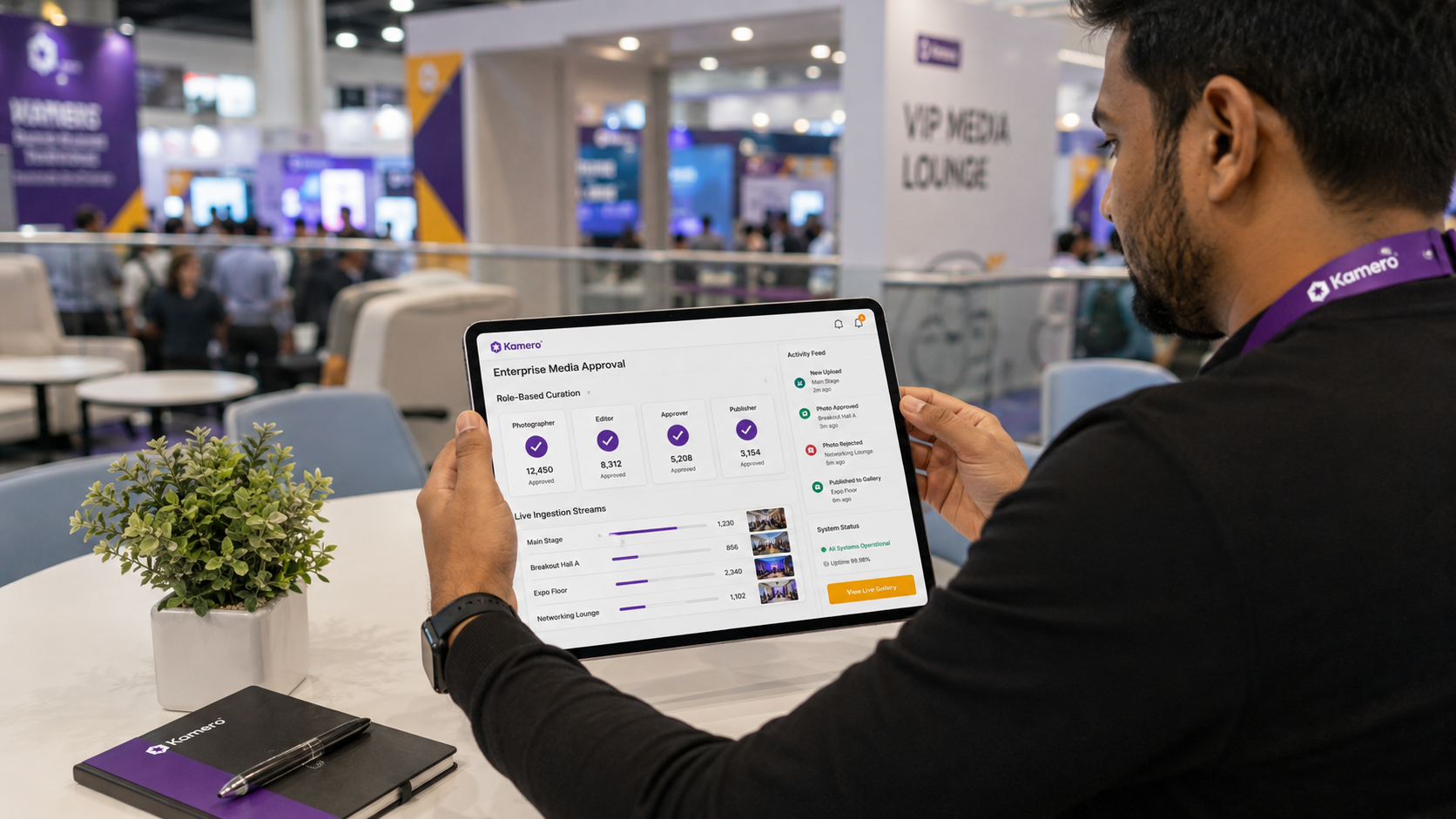
Secure Edge Ingestion: Bringing Content into the Cloud
The quality of distribution depends on the efficiency of ingestion.
Eliminating Manual Transfer Dependencies
Traditional workflows require photographers to offload memory cards to laptops before uploading content manually.
This process introduces delays, increases handling complexity, and creates multiple points of failure.
Camera-to-cloud workflows eliminate these bottlenecks by allowing content to move directly from capture devices into centralized cloud environments.
With Kam-Sync, compatible camera systems can begin transmitting images immediately, reducing the time between capture and availability.
Balancing Speed and File Quality
Exhibitions often require both rapid delivery and high-resolution archival assets.
Modern workflows can prioritize lightweight previews for immediate attendee engagement while simultaneously processing full-resolution RAW files in the background.
This allows organizations to maintain responsiveness without sacrificing quality.
Governance and Control at Enterprise Scale
Speed without governance creates risk.
Securing Content Before Publication
Not every image should be published automatically.
Corporate events frequently involve executives, sponsors, proprietary demonstrations, media embargoes, and compliance considerations that require review before distribution.
Staging environments allow content to be reviewed prior to public release, ensuring organizations retain control over what becomes visible.
Role-Based Access and Approval Systems
Large events involve multiple stakeholders.
Photographers, event agencies, sponsors, exhibitors, communications teams, and administrators all require different permissions.
Role-based access controls help ensure that users only access content relevant to their responsibilities while maintaining accountability throughout the workflow.
This becomes increasingly important as event size and organizational complexity increase.
The Kamero Advantage: Built for High-Concurrency Event Operations
Most photo-sharing platforms were originally designed for small-scale projects.
Kamero is designed for high-volume event environments where thousands of attendees, multiple photographers, and continuous content streams operate simultaneously.
Through Kam-Sync, images move directly from compatible camera systems into cloud environments without requiring manual transfers. Automated processing pipelines help organize assets rapidly, while role-based permissions and approval workflows maintain operational control.
Features such as dynamic watermarking, white-label environments, custom branding, WhatsApp distribution channels, and enterprise-grade governance tools enable organizers to manage large-scale media operations through a unified platform.
Rather than treating event content as a post-event deliverable, Kamero enables it to function as a live engagement channel.
Turning Scale into Business Value
Large attendee numbers create opportunities beyond content distribution.
Capturing First-Party Attendee Data
Every gallery interaction creates valuable engagement signals.
Registration workflows, lead forms, content access requests, and attendee interactions can help organizers gather meaningful first-party data while maintaining compliance requirements.
This transforms galleries into active engagement environments rather than passive storage repositories.
Supporting Post-Event Business Development
The value of an exhibition does not end when attendees leave the venue.
Well-structured media platforms provide ongoing opportunities for sponsor visibility, attendee nurturing, lead generation, and future event promotion.
By extending engagement beyond the event itself, organizers can create additional value for both exhibitors and sponsors.
Reducing Post-Event Administrative Work
Efficient distribution systems simplify event operations.
Streamlining Proofing and Approvals
Traditional post-event workflows often rely on email chains, file-sharing platforms, and manual review processes.
Modern centralized systems allow stakeholders to access, review, approve, and distribute content within a single environment.
This reduces delays while improving transparency.
Accelerating Financial Workflows
Faster content delivery often leads to faster project completion.
When clients receive content sooner, approvals move more quickly, invoicing cycles shorten, and outstanding receivables can be resolved faster.
For event agencies and photography teams, operational efficiency translates directly into improved cash flow.
Conclusion: Building the Future of Large-Scale Event Media Distribution
As exhibitions continue growing in size and complexity, traditional photo-sharing infrastructure is reaching its limits.
Event organizers can no longer rely on systems that were designed for small audiences and low concurrency. Delivering content to 10,000 or more attendees requires infrastructure capable of supporting continuous ingestion, intelligent processing, secure governance, and large-scale distribution without interruption.
Zero-latency event sharing is not simply about speed. It is about creating resilient workflows that maintain performance under pressure while enhancing attendee engagement and operational efficiency.
Organizations that adopt scalable media architectures gain significant advantages in audience satisfaction, sponsor value, lead generation, and post-event communication.
For modern exhibitions, media distribution has become a core operational capability rather than an afterthought.
Ready to Scale Event Media for 10,000+ Attendees?
Book a Demo: Discover how Kamero helps organizers manage high-volume event photography with real-time delivery and enterprise-grade scalability.
Start Your Free Trial: Experience camera-to-cloud workflows, automated organization, and large-scale attendee distribution from a single platform.
Follow Kamero on Instagram: See how event organizers, exhibition boards, and media teams are delivering content faster while managing massive attendee volumes with confidence.

About Mohit Prakash Lal
Hi, I’m Mohit, an MBA student at TAPMI, Manipal, exploring the world of business with a focus on marketing and strategy. I’m interested in understanding how brands connect with people and create meaningful, lasting impact in a competitive landscape. I enjoy working on real-world projects across marketing, sales, and business development, where I can apply ideas in practical settings.
I also enjoy simplifying ideas into clear, practical insights. Outside of work, I like travelling, reading, and taking time to recharge.