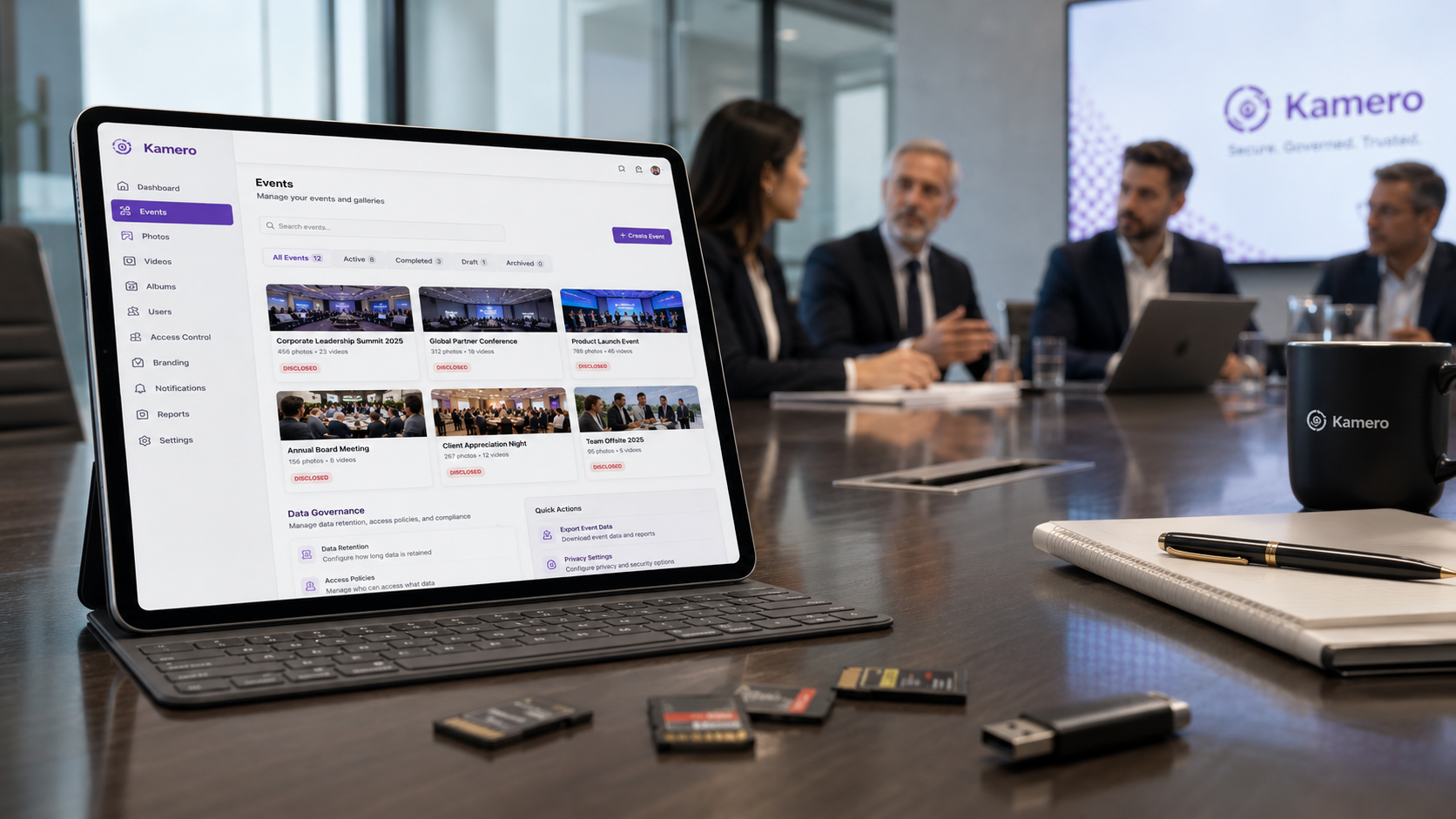
Introduction: The Hidden Security Risk in Executive Event Media
Corporate board meetings, leadership summits, investor briefings, pre-IPO roadshows, and strategic planning sessions generate highly sensitive information.
While organizations often invest heavily in cybersecurity, access management, and data governance, one risk is frequently overlooked: event photography and media distribution.
A single image can unintentionally capture confidential financial projections, acquisition discussions, product roadmaps, customer data, internal dashboards, or strategic presentations visible on screens, whiteboards, or printed documents.
The challenge isn't simply capturing these assets.
It's controlling who can access them, where they are stored, how they are distributed, and whether organizations can maintain visibility throughout the asset lifecycle.
As enterprise governance requirements continue to increase, media delivery can no longer operate as an isolated post-event activity. It must become part of a broader enterprise security and compliance strategy.
This is where a secure corporate image delivery framework becomes essential.
The Security Challenges Hidden Inside Traditional Media Workflows
The Risk of Uncontrolled Asset Distribution
Many organizations still rely on legacy workflows involving memory cards, external hard drives, cloud storage links, email attachments, and consumer-grade file-sharing tools.
These methods introduce multiple points of exposure.
Media files are often duplicated across devices, transferred between vendors, downloaded onto personal machines, and shared through uncontrolled channels.
The result is a fragmented environment where visibility and governance become increasingly difficult.
When Convenience Creates Compliance Exposure
Consumer sharing platforms are optimized for accessibility.
Enterprise environments require control.
Public links, open galleries, unrestricted downloads, and unmanaged permissions may be acceptable for consumer use cases, but they create challenges for organizations operating under internal governance frameworks, vendor risk programs, privacy policies, and regulatory obligations.
For leadership teams, the question is no longer whether assets can be shared.
The question is whether assets can be shared securely.
Why Traditional Event Media Workflows Often Fail Enterprise Audits
Physical Media and Manual Processes
Many security challenges begin before files ever reach the cloud.
Common operational risks include:
- Unencrypted storage devices
- Manual memory card transfers
- USB-based asset movement
- Uncontrolled local backups
- Third-party contractor access
Each additional transfer increases the number of systems and individuals exposed to sensitive content.
Limited Governance After Upload
Even when files reach cloud platforms, governance challenges often remain.
Many platforms provide basic sharing functionality but limited control over:
- Role-based permissions
- Approval workflows
- Audit visibility
- Access segmentation
- Retention policies
For organizations conducting vendor reviews or security assessments, these gaps can become significant concerns.
Building a Secure Corporate Image Delivery Framework
Moving to Camera-to-Cloud Workflows
Modern enterprise media operations benefit from reducing unnecessary transfer points.
Camera-to-cloud workflows help streamline asset movement by transferring media directly into managed environments rather than relying on multiple manual handoffs.
This creates:
- Faster delivery timelines
- Reduced operational friction
- Better centralization
- Improved visibility
For large-scale corporate events, these advantages become increasingly important as content volumes grow.
Establishing Governance at the Platform Level
Security is not achieved through storage alone.
It requires governance.
A secure media framework should support:
- Role-based access controls (RBAC)
- Approval hierarchies
- Segmented content visibility
- Audit tracking
- Administrative oversight
These controls help organizations ensure that sensitive assets remain visible only to authorized stakeholders.
Maker-Checker Approval Workflows
For communications teams, speed must be balanced with control.
Maker-checker workflows allow organizations to review and approve content before distribution.
This is particularly important for:
- Executive communications
- Investor relations
- Board meetings
- Regulatory announcements
- Product launches
By introducing structured review processes, organizations reduce the risk of accidental disclosure while maintaining operational efficiency.
Advanced Privacy and Access Management
Restricting Discovery Through Event-Level Segmentation
Large enterprise events often involve multiple stakeholder groups.
Executives, sponsors, employees, media representatives, partners, and attendees may all require different levels of access.
Event-level segmentation helps organizations control visibility without creating administrative complexity.
Instead of broad access, stakeholders receive access aligned with their role and requirements.
Privacy-First Discovery Models
Modern privacy expectations continue to evolve.
Organizations increasingly favor systems that provide personalized access while minimizing unnecessary exposure.
Opt-in discovery mechanisms help balance convenience and privacy by allowing individuals to access relevant content without requiring broad public visibility.
This approach is particularly valuable for executive teams, VIP attendees, and regulated environments.
Strengthening Access Controls
Enterprise media environments often require multiple layers of authentication and authorization.
These may include:
- Password-protected galleries
- OTP verification
- Permission-based access groups
- Restricted download controls
- Session management policies
Together, these measures create a more controlled and auditable environment for sensitive content.
The Kamero Advantage for Enterprise Event Security
Built for Governance-Oriented Media Delivery
Unlike consumer-focused sharing tools, Kamero is designed to support structured enterprise workflows.
The platform combines content delivery with governance, access management, branding controls, and operational oversight.
This allows organizations to manage event media through a centralized framework rather than a collection of disconnected tools.
Streamlined Camera-to-Cloud Ingestion
Kamero's Kam-Sync infrastructure enables direct media movement from capture devices into centralized cloud environments.
This reduces dependency on manual transfers and accelerates asset availability for authorized teams.
For enterprise environments, the result is a faster and more controlled media workflow.
Access Management and Brand Protection
Organizations can maintain stronger oversight through capabilities such as:
- Role-based permissions
- Administrative approval layers
- White-label deployment options
- Dynamic watermark controls
- Structured content organization
These features help ensure media remains aligned with organizational governance standards.
Privacy-Conscious Event Experiences
Kamero's event-level architecture supports privacy-focused content discovery while helping organizations maintain control over access and distribution.
This enables secure sharing experiences without sacrificing usability for stakeholders.
The Business Value of Enterprise Media Governance
Supporting Internal Compliance Objectives
A structured media delivery framework can contribute to broader organizational objectives related to:
- Data governance
- Vendor risk management
- Information security
- Brand protection
- Audit readiness
Rather than treating media operations as a separate function, organizations can integrate them into existing governance strategies.
Reducing Operational Complexity
Many communications teams rely on multiple tools for storage, approvals, distribution, watermarking, and stakeholder management.
Consolidating these activities into a unified platform can simplify operations while improving oversight.
This creates benefits for both communications teams and IT stakeholders.
Accelerating Secure Communications
Security should not come at the expense of speed.
When governance is built into the workflow itself, organizations can distribute approved content more quickly while maintaining confidence in their controls.
This enables faster communication without compromising oversight.
Conclusion: The Future of Enterprise Event Media Is Governance-Driven
As corporate events become increasingly strategic, media assets become increasingly valuable.
The challenge is no longer generating content.
The challenge is protecting it.
Organizations that continue relying on unmanaged sharing workflows expose themselves to unnecessary operational, compliance, and reputational risks.
By adopting a governance-first approach to media delivery, enterprises can improve security, strengthen compliance, enhance stakeholder trust, and accelerate communications simultaneously.
In the years ahead, media infrastructure will increasingly be evaluated not only on speed and convenience, but also on governance, privacy, and control.
For enterprise organizations, confidentiality by design is rapidly becoming the new standard.
Ready to Strengthen Your Event Media Security?
Book a Demo: See how a governance-first media delivery workflow can help protect sensitive corporate content while accelerating secure stakeholder access.
Start Your Free Trial: Experience centralized access controls, structured approvals, and privacy-focused event media delivery in action.
Follow Kamero on Instagram: Stay updated on enterprise event technology, media governance, and secure content distribution best practices.

About Mayank Oraon
Hi, I’m Mayank, an MBA student exploring the business world with a focus on operations, supply chain, and product strategy (aka the parts of a business that keep things from quietly falling apart).
I’m interested in understanding how systems actually run behind the scenes- and why they sometimes don’t. I also enjoy simplifying complex ideas - partly because it helps others, and partly because if I can’t explain it simply, I probably didn’t understand it in the first place (which is a humbling but effective feedback loop).