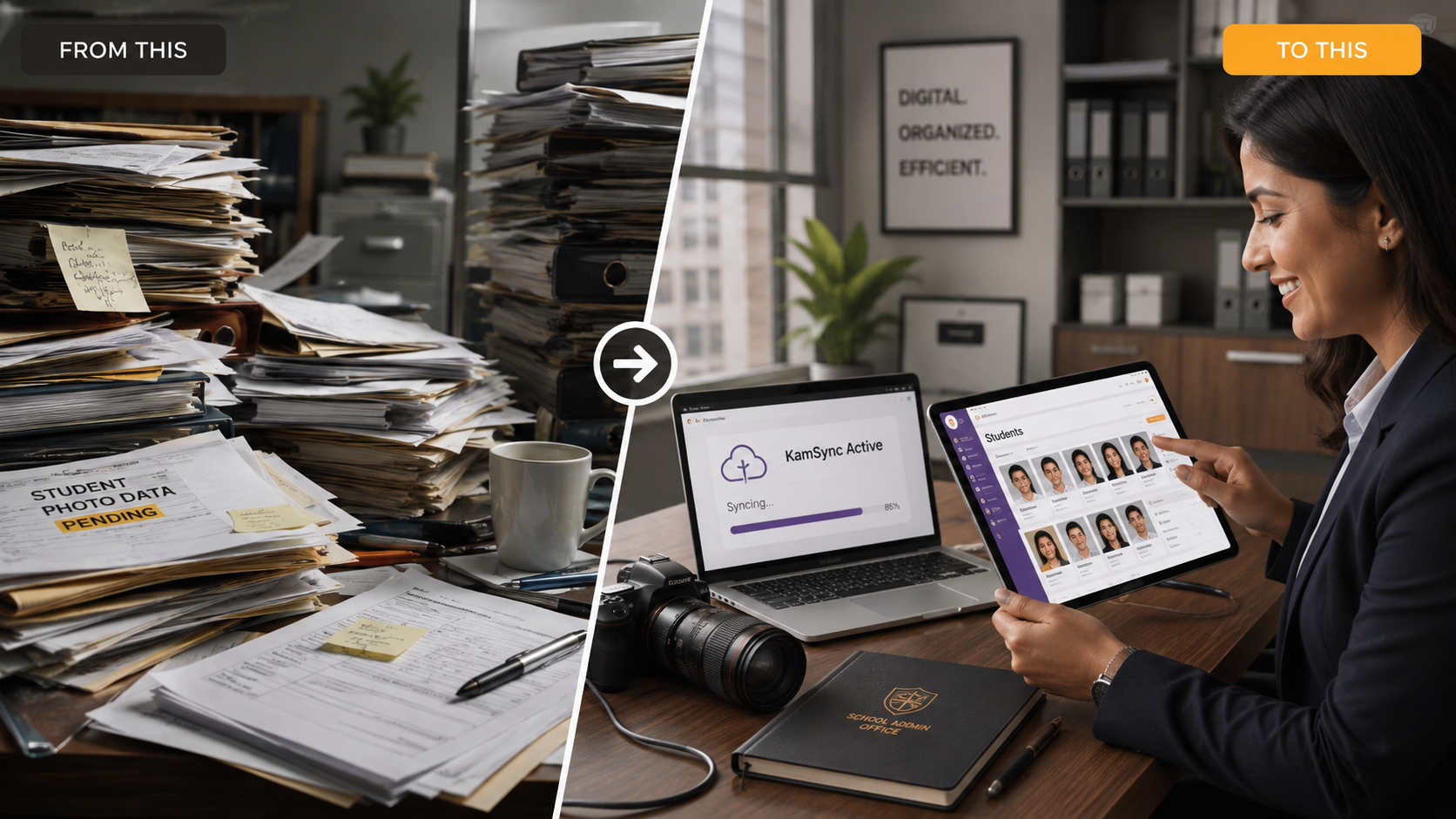
Introduction: The Hidden Administrative Cost of High-Volume Picture Days
School picture day is often viewed as a simple annual event. In reality, it is a complex logistical operation involving students, teachers, administrators, photographers, parent communications, data management, proofing workflows, and final order fulfillment.
While schools focus on educational outcomes, photography day frequently creates unexpected administrative overhead. Staff members spend valuable time coordinating schedules, managing student lists, resolving identification errors, tracking missing orders, and responding to parent inquiries.
For photography studios, the situation is equally challenging. Manual sorting, disconnected software systems, spreadsheet tracking, and delayed matching processes introduce operational friction that slows delivery and increases costs.
As school photography programs scale, these inefficiencies become increasingly difficult to sustain. This is why leading studios are replacing manual workflows with automated school photography pipelines powered by AI-driven processing and cloud infrastructure.
Deconstructing the Coordination Chaos Borne by Educational Institutions
The largest inefficiencies in school photography often occur outside the camera itself.
The Classroom Disruption Problem
Traditional picture days frequently require teachers and administrators to become operational coordinators.
Student lists must be verified manually. Attendance changes require updates throughout the day. Paper forms need to be distributed, collected, and reconciled. Staff members are often pulled away from educational responsibilities to support photography logistics.
The result is unnecessary classroom disruption and increased pressure on school personnel.
The Cost of Post-Event Administration
Administrative challenges rarely end when photography day concludes.
Schools and studios often spend days or weeks resolving missing orders, correcting student identification errors, locating lost gallery links, responding to parent support requests, and reconciling mismatched records.
What appears to be a simple portrait session can generate dozens of hours of downstream administrative work.
Introducing the Automated School Photography Pipeline
Modern school photography workflows are increasingly built around automation rather than manual intervention.
Moving Administrative Burdens Away from Schools
The goal of an automated school photography pipeline is simple: reduce dependency on human coordination wherever possible.
Instead of relying on paper forms, spreadsheets, and manual record matching, information moves through structured digital systems that automatically connect students, portraits, galleries, and orders.
Schools spend less time managing photography operations while studios gain more consistent data quality.
Building High-Volume Operational Efficiency
AI-powered workflows allow studios to process thousands of student images without requiring large teams dedicated solely to sorting and organization.
Automated matching systems, digital registration tools, and structured cloud workflows eliminate many of the repetitive administrative tasks that traditionally slow production.
The result is a faster and more scalable operation for both schools and photography providers.
Engineering an Automated AI Media Loop
The foundation of a modern photography workflow begins before the first image is captured.
Roster Synchronization Through Cloud-Based Data Management
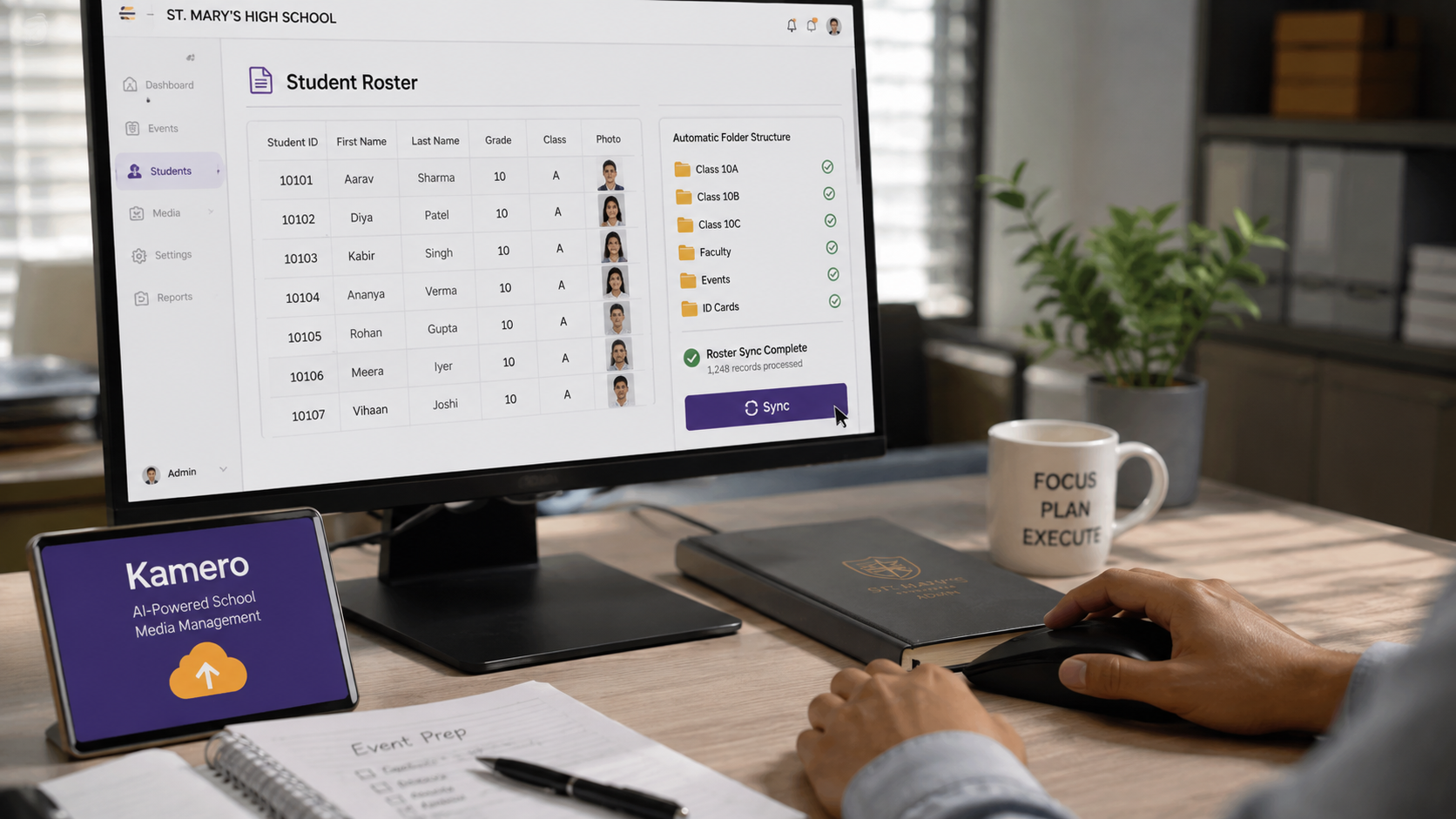
Instead of relying on printed attendance sheets and manual data entry, schools can provide digital student rosters prior to picture day.
These records become the foundation of the entire workflow.
Student information can be organized into structured databases that automatically connect names, grades, classrooms, and identification records before photography begins. This significantly reduces the risk of mismatched profiles later in the process.
Creating Consistent Data Structures
One of the biggest causes of workflow delays is inconsistent organization.
Automated systems create predefined structures that align incoming photographs with specific grades, classrooms, and student records. By eliminating manual folder creation and spreadsheet management, studios gain a far more reliable operational framework.
AI-Powered Matching and Automated Asset Organization
Once images enter the system, automation continues.
Intelligent Image Grouping
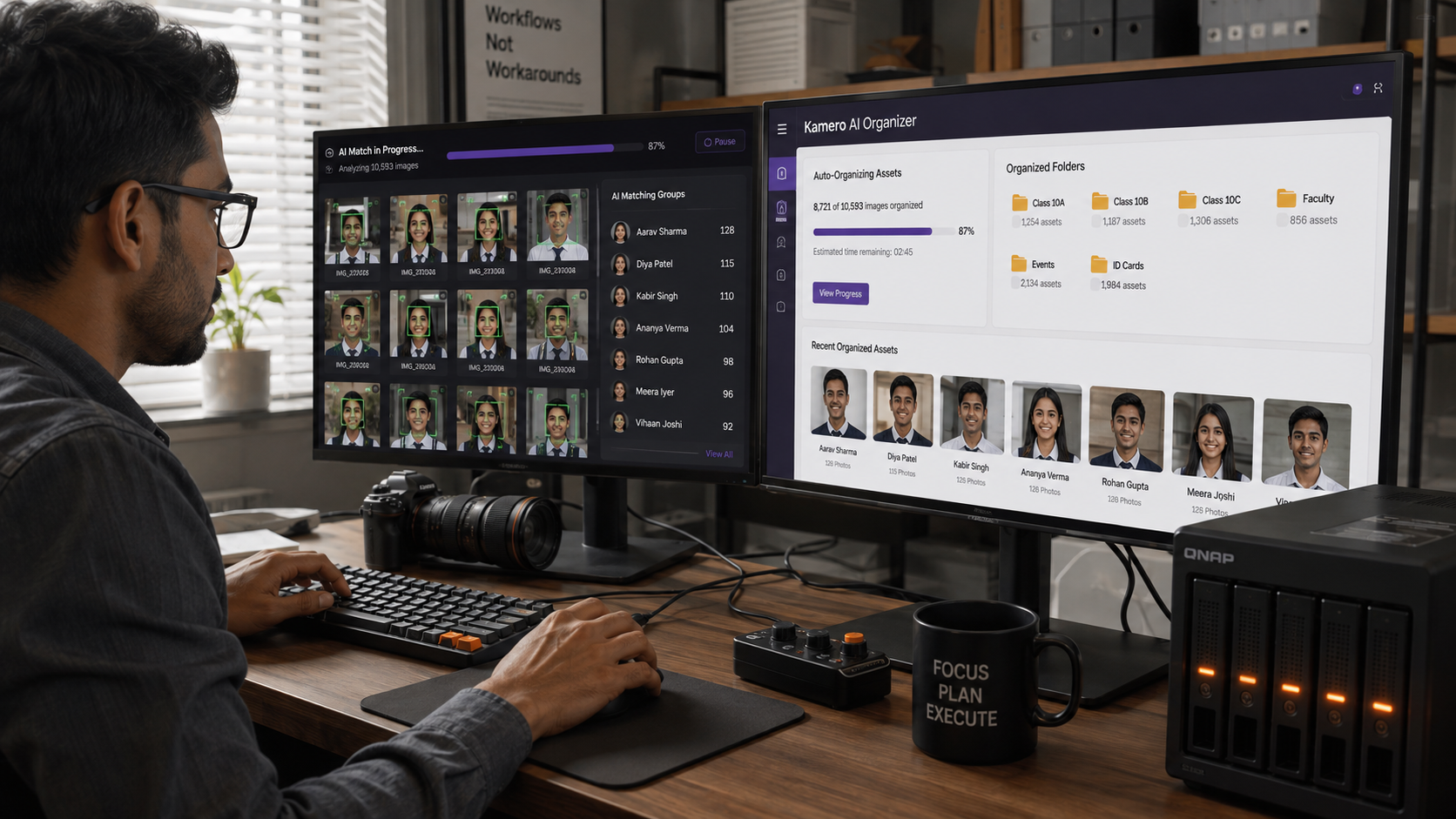
Modern AI school photography platforms can organize incoming imagery using advanced matching and categorization workflows.
Rather than requiring teams to manually sort thousands of photographs after an event, assets can be grouped automatically within secure project environments designed specifically for each school.
This dramatically reduces processing time while improving overall accuracy.
Eliminating Manual Culling Operations
Traditional workflows often involve hours of post-production sorting and file management.
Automated directory structures allow photographs to move directly into organized environments where galleries, proofs, and delivery systems can be generated without requiring extensive human intervention.
The result is a streamlined pipeline capable of handling significantly larger volumes without increasing operational complexity.
Capture Edge Automation: Accelerating Ground Operations
Efficiency gains become even more significant when automation begins at the point of capture.
Continuous Camera-to-Cloud Syncing
Historically, photographs remained trapped inside memory cards until the end of the event.
Modern camera-to-cloud systems eliminate this delay.
Using technologies such as Kam-Sync, images can move directly from compatible cameras into secure cloud environments while the event is still in progress. Photographers no longer need to wait until the end of the day to begin processing.
This creates a continuous operational workflow rather than a series of disconnected steps.
Supporting High-Volume Production Environments
School photography often involves large image volumes generated within short timeframes.
Modern cloud infrastructure allows high-resolution files to move efficiently through the system while maintaining performance under heavy workloads. This enables studios to scale operations without introducing bottlenecks or processing delays.
Enforcing Security Through Structured Governance
Automation must be paired with control.
Secure Review and Staging Workflows
Not every image should immediately move into public-facing environments.
Structured review workflows allow studios to verify galleries, validate student associations, and maintain quality standards before content becomes available to families.
These controls help reduce errors while maintaining trust with schools and parents.
Role-Based Access Management
Different stakeholders require different levels of visibility.
Photographers, editors, administrators, customer support teams, and school representatives all interact with project data differently. Role-based permissions ensure access remains appropriate while preserving operational security throughout the workflow.
The Kamero Advantage: Automated AI Pipelines vs. Manual Sorting
Many photography workflows still depend on disconnected software tools, manual sorting operations, spreadsheet tracking, and delayed uploads.
Kamero was designed to eliminate these inefficiencies.
Through Kam-Sync, images can move directly from compatible cameras into centralized cloud environments without waiting for memory card transfers or browser-based uploads. Automated matching workflows help organize images within structured project environments while role-based permissions, approval workflows, and secure access controls maintain governance throughout the process.
The platform combines image ingestion, organization, proofing, delivery, communications, and operational management within a single environment. This reduces complexity for studios while creating a smoother experience for schools and families.
For high-volume educational photography operations, the result is faster delivery, lower administrative overhead, and significantly improved scalability.
Operational ROI: Turning Efficiency into Growth
The benefits of automation extend well beyond workflow improvements.
Reducing Administrative Work and Software Costs
Many studios operate across multiple tools for storage, communication, proofing, organization, watermarking, and delivery.
Consolidating these functions into a unified platform reduces software sprawl while simplifying day-to-day operations. Teams spend less time managing systems and more time focusing on growth.
Accelerating Selection and Approval Cycles
Digital workflows allow parents to review, select, and approve photographs without relying on paper forms or extended email exchanges.
Faster decisions lead to quicker fulfillment, improved customer experiences, and healthier cash flow for photography businesses.
Strengthening Long-Term School Relationships
Schools value partners who reduce operational burden rather than create additional work.
Studios that deliver streamlined experiences, faster turnaround times, and fewer administrative headaches are more likely to secure repeat business and expand into additional campuses and districts.
Conclusion: The New Automation Standard for Educational Photography
School photography is no longer simply about capturing portraits. It is about managing information, workflows, communication, and delivery at scale.
Studios that continue relying on manual processes will find it increasingly difficult to meet the expectations of modern schools and families. Automated workflows offer a more sustainable path forward by reducing administrative effort, improving operational accuracy, and accelerating delivery timelines.
As educational institutions continue to embrace digital transformation, automated school photography pipelines are becoming the new industry standard.
The future of school photography belongs to studios that can combine speed, accuracy, security, and scalability within a single integrated workflow.
Ready to Modernize Your School Photography Workflow?
Book a Demo: Discover how automated AI-powered workflows can simplify picture day operations while reducing administrative burden for schools and studios.
Start Your Free Trial: Experience camera-to-cloud delivery, automated matching, secure proofing, and streamlined school photography management from one platform.
Follow Kamero on Instagram: See how leading volume photography studios are using AI automation to scale operations and deliver better experiences for schools and families.

About Mayank Oraon
Hi, I’m Mayank, an MBA student exploring the business world with a focus on operations, supply chain, and product strategy (aka the parts of a business that keep things from quietly falling apart).
I’m interested in understanding how systems actually run behind the scenes- and why they sometimes don’t. I also enjoy simplifying complex ideas - partly because it helps others, and partly because if I can’t explain it simply, I probably didn’t understand it in the first place (which is a humbling but effective feedback loop).