Introduction: The Identification Nightmare in Massive High-Volume Running Events
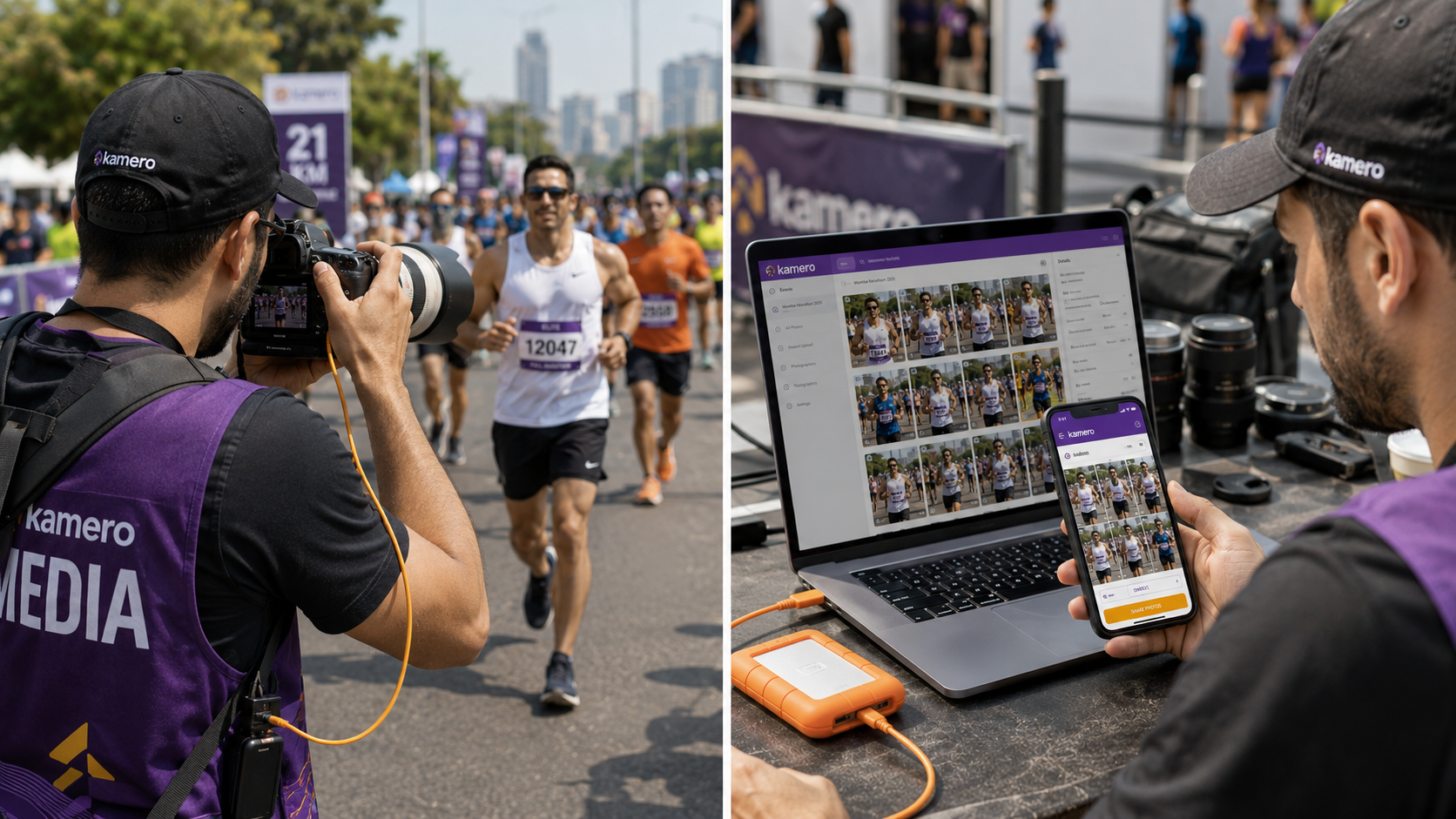
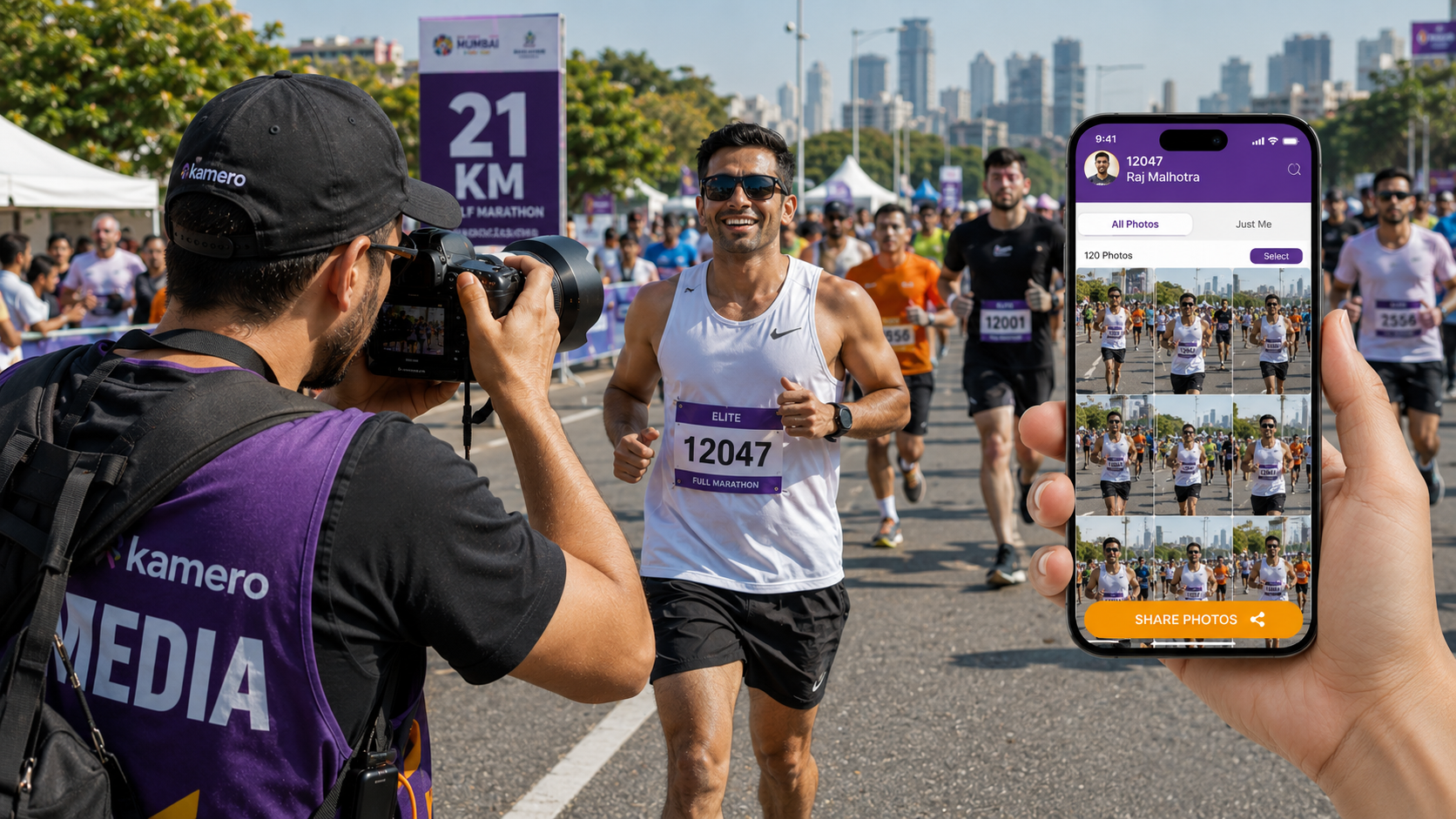
Modern marathons generate an enormous volume of visual content. A single race can produce hundreds of thousands of images captured across start lines, checkpoints, hydration stations, sponsor zones, and finish areas. While capturing these moments has become easier, accurately matching every photo to the correct participant remains one of the most difficult operational challenges in race photography.
Athletes expect immediate access to their photos. Organizers expect efficient delivery. Sponsors expect visibility. None of those goals can be achieved if images remain trapped inside manual sorting workflows.
As race participation continues to grow, traditional identification methods are reaching their limits.
The Edge Failure Cases of Single-Vector Identification Models
For years, race photography platforms relied primarily on either facial recognition or bib recognition. While both approaches offer advantages, neither is perfect when used independently.
Facial recognition systems often struggle in race environments where athletes wear sunglasses, caps, hydration packs, neck gaiters, or helmets. Motion blur, harsh sunlight, crowd density, and side-profile angles further reduce matching accuracy.
Bib recognition faces a different set of challenges. Bibs can become folded, partially covered, damaged by weather, or obscured by running posture. Timing mat inconsistencies, registration errors, and manual bib entry mistakes can also introduce identification gaps.
The result is a fragmented athlete journey where participants frequently miss photos they expected to receive.
The Operational Path to Near-Perfect Match Accuracy
The most effective solution is not choosing between face recognition and bib recognition.
It is combining both.
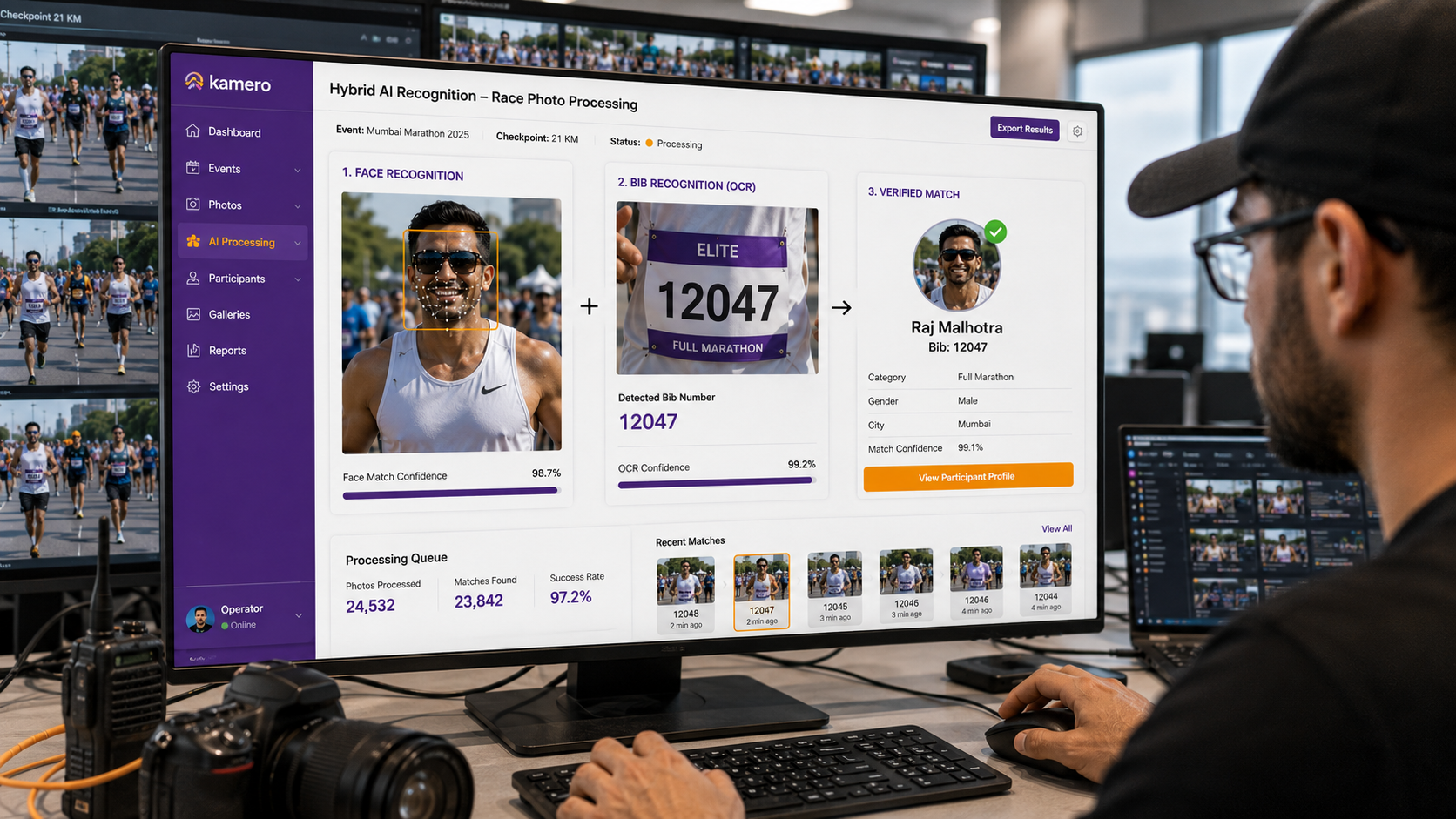
A hybrid AI architecture uses facial vectors and bib data simultaneously, allowing each system to compensate for the weaknesses of the other. When one identifier becomes unreliable, the second layer provides verification.
This dual-engine approach dramatically improves photo discovery accuracy while reducing the amount of manual intervention required from race photography teams.
Technical Architecture: Deconstructing the Hybrid AI Processing Layer
Achieving high match accuracy requires more than simply running multiple algorithms. It requires a coordinated processing pipeline that evaluates, validates, and merges multiple identification signals in real time.
Automated OCR Parsing and Bib Number Recognition
The first layer focuses on bib identification.
As images enter the platform, OCR systems scan visible race bibs and extract alphanumeric information automatically. Modern computer vision systems can identify bib numbers even when images contain complex backgrounds, varying lighting conditions, or moving subjects.
Advanced processing engines also compensate for real-world race conditions.
A folded bib may hide several digits. Mud may partially cover numbers. Athletes may wear jackets over registration identifiers. OCR correction models evaluate surrounding visual patterns and contextual race data to improve recognition performance.
Instead of relying on a perfect bib capture, the system continuously evaluates probability scores and confidence levels.
Event-Scoped Facial Recognition Processing
The second layer focuses on facial recognition.
AI models analyze facial landmarks and generate mathematical vectors that represent unique participant characteristics. These vectors are then compared against event-specific profiles.
Unlike consumer facial recognition systems, event-focused architectures prioritize privacy and contextual accuracy.
Recognition processes remain isolated within the specific race environment rather than drawing from broad public databases. This approach improves privacy controls while maintaining high matching performance.
Merging Face and Bib Matching into a Unified Identity Graph
The real advantage emerges when both systems work together.
A runner may appear with a clearly visible bib but limited facial visibility in one image. In another image, the bib may be hidden while facial visibility remains strong.
By connecting these identification signals into a single participant profile, the platform creates a more complete identity graph across the entire event.
Instead of treating every image independently, the system builds relationships between photos captured at different times and locations throughout the race.
The outcome is a significantly more reliable athlete gallery with fewer missed images and fewer false matches.
Edge Ingestion: Streamlining Massive Multi-Camera Workflows
Identification accuracy depends heavily on how quickly and efficiently images enter the processing pipeline.
Zero-Lag Ingestion via Camera-to-Cloud Sync
Traditional workflows require photographers to finish shooting, collect memory cards, transfer files, and begin uploads after the race.
That process creates unnecessary delays.
Modern camera-to-cloud systems such as Kam-Sync enable images to move directly from camera hardware into cloud infrastructure while the event is still taking place.
Instead of waiting hours for uploads to begin, AI processing can start almost immediately after capture.
This dramatically shortens the path between photography and participant discovery.
Processing Large Volumes Without Bottlenecks
Major marathons often deploy multiple photographers simultaneously across extensive course layouts.
Thousands of images may arrive within minutes during peak race activity.
To handle these bursts efficiently, platforms use asynchronous processing pipelines that separate lightweight preview generation from full-resolution asset storage.
Preview files become available quickly for AI analysis while original RAW files continue uploading in the background.
This architecture prevents bottlenecks and maintains continuous processing even during high-volume race periods.
Automated Routing and Governance Controls
Once images enter the system, automation takes over.
Photos can be organized automatically according to checkpoints, race segments, timing zones, or event timelines. Administrative teams no longer need to spend hours manually sorting folders after an event concludes.
Role-based access controls and maker-checker approval workflows add another layer of operational governance. Before galleries become publicly accessible, administrators can verify content quality, approve branding elements, and confirm deployment settings.
This ensures both accuracy and operational consistency at scale.
The Kamero Competitive Edge: Dual-Vector AI Architecture vs. Single-Format Utilities
Many race photography solutions still rely heavily on either facial recognition or bib search alone.
While these systems can perform adequately under ideal conditions, they often struggle in real-world race environments where athletes move quickly, visibility changes constantly, and identifiers become partially obscured.
Kamero's architecture combines multiple identification mechanisms within a unified workflow.
Camera-to-cloud synchronization through Kam-Sync allows processing to begin immediately. Hybrid face and bib matching engines work simultaneously to improve participant discovery accuracy. Event-scoped AI processing helps maintain privacy while ensuring efficient identification.
Beyond matching technology, the platform includes native mobile applications, automated WhatsApp delivery workflows, dynamic watermarking, configurable branding controls, secure role-based permissions, and event-specific data governance controls.
The result is an infrastructure designed not only to find photos faster but also to manage large-scale race operations more efficiently.
Commercial Optimization: Turning Data Accuracy into Revenue
Matching accuracy has a direct impact on commercial performance.
When athletes can instantly find their photos, engagement rises dramatically. Higher engagement creates more opportunities for digital sales, sponsor visibility, and participant retention.
Improving E-Commerce Conversion Rates
Race participants are most likely to purchase photos when discovery is effortless.
If athletes must manually search through thousands of images, many abandon the process before finding their content.
Hybrid AI matching removes that friction.
Participants receive highly personalized galleries containing relevant images from throughout the race journey. This streamlined experience increases viewing time, improves satisfaction, and creates stronger purchasing intent.
Integrated storefronts can then offer digital downloads, premium packages, sponsor-branded collections, and high-resolution image bundles directly within the gallery experience.
Accelerating Production and Client Approvals
Operational efficiency extends beyond athlete engagement.
Media directors, event organizers, sponsors, and communications teams often require rapid access to approved images for marketing and press coverage.
Automated sorting and centralized review workflows significantly reduce production timelines.
Instead of manually reviewing massive image libraries, stakeholders can access organized galleries, approve selections, and complete project reviews more quickly.
Faster approvals often translate into faster contract completion and shorter payment cycles for photography teams.
Strategic Conclusion
As marathon participation continues to grow, race photography workflows must evolve alongside it.
Single-method identification systems are increasingly challenged by the complexity of modern race environments. Motion blur, crowd density, weather conditions, and participant behavior create too many variables for any one technology to solve alone.
Hybrid AI combines the strengths of facial recognition and bib recognition to create a more resilient and accurate identification framework.
For race organizers, photographers, and media teams, this means better participant experiences, faster delivery timelines, stronger commercial outcomes, and a scalable foundation for future events.
The future of advanced race photo sorting will not be powered by a single identifier. It will be powered by intelligent systems that combine multiple data signals to ensure every athlete can quickly find the moments that matter most.
Ready to Improve Race Photo Match Rates?
Discover how Kamero helps marathon organizers and sports photographers deliver faster photo discovery, hybrid AI face-and-bib matching, Kam-Sync camera-to-cloud workflows, privacy-first participant identification, and integrated commerce tools.
Start Your Free Trial: Click Here
Book a Demo: Click Here
Follow Kamero on Instagram: Click Here

About Mohit Prakash Lal
Hi, I’m Mohit, an MBA student at TAPMI, Manipal, exploring the world of business with a focus on marketing and strategy. I’m interested in understanding how brands connect with people and create meaningful, lasting impact in a competitive landscape. I enjoy working on real-world projects across marketing, sales, and business development, where I can apply ideas in practical settings.
I also enjoy simplifying ideas into clear, practical insights. Outside of work, I like travelling, reading, and taking time to recharge.