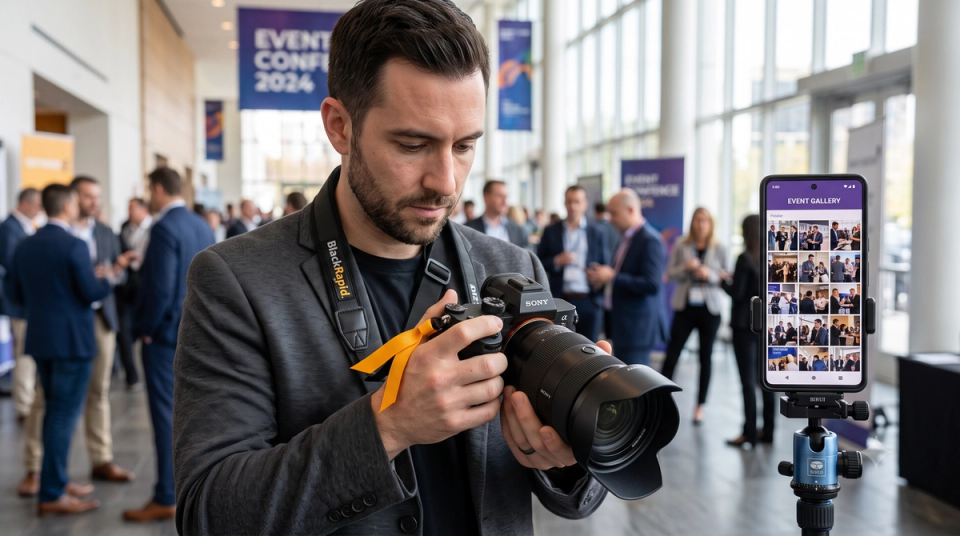
Enterprise event photography generates thousands of visual assets within hours, yet traditional digital asset management (DAM) relies almost entirely on 1:1 biometric facial recognition. While face-matching works for individual attendee galleries, it breaks down inside multi-brand corporate ecosystems. Enterprise PR, marketing, and legal teams do not just search for executives; they need immediate visibility into sponsor logos, physical product placements, stage architectures, and ambient venue signage. Transitioning from narrow biometric lookups to a multi-modal semantic search architecture unlocks the full lifecycle value of event media.
At Kamero, we have engineered our core processing pipeline to move beyond isolated, event-scoped face vectors. By integrating contextual computer vision, optical character recognition (OCR), and spatial clustering directly into our ingestion engine, Kamero eliminates unindexed content silos natively—turning raw camera captures into an enterprise-grade, queryable visual database.
The Hidden Enterprise Cost of Dark Media Archives
When corporate media lacks multi-modal metadata, massive volumes of high-resolution photography become "dark assets"—stored in cloud buckets, paid for in production budgets, yet functionally invisible to marketing teams.
The Blind Spots of Pure Biometric Search
The Attribution Deficit
Standard face-matching models are mathematically blind to frames without human subjects.Up to 40% of high-value commercial event photography features zero recognizable faces, instead capturing architectural stage builds, VIP lounge styling, product demo kiosks, and keynote presentation decks. Without contextual indexing, brand managers cannot retrieve wide-angle venue shots or sponsor activations without manually scrubbing through thousands of thumbnails.
Manual Cataloging Bottlenecks
The Serial Processing Penalty
To compensate for biometric blind spots, organizations often rely on post-event agency teams to manually apply IPTC keywords.Manual metadata tagging introduces a 48-to-72-hour operational lag, eroding the real-time value of event content. Worse, human taggers introduce severe taxonomic drift—one editor tags a display as "booth signage" while another labels it "sponsor banner," fragmenting search queries and inflating agency labor costs.
Compliance and Trademark Vulnerabilities
The Legal Exposure Penalty
Publishing unvetted event photography across global PR wires carries steep legal risks. Background frames frequently capture unauthorized competitor trademarks, expired sponsor branding, or restricted prototype hardware.Publishing a single unverified frame containing a rival trademark can trigger immediate sponsorship contract breaches or intellectual property disputes, forcing legal teams into reactive takedowns.
Foundations of Modern Event Photo Indexing
Solving dark media archives requires rethinking how visual data enters the cloud. Effective keyword search event photo indexing begins at the moment of shutter actuation, not days later in a post-production queue.
Multi-Modal Ingestion Engines
Asymmetric Ingestion Cascades
Instead of running sequential, single-purpose scripts, Kamero executes asymmetric ingestion cascades over hardware-level Kam-Sync camera-to-cloud FTP links. As raw or high-res JPEG files stream from the camera body, parallel microservices simultaneously extract biometric face vectors, parse alphanumeric text blocks, detect brand logos, and map scene objects—enriching every asset before it hits the client gallery.
Asymmetric Metadata Stitching
Relational Database Serialization
At the cloud ingestion boundary, Kamero serializes environmental telemetry directly into the asset's relational record and XMP/EXIF headers. GPS coordinates, sub-second timestamps, hall identifiers, stage IDs, and session tracks are stitched to visual detections, allowing teams to execute compound queries like "Brand X logo + Main Stage + Day 2 Afternoon."

Ingestion Pipeline Benchmarking
System Backpressure Mitigation
High-volume trade shows and conferences easily generate 10,000+ frames per hour. Kamero’s distributed worker queues utilize dynamic load balancing and backpressure mitigation to maintain sub-second indexing latency under peak ingestion bursts, ensuring newly captured images become searchable across global stakeholder viewports within seconds.
Mechanics of Automated Smart Cluster Image Cataloging
Raw computer vision detections only create value when organized into intuitive visual hierarchies.Automated smart cluster image cataloging bridges the gap between neural network outputs and human editorial workflows.
Semantic and Spatial Clustering
Unsupervised Neural Categorization
Rather than relying solely on rigid, pre-defined keyword dictionaries, Kamero utilizes unsupervised vector clustering to group images by visual similarity, color palettes, lighting profiles, and structural geometry. This automatically separates candid networking shots, stage keynotes, product close-ups, and architectural exteriors into distinct visual clusters without human intervention.
Contextual Hierarchy Management
Configuration Invariance
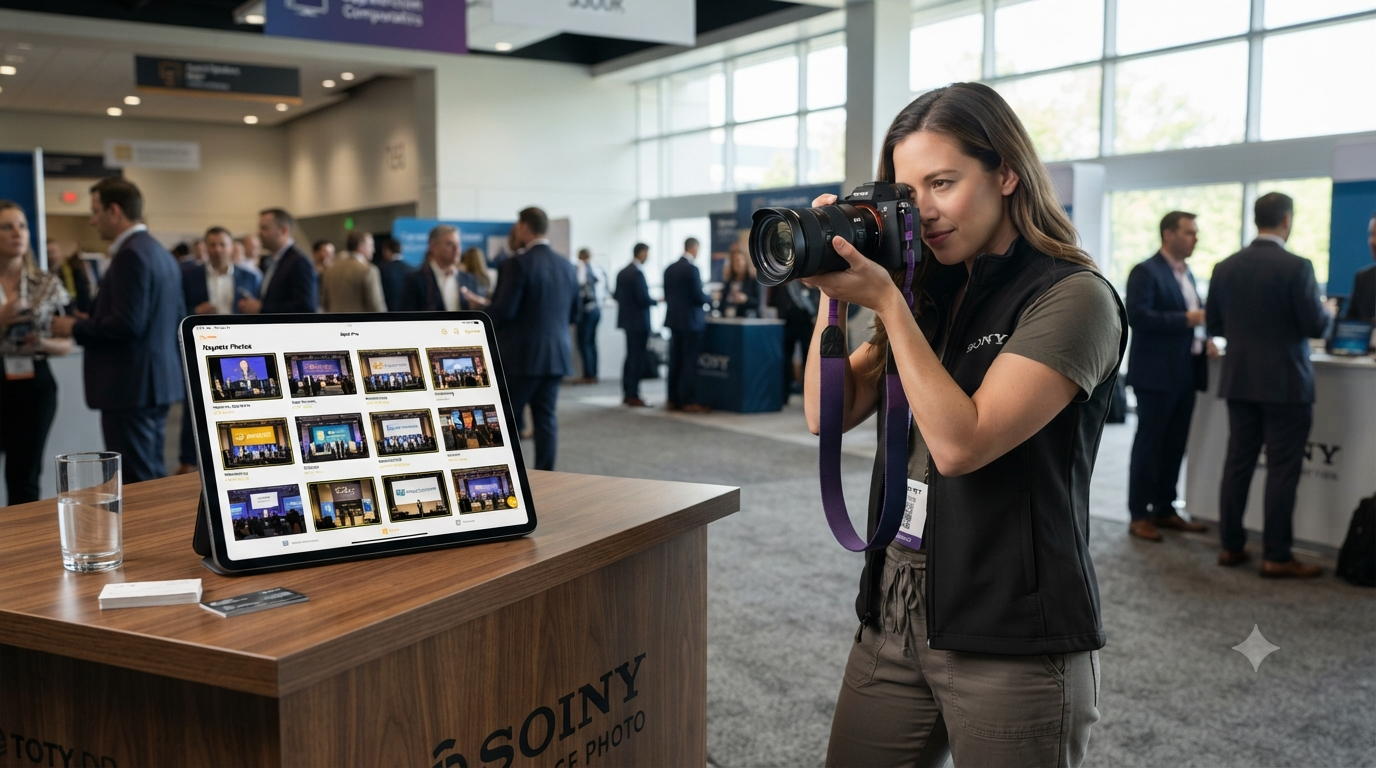
Enterprise exhibitions span complex physical footprints. Kamero enforces configuration invariance by translating spatial and textual detections into multi-layered virtual directories. Assets are automatically nested from macro-level venue zones (e.g.,Hall B) down to micro-level exhibitor booth numbers and specific brand activations.
Edge-Case Handling
Confidence-Threshold Calibration
Exhibition floors present hostile computer vision conditions: skewed viewing angles, harsh LED glare, partial occlusions, and overlapping sponsor backdrops. Kamero applies calibrated confidence thresholds and non-maximum suppression algorithms to filter out false positives, ensuring background noise never pollutes high-priority brand searches.
Driving ROI via AI Driven Brand Asset Discoverability
Accelerating AI driven brand asset discoverability transforms corporate photography from a sunk operational expense into a measurable revenue and retention engine.
Real-Time Logo and Trademark Detection
Multi-Tenant Object Discovery
Kamero’s custom-trained logo detection models identify corporate marks, product silhouettes, and brand slogans across diverse surfaces—from fabric step-and-repeats to digital LED walls. In multi-tenant expos, each sponsor’s visual footprint is isolated and indexed independently.
Value Validation for Corporate Sponsors
AdOps Integration Superiority
Sponsorship renewal hinges on proving brand exposure. Instead of sending sponsors a generic link to 15,000 unsorted photos, event organizers can deliver a dedicated, dynamically updated gallery containing 100% of frames featuring that partner’s logo, complete with impression metrics and asset download telemetry to prove contract fulfillment.
Streamlining PR Timelines
Compressing Studio Account Receivables
When corporate communications teams receive logo-verified, brand-safe imagery while a keynote is still underway, press releases hit news wires before competitors react. For commercial photography studios, eliminating manual culling and tagging compresses post-event delivery cycles by up to 80%, accelerating client sign-offs and invoice settlements.
Implementing Non Facial Recognition Image Tags
Deploying non facial recognition image tags gives enterprises granular search precision while satisfying strict global privacy frameworks.
Text and Signage Transcription (OCR)
Alphanumeric Text Tokenization
Kamero’s integrated OCR engine extracts and tokenizes text from presentation slides, podium placards, attendee lanyards, and directional signage. Searching for a specific product SKU, keynote title, or speaker name on a slide deck immediately surfaces every frame where that text appears.
Object and Scene Recognition Architecture
Structural Layout Profiling
Beyond text and logos, scene-parsing models classify structural elements—identifying panel discussions, ribbon-cutting ceremonies, interactive product displays, catering setups, and crowd density. Creative directors can pull specific visual compositions (e.g.,"wide shot, packed auditorium, stage lighting") in seconds.
Privacy-First Non-FR Fallbacks
Sovereign Data Governance
In jurisdictions governed by GDPR, CCPA, or strict corporate works-council mandates, biometric processing may be restricted or disabled entirely. Kamero’s non-FR indexing operates independently of facial vectors, enabling biometric-free discovery pipelines that honor strict data sovereignty without sacrificing searchability.
B2B Operational Playbooks: Multi-Modal Indexing Deployment
Enterprise Exhibitions and Large-Scale Expos
Exhibition organizers deploy multi-modal indexing to track hundreds of exhibitor booths simultaneously. OCR captures booth numbers while logo recognition maps brand activations, automatically routing curated visual assets to respective exhibitor portals.
Major Marathons and Sports Event Activation
Sports marketing teams pair OCR runner bib tracking with apparel and course-banner logo detection. Sponsors gain verified visibility into every frame where their branding appears alongside race participants, maximizing activation ROI.
Corporate AGM Sessions and Training Keynotes
Internal communications and compliance teams archive Annual General Meetings by indexing slide deck text, executive podium setups, and stage layouts—creating a searchable, audit-ready visual repository for annual reports and investor relations.
Architecture Comparison: Contextual Discovery Platforms vs. Traditional Storage
Enterprise event ecosystems require far more than consumer photo-sharing links. Kamero pairs hardware-level camera-to-cloud FTP streaming with multi-tenant database architecture, strict white-label domain masking, role-based access control (RBAC), and event-scoped vector sandboxes with automated post-event data scrubbers—leaving flat storage tools behind.
Kamero vs. India-Focused Utilities (Samaro.ai / Kwikpic)
Multi-Modal Semantic Ingestion
Consumer-oriented utilities rely exclusively on face-matching over chronological photo dumps. While adequate for social weddings, they lack OCR text tokenization, brand logo detection, and enterprise access controls—leaving non-facial corporate assets completely unindexed.
Kamero vs. Legacy Portfolios (Pixieset / SmugMug)
Pure White-Label Abstraction
Legacy portfolio platforms are built around individual photographers showcasing artistic work, forcing enterprises to rely on manual tagging and rigid gallery templates. Kamero replaces artist-centric storefronts with a fully white-labeled, API-ready corporate asset workspace.
Kamero vs. Basic Storage Folders (Fotoowl / Memzo)
End-to-End Enterprise Ecosystems
Basic link-sharing tools function as temporary file dumps without relational metadata or compliance guardrails. Kamero upgrades raw storage into a persistent, searchable marketing database engineered for high-throughput commercial operations.
Blueprint: Launching a Context-Aware Enterprise Search Workspace
- Step 1: Mapping Indexing Parameters and Brand Profiles in the Master ConsoleConfigure event-scoped search taxonomies, upload target sponsor logo vectors, enforce custom domain masking, and apply corporate UI themes (such as primary
#6F4898and accent#FFB700brand tokens) alongside granular RBAC permissions. - Step 2: Activating Real-Time Edge Capture via Kam-Sync FTP DaemonsConnect on-ground DSLR/mirrorless bodies via Kam-Sync FTP profiles. Monitor real-time ingestion telemetry as multi-modal workers parse OCR text, detect sponsor trademarks, and populate smart clusters live during the event.
- Step 3: Exporting Performance Insights and Compliance-Verified GalleriesRun final trademark compliance sweeps, export sponsor exposure analytics for AdOps reporting, and distribute curated, password-protected media kits directly to PR wires and executive stakeholders.
Conclusion: The Evolution of Intelligent Media Management
Practical Roadmap for Migrating Your Enterprise Portfolio
Start by auditing historical event archives to identify high-value dark assets, then pilot a hybrid ingestion workflow on your next flagship activation—pairing Kam-Sync camera-to-cloud streaming with automated logo and OCR indexing before scaling across global regional teams.
Future-Proofing Corporate Asset Workspaces
As visual content velocity accelerates, relying on manual tagging or narrow facial recognition guarantees operational bottlenecks. Consolidating capture, multi-modal AI indexing, brand governance, and white-label distribution into a single platform ensures every frame delivers measurable enterprise value.
Do not let valuable marketing assets stay hidden in unindexed cloud storage folders. Upgrade your workflow with comprehensive event photo indexing paired with automated smart cluster image cataloging. Protect your brand safety, satisfy your corporate sponsors, and streamline your media operations by building your enterprise workspace on Kamero today.
- Start Your Free Trial: Sign up on Kamero to launch your first multi-modal event workspace in minutes.
- See It in Action: Book a personalized enterprise demo with our computer vision architects.
- Stay Connected: Follow Kamero on Instagram for real-time product updates, event tech insights, and live activation showcases.

About Pavani Nagar
Hey there! Pavani Nagar, a Digital Marketing Manager who enjoys working on content, social media, and figuring out what makes people pay attention. I like trying new ideas, learning along the way, and keeping things simple.