Introduction: The Valuation Crisis in Mass Sports Sponsorship
Marathon sponsorship has become increasingly sophisticated over the past decade. Sponsors no longer invest solely for logo visibility at the start line or branding on race bibs. They expect measurable engagement, trackable impressions, and clear evidence that their investment generated meaningful exposure among participants and spectators.
Yet despite the growth of sports marketing technology, many races still rely on branding methods that are difficult to measure. Banners, finish-line arches, and physical signage certainly create visibility, but proving their true impact remains challenging.
At the same time, another opportunity often goes underutilized: race photography.
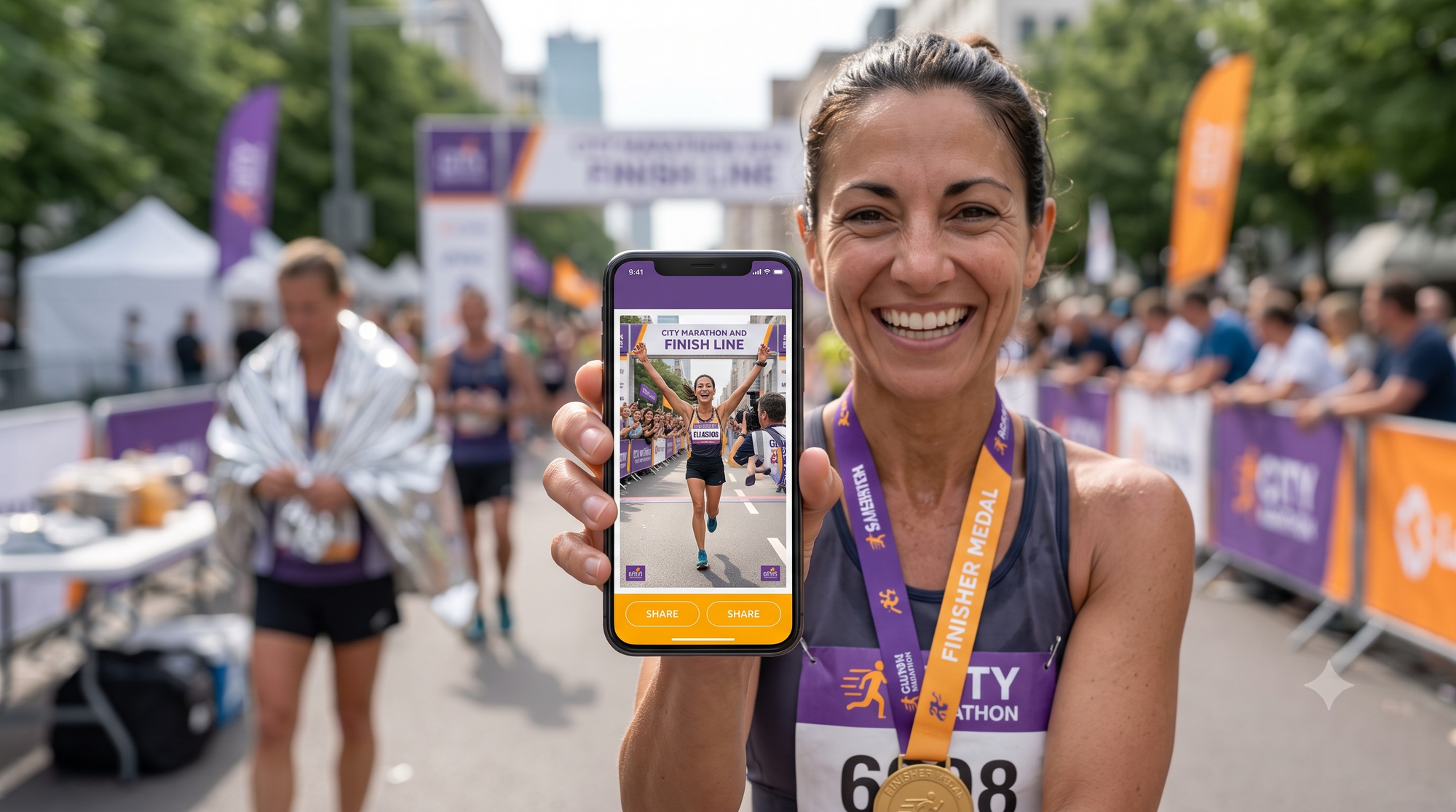
Every marathon generates thousands of highly shareable participant photos. These images travel across Instagram, WhatsApp, LinkedIn, Facebook, and private messaging groups within hours of the event. For many athletes, race photos become the primary way they celebrate and share their achievement.
The question is no longer whether race photos create engagement. The question is whether organizers are maximizing their branding potential.
The Vanishing Impression Challenge in Traditional Sports Media
The highest engagement period for any participant occurs immediately after crossing the finish line.
Athletes check their timings, celebrate with friends, upload stories, and share their accomplishments online. During these moments, excitement is at its peak and social sharing activity is strongest.
Unfortunately, many race photography workflows operate on multi-day delivery cycles. By the time images reach participants, the peak sharing window has already passed.
This creates a disconnect between sponsor visibility and participant engagement.
When photos arrive too late, sponsors lose access to the moment when athletes are most likely to amplify event content organically.
The Valuation Deficit in Traditional Sponsor Exposure
Physical branding remains important, but it has limitations.
Trackside banners create visibility for attendees who physically see them. Sponsor logos on race infrastructure help reinforce brand presence throughout the event. However, measuring the downstream value of these placements can be difficult.
Digital race photos offer a different opportunity.
Unlike a roadside banner, a branded race photo travels with the participant. Every share, download, repost, and message extends sponsor visibility beyond the race venue itself.
When implemented correctly, photography becomes a scalable digital branding asset rather than a simple event deliverable.
Driving Marathon Sponsor ROI Through Instant Branded Race Photos
Modern race organizers increasingly view photography as a distribution channel rather than a post-event service.
Instead of treating branding as a static event component, they are integrating sponsor visibility directly into participant media experiences.
Programmatic Brand Activations Through Photography
Every race photo represents a personalized piece of content created around a participant's achievement.
Unlike traditional advertising, these images are voluntarily shared by athletes because they have emotional value. This creates significantly higher engagement than generic promotional content.
By embedding sponsor branding directly into race photos, organizers transform every participant image into a branded digital asset capable of generating ongoing impressions long after the event concludes.
The result is a branding model that scales organically through participant behavior.
Extending Reach Beyond the Event Venue
A finish-line photo rarely stays within the event ecosystem.
Participants typically distribute images across social networks, family groups, running communities, and professional circles. In many cases, a single image reaches audiences that never attended the race.
This organic distribution expands sponsor visibility far beyond the physical footprint of the event.
The faster branded images are delivered, the more likely sponsors are to benefit from this amplification effect.
Technical Architecture: Engineering the Real-Time Dynamic Processing Layer
Delivering branded race photos at scale requires infrastructure capable of processing large image volumes without slowing event operations.
Traditional editing workflows depend on manual intervention, which becomes increasingly difficult as event sizes grow.
Modern systems automate branding directly within the delivery pipeline.
Automated Server-Side Graphic Placement
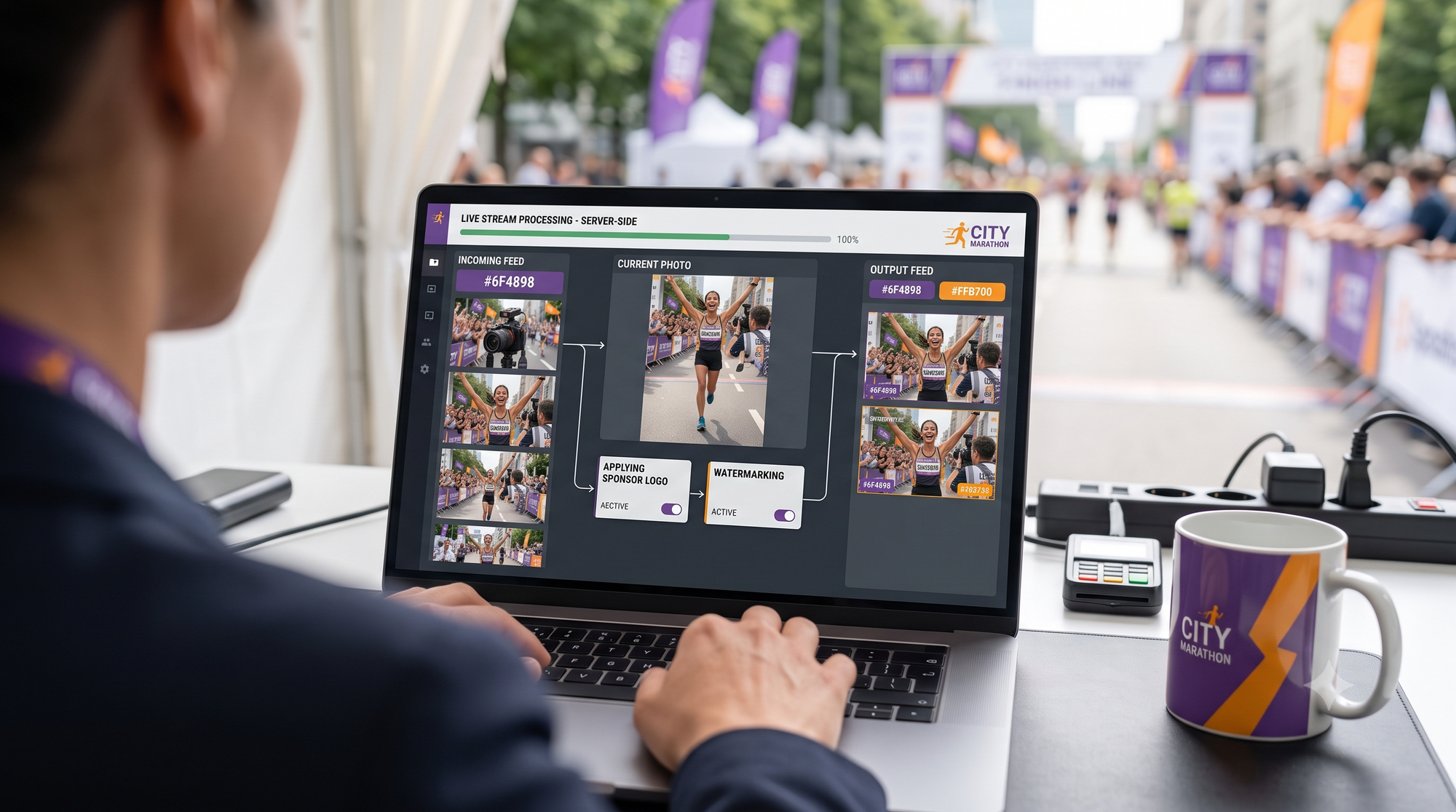
Instead of manually editing thousands of race photos, dynamic branding systems apply overlays automatically during processing.
As images enter the platform, predefined branding templates can place race logos, sponsor identities, event crests, and campaign assets consistently across all media.
Because this occurs automatically, organizers maintain visual consistency without introducing additional production delays.
Maintaining Brand Consistency Across Thousands of Images
One of the biggest challenges in large-scale event branding is ensuring logos remain correctly positioned across varying image dimensions and orientations.
Automated processing engines solve this by applying standardized placement rules during ingestion.
Whether an image is portrait, landscape, wide-angle, or tightly cropped, sponsor visibility remains consistent throughout the gallery.
This ensures sponsors receive reliable brand representation across the entire event media library.
High-Throughput Asset Processing at Scale
Large races often generate tens of thousands of images.
Processing branding elements manually across these volumes would be operationally impossible.
Modern cloud-based workflows distribute processing automatically, allowing branding overlays to be applied while images are uploaded and organized in the background.
As a result, organizers can maintain rapid delivery timelines while preserving sponsor visibility across every asset.
Governance, Administration, and Brand Protection Workflows
Brand visibility is important, but so is brand control.
Sponsors frequently require approval processes that ensure logos are used correctly and consistently.
Enforcing Corporate Alignment Through Approval Workflows
Enterprise sponsors often maintain strict branding guidelines regarding logo placement, spacing, colors, and visibility.
Automated approval environments help event organizers maintain compliance without creating operational bottlenecks.
Before galleries go live, stakeholders can review templates, verify branding rules, and approve visual standards.
This reduces the risk of inconsistencies while simplifying sponsor management.
Protecting Media Assets and Sponsor Investments
Race photos often contain valuable participant and sponsor data.
Secure infrastructure helps ensure assets remain protected throughout their lifecycle.
Role-based permissions, controlled access environments, encryption frameworks, and configurable retention policies help organizers maintain governance while supporting large-scale media distribution.
This combination of speed and control is increasingly important for enterprise-level sporting events.
Analytical Optimization: Converting Shared Visual Assets into Trackable Funnels
One of the most valuable aspects of digital race photography is measurability.
Unlike physical signage, branded race photos generate engagement data that can be tracked and analyzed.
Measuring Sponsor Performance Beyond Visibility
Modern platforms can provide insight into how participants interact with event media.
Metrics such as gallery visits, image downloads, shares, notification engagement, and repeat visits create a clearer picture of sponsor exposure.
These insights help organizers move beyond estimated visibility and toward measurable performance reporting.
For sponsors, this makes photography a more accountable marketing channel.
Transforming Media Engagement into Business Intelligence
Race organizers increasingly use media analytics to demonstrate sponsor value during post-event reporting.
Instead of presenting anecdotal evidence, teams can showcase engagement patterns, audience interactions, and content performance metrics.
This improves sponsor retention and strengthens future partnership discussions.
Data-backed storytelling often creates stronger commercial outcomes than traditional visibility reports alone.

The Kamero Competitive Edge: Live Automated Branding vs. Manual Graphic Editing
The difference between traditional race photography workflows and modern media operations often comes down to automation.
Many systems still rely on manual uploads, external editing tools, and fragmented workflows that slow delivery and increase operational complexity.
Kamero approaches branding as part of the media infrastructure itself.
Through Kam-Sync camera-to-cloud workflows, automated branding controls, AI-powered media organization, secure delivery environments, and enterprise-grade administration tools, organizers can manage race photography and sponsor visibility from a single platform.
Dynamic watermarking, white-label branding, role-based access controls, native mobile applications, and integrated communication channels help organizers deliver branded media experiences at scale without increasing production overhead.
The result is faster delivery, stronger sponsor visibility, and more measurable event outcomes.
Strategic Conclusion: The New Playbook for High-Yield Sports Activations
Marathon sponsorship is evolving from passive visibility toward measurable engagement.
Sponsors increasingly expect more than banner impressions and logo placement. They want evidence of reach, interaction, and audience engagement.
Race photography provides a unique opportunity to meet those expectations.
By combining real-time delivery, automated branding overlays, scalable cloud infrastructure, and measurable analytics, organizers can transform participant photos into powerful sponsor activation assets.
As race participation continues to grow and digital engagement becomes more important, branded media distribution will play an increasingly central role in sponsorship strategy.
The events that successfully connect photography, technology, and sponsor visibility will be best positioned to deliver stronger commercial outcomes for both organizers and partners.
Ready to Turn Every Race Photo Into a Sponsor Asset?
Discover how Kamero helps marathon organizers automate branded media delivery, maximize sponsor visibility, and create measurable engagement through AI-powered galleries, Kam-Sync camera-to-cloud workflows, dynamic watermarking, and integrated analytics infrastructure.
Book a Demo: Click Here
Start Your Free Trial: Click Here
Follow Kamero on Instagram: Click Here

About Mayank Oraon
Hi, I’m Mayank, an MBA student exploring the business world with a focus on operations, supply chain, and product strategy (aka the parts of a business that keep things from quietly falling apart).
I’m interested in understanding how systems actually run behind the scenes- and why they sometimes don’t. I also enjoy simplifying complex ideas - partly because it helps others, and partly because if I can’t explain it simply, I probably didn’t understand it in the first place (which is a humbling but effective feedback loop).