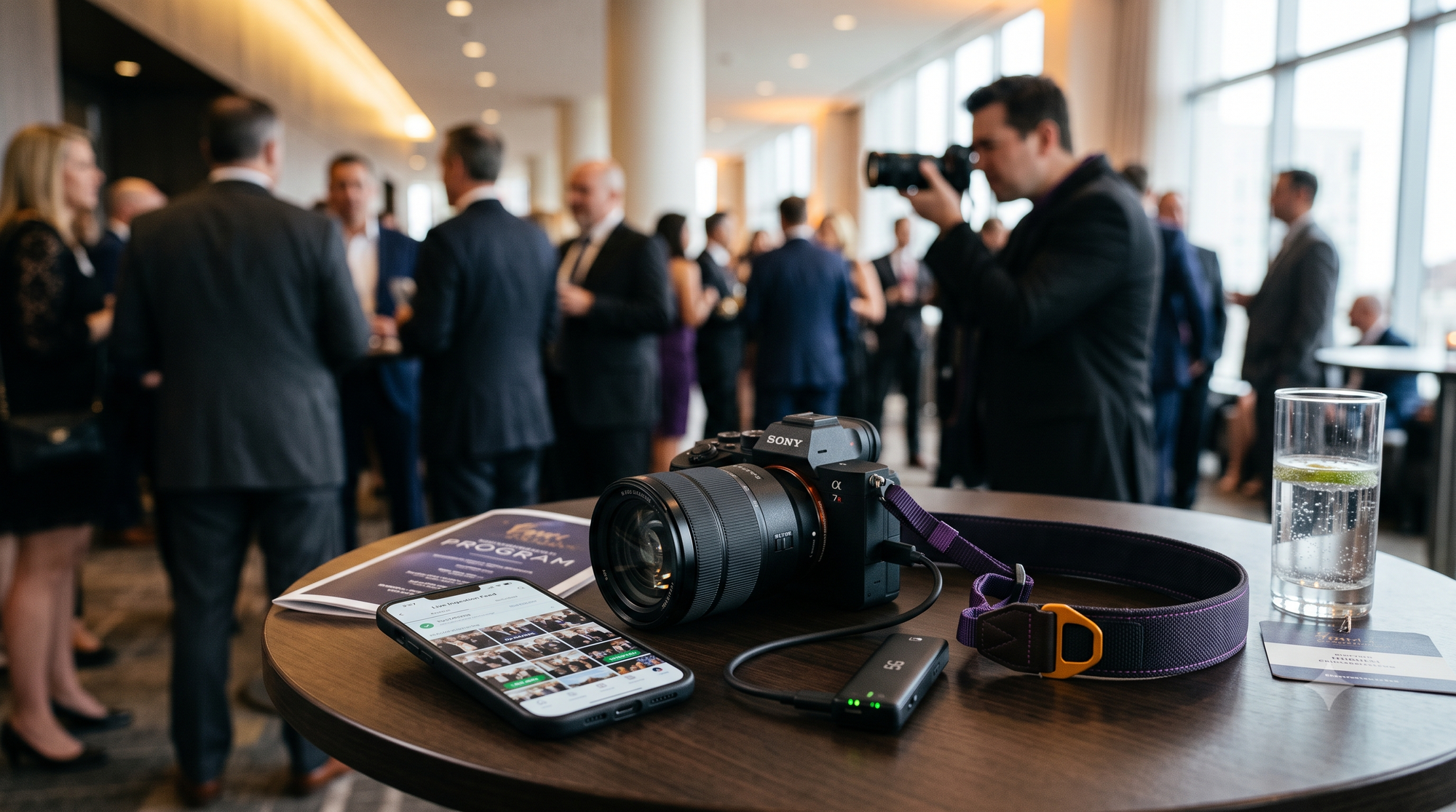
The days of making clients wait three to four weeks for an event gallery are officially over.
Whether covering a 3-day destination wedding with eight shooters or a 5,000-attendee corporate summit, the post-event waiting period is where client excitement declines, social media momentum stalls, and referral opportunities disappear. Modern event attendees expect photos on their smartphones while the event is still happening—not days later via an unorganized web link.
Fulfilling that expectation requires rethinking studio infrastructure. Traditional batch uploads and static galleries cannot handle live demands. High-volume teams need a streaming photo ingestion pipeline paired with an autonomous background image indexing engine to ingest, sort, and deliver thousands of high-resolution files in real time.
Beyond the Batch Upload: Why Live Events Demand Real-Time Photo Ingestion
Every studio owner knows the traditional post-event routine: pack up gear, return to the studio, offload multiple SD cards, run batch exports, and queue an overnight upload of 4,000 to 8,000 photos.
If the studio Wi-Fi drops at 3:00 AM, the queue stalls. If a browser crashes, files corrupt. This legacy approach creates operational delays that directly harm client satisfaction and studio profitability.
The Modern Event Expectation: Instant Access During the Live Experience
Guest engagement follows a steep drop-off curve. Attendee dopamine peaks within 60 minutes of a moment occurring on stage or on the dance floor.
- The attendee mindset: Guests take blurry smartphone photos simply because they cannot access your professional shots in the moment. When professional images arrive on their phones instantly, they share your work immediately across Instagram Stories, LinkedIn, and WhatsApp, giving your studio real-time attribution and massive organic reach.
- Corporate sponsor ROI: Brands investing heavily in corporate summits, galas, and product launches evaluate event photographers on speed. Real-time image distribution drives live event hashtags and sponsor visibility. A gallery delivered a week late offers near-zero promotional value to corporate stakeholders.
The Technical Failure of Batch-and-Wait Architectures
Legacy client proofing galleries were built for batch jobs. You must finish shooting, export the full set, upload the complete batch, and publish the gallery before anyone sees a single photo.
If you attempt to bulk upload high res images into a standard gallery while shooting live, the interface locks up. The gallery remains inaccessible until every file finishes rendering, turning what should be a live photo feed into a multi-hour bottleneck.
Deconstructing the Streaming Photo Ingestion Pipeline
To break free from batch limitations, studios are shifting to asynchronous streaming infrastructure. Rather than treating an event gallery as one massive file transfer, streaming architecture processes each photograph as an independent, immediate data event.
What Is a Streaming Pipeline for Event Photography?
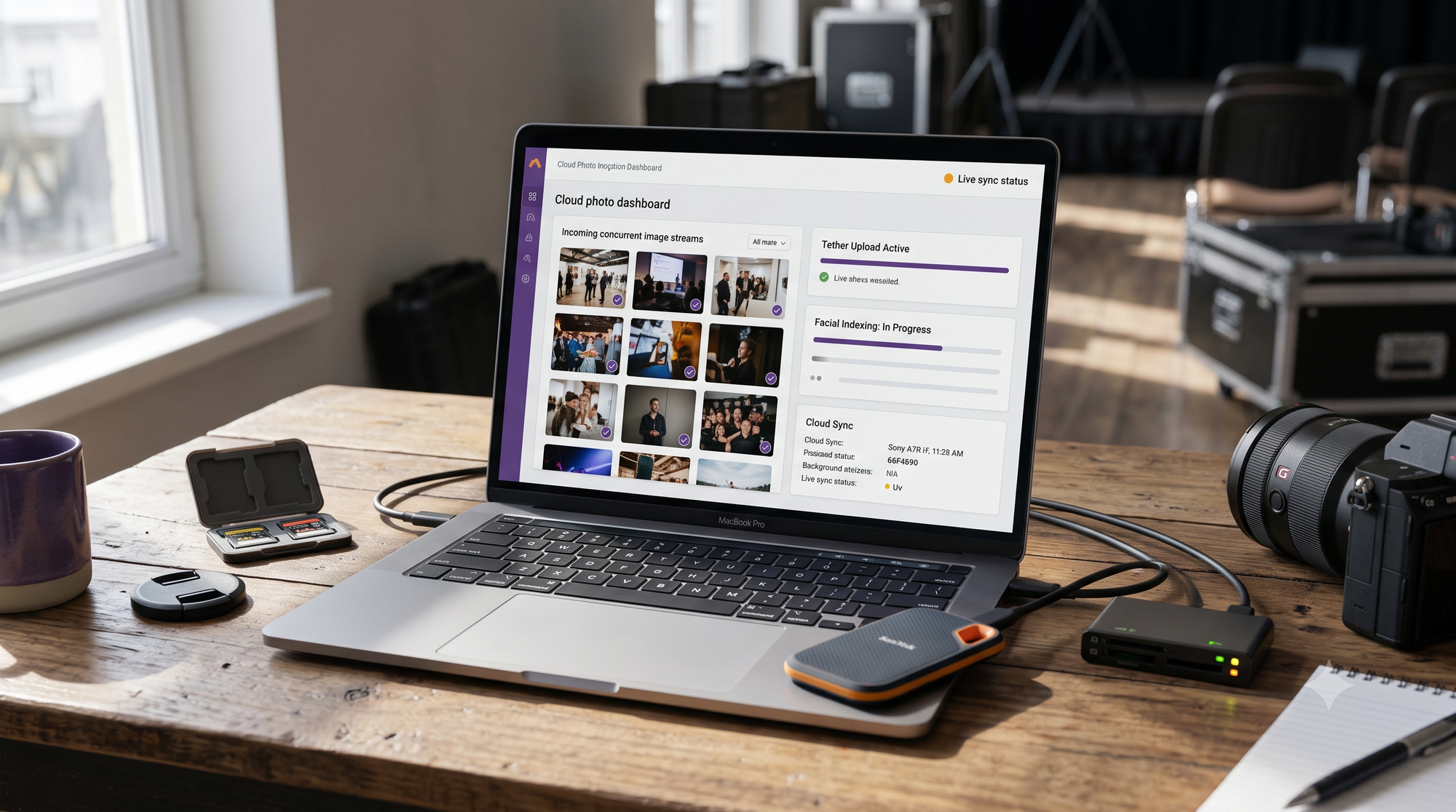
A streaming photo ingestion pipeline ingests photos concurrently as they are captured. Using direct camera-to-cloud connections (via in-camera FTP over 5G/Wi-Fi) or live tethered field stations, images enter the ingestion pipeline within seconds of the shutter releasing.
- Continuous data streams: Ingestion occurs in parallel across multi-shooter teams. Shooter A’s portraits, Shooter B’s candid moments, and Shooter C’s stage shots stream into a centralized processing pipeline simultaneously without locking the target gallery.
- Resilient chunking: High-throughput streaming protocols break assets into manageable data payloads. If network connectivity dips momentarily at a busy venue, the pipeline automatically resumes the exact packet where it paused, preventing corrupted uploads and eliminating failed transfers.

The Role of an Asynchronous Background Image Indexing Engine
Ingesting files rapidly is only half the battle; those files must also be instantly discoverable. A streaming pipeline relies on a high-speed background image indexing engine running parallel to the ingest queue.
Instead of waiting for an entire batch to land before scanning, the engine processes each photograph the moment it hits the server:
- Real-time biometric vectorization: The indexing engine identifies facial landmarks, converts them into mathematical vectors, and indexes them in under 500 milliseconds.
- Metadata extraction: EXIF parameters, timestamps, and multi-camera color profiles (sRGB and Adobe RGB) are indexed in the background without user intervention.
- Zero queue-blocking: Because indexing is decoupled from image hosting, your upload speed never degrades. Master files stream into storage while guest indexes update instantaneously in the background.
The Infrastructure Shift: True Large File Photo Hosting for Studios
High-volume production studios deal with immense data footprints. An average wedding weekend produces 150GB to 300GB of clean high-resolution exports. General-purpose cloud drives (such as Google Drive or Dropbox) are designed for document collaboration—not high-concurrency event distribution.
True large file photo hosting for studios requires three core capabilities:
- Non-Destructive Web Compression: Generating instant, responsive mobile previews without compressing or degrading the clean, full-resolution master files stored in the cloud.
- High-Concurrency Proofing: Allowing 1,000+ event guests to search, view, and download images simultaneously without server lag or bandwidth throttling.
- Automated Asset Lifecycle Management: Seamlessly archiving past events while keeping active client galleries instantly responsive.
Head-to-Head Comparison: Kamero vs. Traditional Studio Hosting Platforms
Legacy proofing galleries (Pixieset, ShootProof, Pic-Time) were built as passive portfolio shopfronts. They rely on manual user actions at every step of the workflow. Kamero was engineered from the ground up as an intelligent AI delivery and live-ingest ecosystem.
The Studio Efficiency Bottleneck
With legacy hosting, your team spends billable studio hours on administrative tasks: culling, organizing folders, applying watermarks, uploading large batches, and fielding client emails asking "Where are my photos?"
The Kamero Advantage
Kamero replaces manual gallery administration with intelligent automation. As you shoot, files enter the platform, the indexing engine maps every face, and guests receive direct notifications via WhatsApp the moment their photos are cataloged. Your studio delivers a frictionless client experience on-site while cutting post-event delivery time down to zero.
How to Deploy a Real-Time Streaming and Indexing Workflow
Adopting a live streaming setup is straightforward and works with the professional camera gear your studio already owns:
- Configure Camera-to-Cloud Connections: Set up your Sony, Canon, or Nikon cameras to transmit compressed high-res JPEGs via built-in FTP directly to a dedicated field router or 5G hotspot.
- Establish the Kamero Event Workspace: Create your event gallery, set dynamic dual-branding parameters (such as your studio logo and corporate sponsor marks), and activate the live stream listener.
- Deploy Guest Access Points: Place Kamero-generated QR codes on tables, reception boards, or credential badges. Guests scan once, register their selfie, and authorize WhatsApp notifications.
- Shoot and Let Automation Work: Focus entirely on capturing the event. As your shutter clicks, the pipeline streams the files, the background engine indexes them, and attendees receive their personal photos in real time.
Frequently Asked Questions
Can I bulk upload high res images without running into platform timeouts?
Yes. Modern platforms built with multi-threaded chunking upload images in resilient segments rather than single continuous streams. If a connection drops, the system resumes where it left off, allowing you to ingest thousands of high-res files without timeouts or corrupted sessions.
Does real-time facial indexing compromise original image quality?
No. The background image indexing engine operates purely on analytical preview layers. It maps facial vectors from optimized server proxies without altering, degrading, or compressing your full-resolution master files. The clean, uncompressed files remain intact for high-res downloads and print orders.
What happens if the venue has poor internet connectivity?
A streaming pipeline is naturally resilient to variable network speeds. When using an on-site field station, files queue locally and upload incrementally as bandwidth allows. Even with intermittent 4G/5G connections, images process sequentially in the background rather than freezing the entire system.
Upgrade Your Studio Workflow and Eliminate Delivery Delays
Running a modern photography studio requires cutting-edge technology that matches your creative talent. Moving from static batch uploads to an automated, real-time delivery pipeline protects your team's time, delights clients, and establishes your studio as a market leader.
Stop spending late nights waiting on upload progress bars. Step into the future of live event photography.
- Ready to accelerate your delivery pipeline? Sign up on Kamero to start your free trial today.
- Want to see real-time streaming in action? Book a 1-on-1 Demo with our workflow specialists.
- Looking for modern photography tips and platform updates? Follow us on Instagram @kamero.ai.
About Pavani Nagar
Hey there! Pavani Nagar, a Digital Marketing Manager who enjoys working on content, social media, and figuring out what makes people pay attention. I like trying new ideas, learning along the way, and keeping things simple.